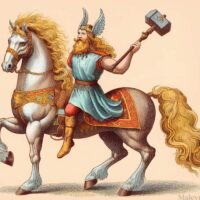
In the thirteenth-century Prose Edda of Snorri Sturluson, the gods of Asgard owe the impenetrable stone walls that protect their realm—as well as Odin’s iconic eight-legged steed, Sleipnir—to the superhuman labor of a single dark stallion named Svadilfari. Owned by a disguised frost giant who nearly tricked the gods into surrendering the sun, the moon, and the goddess Freyja, Svadilfari proved so impossibly strong at hauling mountain boulders that the gods could only save themselves by sending Loki in the shape of a mare to seduce the stallion away from his work on the final night of winter.
The Impossible Wager to Build Asgard’s Walls
According to the Gylfaginning, shortly after the gods established Midgard and built their halls in Asgard, their realm stood unfortified and vulnerable to attacks by the frost giants (hrimthursar) and mountain giants (bergrisar). One day, a mysterious master builder rode up to the gates accompanied by his powerful stallion, Svadilfari—whose Old Norse name translates roughly to “Unlucky Traveler” or “He Who Causes Slippery/Disastrous Journeys.”
The builder offered to construct a stone fortress wall around Asgard so high and thick that no giant could ever breach it, completing the entire monumental project within just three seasons (or a single winter). In payment, however, the builder demanded an astronomical price: the hand of the beautiful goddess Freyja in marriage, plus the Sun and the Moon plucked right out of the sky.
Thinking the task was physically impossible for one man, the Trickster god Loki persuaded the other gods to accept the bargain—provided they added strict fine-print conditions:
- The builder had to finish every single stone of the wall within one single winter, by the very first day of summer.
- If even a single block remained unfinished on the morning of summer, the builder would forfeit his entire payment.
- He was forbidden from receiving help from any other man—whereupon the builder calmly asked for permission to use his horse, Svadilfari, a request the gods foolishly granted at Loki’s urging.
Hauling Mountains by Night
The very first night of work, the gods realized to their horror that Svadilfari was no ordinary farm horse. While the master builder shaped and laid the stone courses during the day, at nightfall he hitched Svadilfari to a colossal sled and rode into the mountains. Dragging boulders the size of houses that were twice as heavy as anything the builder could move himself, Svadilfari hauled entire rock faces right up to the gates of Asgard before sunrise, doing twice the work of his master.
As winter drew to a close and the wall rose to towering heights, only three days remained before the first day of summer, and the builder had already finished everything except the single archway over the main fortress gate. Terrified that they were about to lose Freyja and plunge the cosmos into eternal darkness without the Sun and Moon, the gods held an emergency assembly, realized it was Loki who had talked them into allowing the horse, and threatened to torture Loki to death on the spot unless he found a way to make the builder miss his deadline.
Loki’s Shapeshifting Mare and the Birth of Sleipnir
That evening, as the master builder drove Svadilfari out toward the mountain quarry to haul the final load of capstone boulders for the gate, a beautiful young filly suddenly trotted out of the dark forest directly in front of them, neighing seductively and tossing her mane. It was Loki, who had used his shapeshifting magic to transform himself into a mare in heat.
The instant the stallion Svadilfari caught the scent of the mare, he went wild: snapping his thick leather harness straps in half, abandoning the rock sled, and galloping straight into the woods after the disguised Loki, while the frantic builder chased after his horse all night long as the boulders lay untouched on the ground. Realizing the next morning that he could no longer finish the wall before the deadline without his stallion, the builder flew into a giant’s rage (jotunmodr), dropping his disguise and revealing himself as a sworn enemy of the Aesir—prompting Thor, who had just returned from campaigning in the East, to swing his hammer Mjolnir and shatter the giant’s skull into tiny fragments below Niflhel.
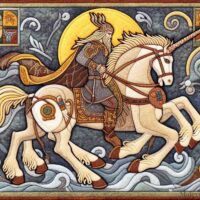
As for Loki, his night in the forest with the stallion Svadilfari had a permanent biological consequence: several months later, the still-transformed Loki gave birth to a grey foal possessing eight legs—Sleipnir, who grew into the fastest and greatest horse among gods and men, presented by Loki to Odin to carry the Allfather across sky, sea, and the road to Hel.