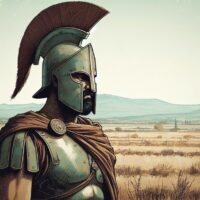
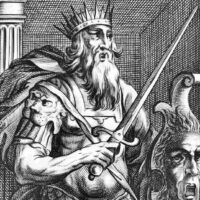
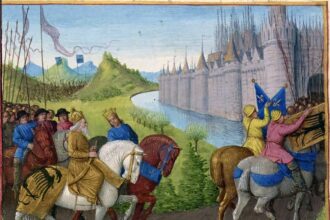
On a hot August day in 338 BC, across a narrow agricultural plain in Boeotia framed by Mount Thurion and the Cephisus River, the centuries-old era of the independent Greek city-state came to a violent and permanent end. At the Battle of Chaeronea, King Philip II of Macedon and his eighteen-year-old son, Prince Alexander—soon to be immortalized as Alexander the Great—crushed the combined allied armies of Athens and Thebes. Blending Philip’s unmatched tactical cunning on the right wing with the teenage Alexander’s thunderous decisive charge on the left, Chaeronea forged the united Greek military machine that crossed into Asia just four years later to topple the Persian Empire.
Demosthenes’ Coalition Against the Rise of Macedon
When Philip II seized the throne of Macedon in 359 BC, the sophisticated city-states of southern Greece—Athens, Thebes, Sparta, and Corinth—viewed the northern kingdom as a semi-barbarous backwater of shepherds and timber merchants. Over the next twenty years, however, Philip transformed the Macedonian army into the most professional war machine in the Mediterranean. Utilizing gold from the mines of Mount Pangeon, he drilled year-round professional infantry armed with the eighteen-foot sarissa pike, turning the Macedonian phalanx into a bristling wall of iron points that pinned enemies in place while his elite aristocratic heavy horsemen, the Companion Cavalry, delivered the fatal blow.
In Athens, the brilliant orator Demosthenes recognized that Philip’s steady southward expansion threatened the democratic sovereignty of every polis in Greece. Delivering his blistering series of speeches known as the Philippics, Demosthenes finally persuaded the Athenians in 339 BC to accomplish a diplomatic miracle: burying decades of bitter rivalry to sign a military alliance with their northern neighbor, Thebes, the premier land power of central Greece. Marching roughly thirty-five thousand allied Greek hoplites to the plain of Chaeronea, the coalition blocked the narrow valley gateway into Boeotia against Philip’s thirty-thousand-man Macedonian infantry and two thousand cavalry.
Philip’s Feigned Retreat Against the Athenians on the Right Wing
Facing the allied Greek line across the two-mile-wide plain, Philip II divided his command with calculated precision. On the allied Greek left wing nearest the foothills stood the citizen hoplites of Athens, eager for glory but lacking recent big-battle experience since their generals had relied mostly on mercenaries for years. On the allied Greek right wing anchored solidly against the marshes of the Cephisus River stood the battle-hardened veterans of Thebes, spearheaded by the legendary Sacred Band—an elite corps of three hundred paired soldiers who had never been defeated in open battle since shattering the Spartans at Leuctra thirty-three years earlier.
Taking personal command of the Macedonian right wing directly opposite the excitable Athenians, while entrusting his eighteen-year-old son Alexander and his most seasoned generals with the Macedonian left wing facing the Thebans, Philip executed a masterstroke of psychological warfare. Knowing the Athenians were hot-headed and desperate to attack, Philip ordered his own elite Guards Brigade to engage the Athenians briefly and then begin stepping backward—walking slowly downhill in reverse formation with their pikes still leveled forward as if giving ground. Thinking they had already won the battle, the Athenian general Stratocles shouted to his men to press forward until they chased the Macedonians all the way back to Macedon. In their excitement to rush after Philip’s retreating line, the Athenians charged down off their high ground and surged obliquely leftward, opening a fatal, yawning gap right in the center of the allied Greek battle line between the advancing Athenians and the stationary Thebans.
Alexander’s Wedge Charge and the Annihilation of the Sacred Band
Out on the Macedonian left wing, eighteen-year-old Prince Alexander was waiting for that exact structural tear in the enemy line. The instant the gap opened beside the Theban flank, Alexander spurred his horse at the point of the Companion Cavalry’s triangular wedge formation and thundered straight into the breach, followed closely by Macedonian phalanx battalions attacking the Thebans from the front and side simultaneously.
Simultaneously, over on the right wing, once Philip saw that his retreating infantry had drawn the disorganized Athenians down onto flat ground and reached a low rise, the king ordered his trumpeters to sound the sudden halt and counterattack. Lowering their eighteen-foot sarissas in unison, the Macedonians charged downhill into the winded, ragged Athenian ranks. Over one thousand Athenian citizens were killed in minutes and two thousand were captured as the rest fled over the mountains—including the orator Demosthenes himself. Isolated on the riverbank and surrounded on all sides by Alexander’s cavalry and the Macedonian pikes, the three hundred warriors of the Theban Sacred Band refused to surrender or take a single step backward. Fighting until their spears snapped and their swords broke, two hundred and fifty-four of the three hundred men fell dead in the exact spots where they stood, while the remaining forty-six dropped only after being incapacitated by wounds.
The Lion of Chaeronea and the League of Corinth
Walking across the battlefield after the slaughter stopped, Philip II gazed down at the unbroken rows of the fallen Sacred Band lying side by side in their armor. Moved to tears by their courage, the Macedonian king raised his hand and cursed anyone who dared suspect that such men had ever done or suffered anything shameful. Following the victory, Philip treated Athens with remarkable diplomatic leniency—sending Prince Alexander to Athens in person to return the ashes of their fallen dead without ransom in exchange for the peaceful dissolution of Athens’ naval empire—while installing a Macedonian garrison on the citadel of Thebes and allowing the Thebans to erect the monumental eighteen-foot marble Lion of Chaeronea over the mass grave of the Sacred Band, where archaeologists later excavated the actual skeletons of those two hundred and fifty-four warriors in 1879.
In the winter of 338 to 337 BC, Philip summoned delegates from every Greek state (except Sparta) to assemble at Corinth, establishing the League of Corinth and declaring a universal peace across Greece under his leadership as Hegemon for a joint crusade against the Persian Empire. When Philip II was assassinated at a royal wedding two years later in 336 BC, the twenty-year-old Alexander inherited both his father’s invincible army and the unified Greek alliance forged in blood on the plain of Chaeronea.