Across the painted codices, temple murals, and sacred Nahuatl hymns of pre-Columbian Mesoamerica, no mythical place was spoken of with deeper reverence or mystery than Tamoanchan. Revered by the Aztecs, Toltecs, Mixtecs, and Zapotecs as the primordial mountain paradise where the gods first mixed their own divine blood with ground maize and bones to fashion the human race, Tamoanchan stood at the axis of the Mesoamerican cosmos: a mist-shrouded realm of eternal spring, blooming cacao and plumeria trees, and running waters from which all royal dynasties, calendars, and sacred knowledge descended to Earth.
Why a Huastec Mayan Name Appeared in Aztec Myth
When sixteenth-century Spanish chroniclers like Friar Bernardino de Sahagún asked elderly Aztec (Mexica) scholars in Tenochtitlan what the word Tamoanchan meant, the priests offered a poetic Nahuatl folk etymology: Temoa-in-chan, meaning “We Seek Our Home” or “The Place From Which We Descend.” However, twentieth-century linguists and epigraphers made a startling discovery: Tamoanchan is not originally a Nahuatl word at all!
Instead, the name comes from the ancient Mayan (specifically Huastec Mayan) language phrase Ta-moan-chan, which translates literally to “The Place of the Misty Sky” or “Land of the Bird-Serpent (Cloud-Serpent).” This linguistic fossil proves that the myth of Tamoanchan was far older than the Aztecs—originating thousands of years earlier among the Pre-Classic Olmec and Gulf Coast civilizations around the humid, cloud-forested volcanic peaks of Veracruz and Morelos before being inherited as a shared sacred origin story by every culture in central Mexico.
The Broken Bleeding Tree (Xochitlicacan) and the Fall of the Gods
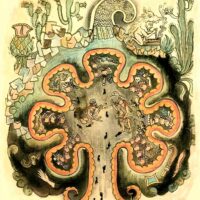
In the Aztec codices—such as the Codex Borgia and the Codex Telleriano-Remensis—the visual symbol for Tamoanchan is always the exact same dramatic image: a magnificent, flowering cosmic world-tree called Xochitlicacan (“Place of the Standing Flowers”) that is split and snapped cleanly in half down its trunk, bleeding bright crimson blood from the break.
According to the sacred creation narratives, Tamoanchan was originally a terrestrial and celestial Garden of Eden located high atop a verdant mountain above the nine underworld levels and below the thirteen heavens, presided over by the supreme creator couple Ometecuhtli and Omecihuatl and the weaving and fertility goddess Xochiquetzal:
- The Marvelous Tree: Growing at the center of Tamoanchan was the great flowering tree whose branches produced every sweet-smelling blossom in creation. Anyone who touched or caught a falling petal from this tree was guaranteed to become a faithful, joyful lover and master artisan.
- The Transgression in the Garden: The supreme creator god commanded the younger gods and ancestral spirits living in Tamoanchan never to pluck the flowers or break the branches of the sacred tree. Unable to resist its beauty (and in some accounts associated with the first act of sexual passion between Xochiquetzal and Piltzintecuhtli), the inhabitants reached up and plucked the forbidden blossoms.
- The Expulsion and the Birth of Mortal Time: Instantly, the great tree of Tamoanchan snapped in half with a thunderclap and bled. Furious at the disobedience, the supreme creator cast the offending deities down out of Tamoanchan: some were hurled down into Mictlan (the Underworld), while others were banished onto the surface of the mortal Earth—simultaneously initiating mortal childbirth, human mortality, and the ticking of the 260-day ritual calendar (constructed inside Tamoanchan by the aged wise couple Oxomoco and Cipactonal).
Quetzalcoatl’s Creation of Humanity and Historical Echoes
It was also directly to the paradise of Tamoanchan that the feathered-serpent god Quetzalcoatl brought the precious bones of the previous race of humans after stealing them from the Lord of the Underworld, Mictlantecuhtli. Inside Tamoanchan, the mother-goddess Cihuacoatl (Quilaztli) ground those ancient bones into fine meal inside a jade basin like corn flour, and Quetzalcoatl pierced his own body with a sharpened bone awl to bleed over the dough—bringing the present Fifth Sun humanity to life.
On the ground in ancient Mexico, archaeologists have linked the earthly geography of Tamoanchan to the ancient ruined cities of Chalcatzingo and Xochicalco (“In the House of Flowers”) in the lush subtropical valleys of Morelos just south of Mexico City—where priests carved feathered serpents and flowering cocoa trees into stone terraces to recreate the misty mountain paradise where humanity first opened its eyes.