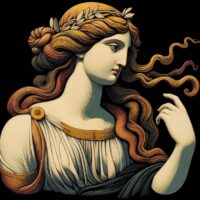
Within the vast tapestry of ancient Greek mythology, the name Eurynome—meaning wide ruling or broad wandering—belongs to one of the oldest and most maternal divinities of the pre Olympian world. As an elder Oceanid nymph born at the dawn of creation to the Titans Oceanus and Tethys, Eurynome occupied a pivotal seat of honor across several distinct mythological eras: reigning first as the early queen of heaven beside the Titan Ophion, risking her safety to rescue the crippled infant god Hephaestus beneath the waves, and becoming the mother of the radiant Charites by Zeus before being venerated in a mysterious, mermaid like sanctuary deep in the mountains of Arcadia.
The First Queen of Olympus and the Cosmic Dance of Creation
Long before Zeus overthrew his father Cronus to establish the rule of the Twelve Olympians, an older generation of deities held sovereignty over the snowy peaks of Mount Olympus. According to the Hellenistic epic Argonautica by Apollonius of Rhodes and the poetry of Lycophron, when the bard Orpheus sang of the birth of the cosmos to calm his fellow Argonauts, he revealed that the very first rulers of Olympus were the Titan Ophion and his bride, the Oceanid Eurynome. Together they governed the young world in harmony until Cronus and Rhea challenged them for the throne; overpowered in titanic combat, Ophion and Eurynome were cast down from the mountain into the swirling depths of the Ocean stream, where they made their permanent home.
In the twentieth century, the British poet and mythographer Robert Graves expanded upon these ancient Orphic and Pelasgian fragments to construct a famous literary creation myth centered entirely on Eurynome. In this reconstruction, Eurynome rose naked from primordial Chaos, found nothing solid for her feet to rest upon, and divided the sea from the sky by dancing lonely across the waves toward the south. Catching the north wind that swirled behind her back, she rubbed it between her hands until it warmed into the great serpent Ophion, who coiled around her divine limbs. Transforming into a dove upon the waves, Eurynome laid the Universal Egg, which Ophion incubated in his coils until it split open to spill out the sun, moon, planets, mountains, and living creatures of the earth.
Rescuing the Infant Hephaestus and Mothering the Three Graces
In the mainstream Homeric tradition of the Iliad, Eurynome shines as a figure of profound compassion and artistic mentorship. When the smith god Hephaestus was born with a lame foot—or hurled down from the threshold of heaven by his mother Hera in shame over his infirmity—he plunged into the deep sea, where he would have suffered terrible misery had he not been caught in the gentle, welcoming arms of Eurynome and the sea nymph Thetis.

Carrying the injured young god down into a hollow, vaulted underwater grotto surrounded by the foaming currents of Oceanus, Eurynome and Thetis nursed and raised Hephaestus in complete secrecy for nine years. Inside their submarine cavern, while the ocean roared outside, Eurynome nurtured his extraordinary talent for metallurgy, watching as the grateful young god forged exquisite spiral brooches, curved bracelets, floral ear-pendants, and necklaces of gold and silver for his two foster mothers before returning in triumph to Olympus. Later, after Zeus secured the throne of heaven, he courted the wise Oceanid himself; from the union of Zeus and Eurynome were born the three Charites—Aglaea (Splendor), Euphrosyne (Mirth), and Thalia (Good Cheer)—known to the world as the Three Graces, who brought beauty, dance, and joy to mortals and immortals alike, alongside the river god Asopus in certain regional traditions.
The Mysterious Mermaid Sanctuary at Phigaleia
Perhaps the most intriguing historical proof of Eurynome’s antiquity survived in the rugged highlands of Arcadia in the central Peloponnese. When the Greek geographer Pausanias traveled through the remote mountain territory of Phigaleia in the second century AD, he visited a dark, ancient sanctuary surrounded by a thick grove of towering cypress trees right at the turbulent confluence where the Lymax and Neda rivers crashed together.
This holy shrine belonged to Eurynome, and its doors were kept locked and sealed for three hundred and sixty-four days of the year, opened only on a single annual festival day when public and private sacrifices were offered. Although Pausanias arrived on the wrong day to look inside the sanctuary himself, the local Phigaleians described the ancient cult statue within: bound securely to its pedestal by chains of solid gold, the wooden image depicted a woman down to the waist, while the lower half of her body tapered into the scaled tail of a fish. While later Greeks tried to explain the fish tail by confusing Eurynome with a title of Artemis, modern historians recognize the chained mermaid statue of Phigaleia as a surviving bronze-age relic of an archaic pre-Olympian water and nature goddess whose memory endured for millennia in the mountain valleys of Greece.