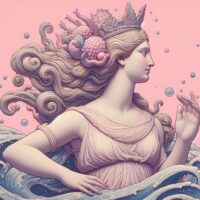
Pasithea (Ancient Greek Πασιθέα Pasithéa), also known as Pasithee, is one of the Charites, also known as the Graces, in Greek mythology. They are considered the daughters of Zeus and Eurynome. In Greek mythology, Pasithea is also one of the “youthful Graces” that appears in Homeric texts.
Description
According to Homer, Hera promised her to Hypnos, the god of sleep, as his wife if he helped her to lull Zeus to sleep (see also Pausanias, Description of Greece 9,35,4). In Catullus and the Palatine Anthology, Pasithea is mentioned as the wife of the god of sleep.
In Nonnus of Panopolis’ Dionysiaca, a scene analogous to the Iliad is described. However, in this version, Hera is named as the mother and Dionysus as the father of Pasithea. She is also depicted as a servant of Aphrodite.
In Mythology
In the Iliad, the goddess Hera swears to Sleep (Hypnos) that she will give Pasithea in marriage in exchange for causing Zeus to fall asleep, intending to take advantage of his absence to favor the Achaeans in the battle against the Trojans that was taking place. Homer adds that Hypnos “longs for her ceaselessly every day.” In later sources, Hypnos is already married to Pasithea.
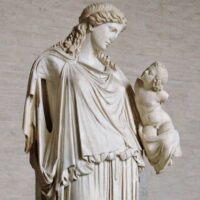
In Ovid’s Metamorphoses, it is mentioned that Hypnos had about a thousand children, the Oneiroi, among them Morpheus, Phobetor, and Phantasos, but the identity of their mother is not mentioned.
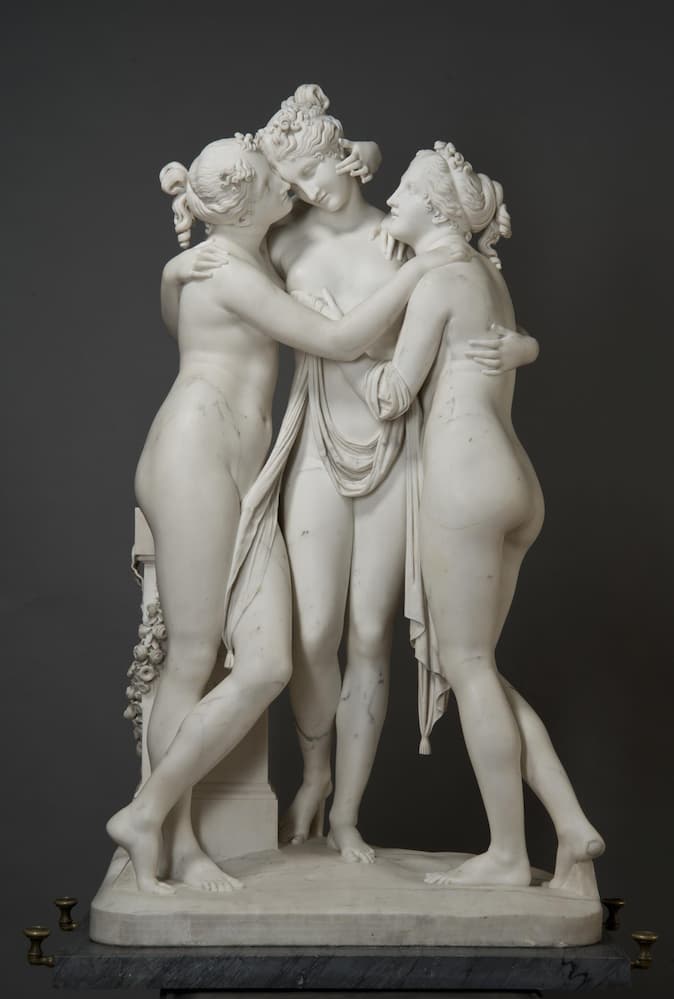
In Hesiod’s texts, Pasithea corresponds to one of the fifty Nereids. Pasithea is Hera’s daughter in a minor version, in which the father is not mentioned. Interestingly, in the same work, it is said that her father was Dionysus, but Hera is not mentioned. At least one version states that the Graces were daughters of Zeus and Hera, among two other options: Zeus and Eurynome (daughter of Oceanus), or Zeus and Euanthe (daughter of Uranus).
Pasithea corresponds to the personification of relaxation, meditation, hallucinations, and all other altered states of consciousness.
Her Origin
The origin of the name Pasithea is disputed. Therefore, there are several proposed translations. Hederich’s Thorough Mythological Dictionary translates it as “the one running to all” and is said to denote the universality and pleasantness of sleep. Therefore, Pasithea is sometimes considered the goddess of rest and relaxation. Since she was considered the wife of the god of sleep, this assumption can be made.
Friedrich Nork translates it as “the goddess revered by all.” Another translation for the prefix pasis is “acquired.” For the suffix thea, “goddess” or “sight” or “view” is given. From this, further etymological explanations arise, such as “acquired goddess,” since Hypnos acquired her through Hera in the Iliad, or “acquired sight.” Therefore, Pasithea is sometimes also considered the goddess of hallucinations. This is supported by the fact that Hypnos is associated with sleep-inducing plants and opiates and by a scene in Dionysiaca where she produces ointments and medicines.
Family
Her sisters are Aglaea (“Splendour”), Euphrosyne (“Mood”) and Thalia (“Good Mood”). In Roman mythology, they were known as Gratiae, the “Graces”.
In book 14 of Homer’s Iliad, Pasitheus is one of the young Charites. Robert Graves thinks that Homer also mentions the names of two Charites, Pasitheus and Cale (“Beauty”), but the two Charites that Homer used for Hesiod’s Aglae.
Although the Graces are usually three in number, according to the Spartans, it was Cleta, not Thalia, who was the third, and other Graces are sometimes mentioned, including Auxo, Hegemon, Peitho, and Phaenna.
Named After
- A genus of plants in the family Asphodeliaceae with the single species Pasithea caerulea
- The spider genus Pasithea is hereafter included in and synonymized with the spider genus Peucetia in the family Oxyopidae.
- The satellite named after her was discovered on May 16, 2002, and it is Jupiter’s moon, designated as S/2002 (148) Pasithee.
- A butterfly of the grass moth family from East Africa, Goniorhynchus pasithea.
- Additionally, Pasithea is the name of one of the Nereids as well as a Naiad (cf. Praxithea).