In Scottish tradition, a female ghost known as the Bean Nighe is believed to be a portent of death or a contact with the Otherworld. She is seen washing the bloodstained garments of those who are due to die, and she is shown near bodies of water while doing that. Bean Nighe is said to be the soul of a lady who perished during delivery and is enchanted to continue her job until the day her real life would ordinarily come to an end, according to Scottish folklore. She is portrayed as a small, unattractive lady with a hooked nose, webbed feet, and long, drooping breasts.
Origin of the Bean Nighe
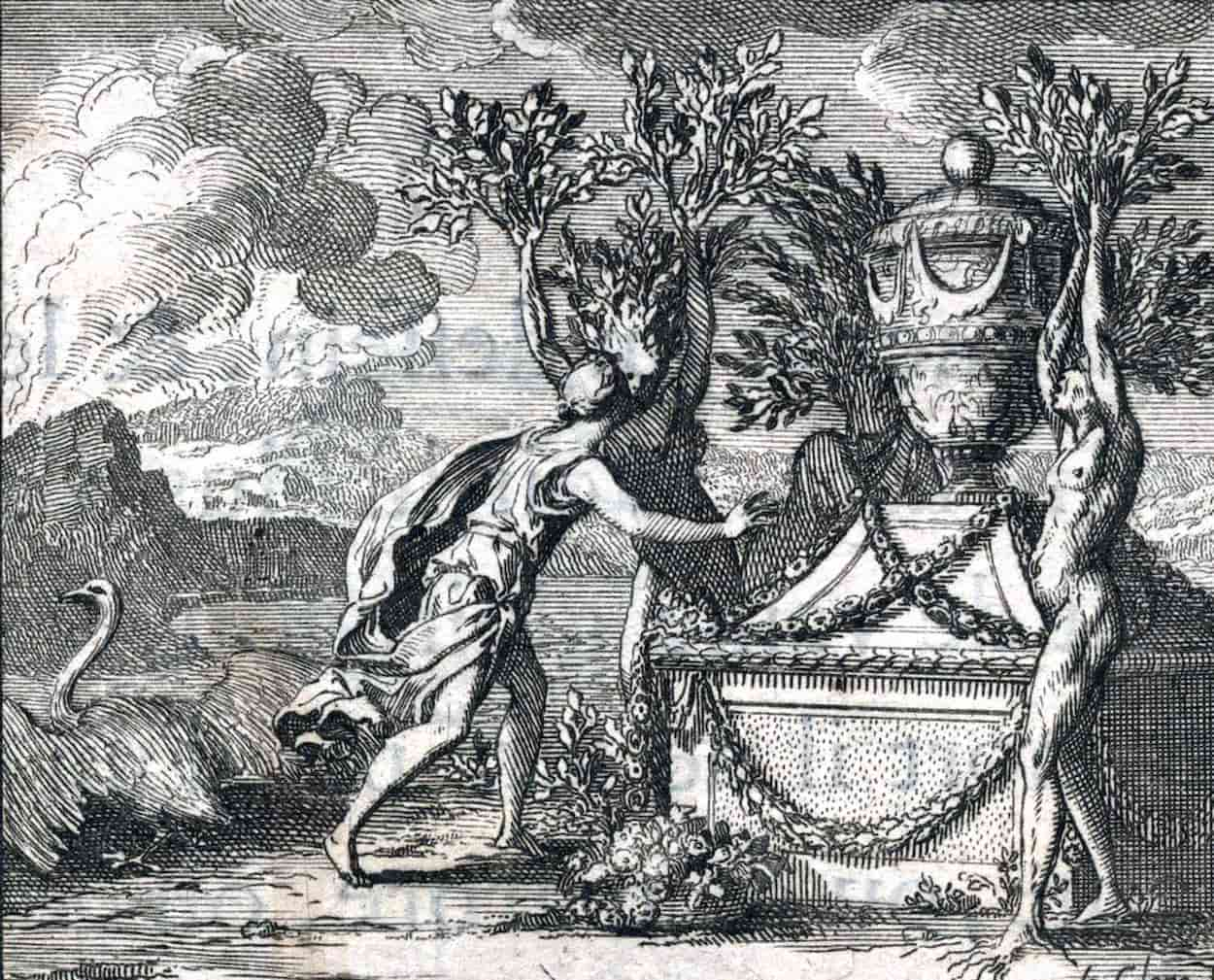
Along with the Irish Banshee (Bean Sidhe) and its French counterpart, Les Lavandières (“night washerwomen”), the Bean Nighe is also thought of as a banshee type. Banshee has a correlation with death across many cultures and it is the anglicized version of the Irish word ban-sìth. They are female ghosts that wail to announce a family member’s impending death.
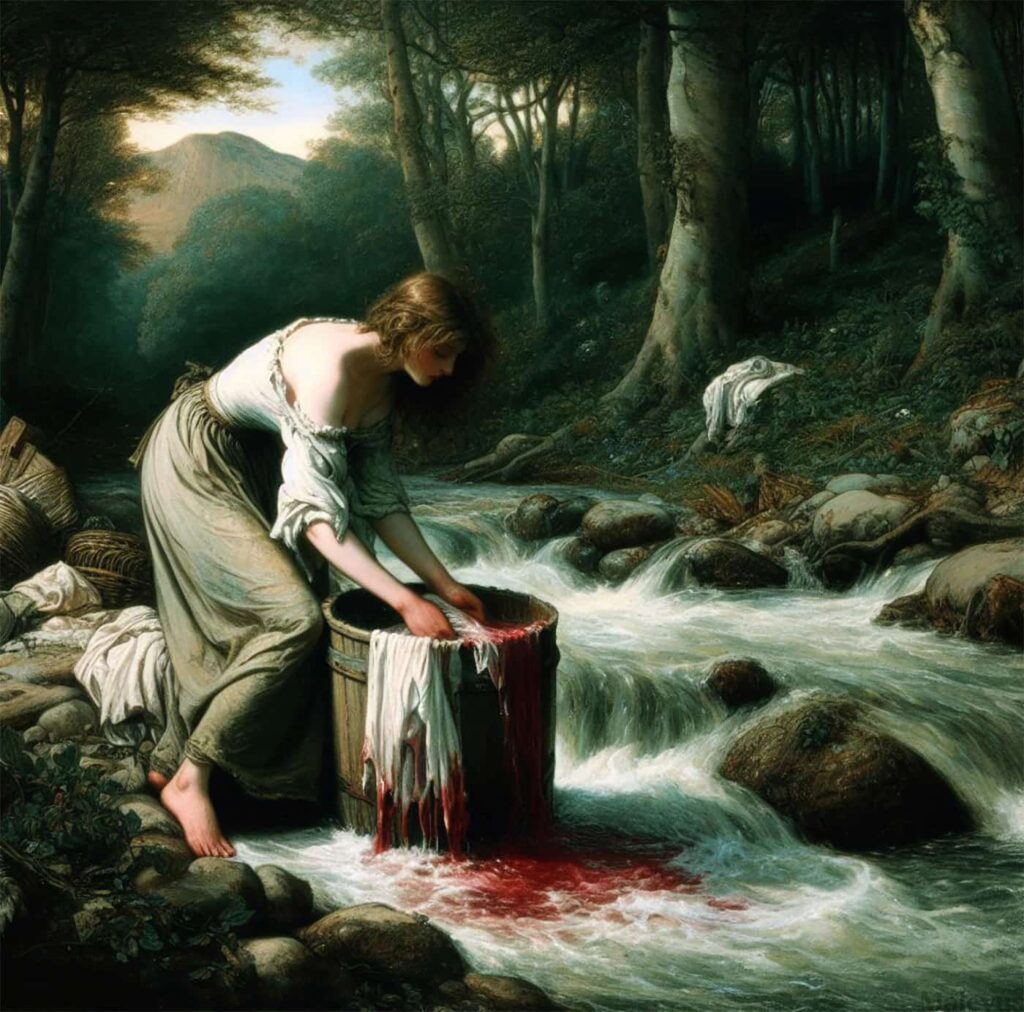
An old Highland legend describes a Sunday morning stroll by a woman beside a lake near the town of Cromarty in Scotland. She watched as the bean-nighe washed thirty clothes in the loch, each one allegedly stained with blood. After her return to the town, the 96-foot-high Fearn Abbey’s ceiling gave apart during Sunday morning worship, killing 36 people in 1742.
The Legends of the Bean Nighe
Her Legend in the “Ulster Cycle”
In the Ulster Cycle, an ancient Celtic epic, Morrígan is cast in the role of a bean nighe. The Celtic hero Cúchulainn is on his way to war when he sees Morrígan by a river. Learning that the bloody clothes Morrígan washed belonged to him, Cúchulainn realizes that he will fight his last battle.
Her Legend in “Carmina Gadelica”
The book “Carmina Gadelica” contains Highland lore and it’s written by Alexander Carmichael. It was published in six volumes between 1900 and 1971. In his work, Alexander Carmichael describes a character named “Guille-cas-fliuch” who encountered the bean-nighe as she was washing and rubbing her clothing and lamenting and groaning.
The person asked for three wishes from the witch and when he asked her to identify the owner of the garment she was washing, she told him that the clothes belonged to the Great Clanranald of the Isles, to whom the Scottish clan man belonged. Before going to inform Clanranald, Gill-cas-fliuch promptly tossed the shroud into the river. Ultimately, he crossed the water to the mainland and never came back to the island.
Bean Nighe’s Story
Legend has it that she haunts lonely streams and that if captured, she tells you your destiny. On the other hand, if you approach her carefully, she can fulfill your requests as well. So, she is not that evil after all. According to popular belief, the bean-nighe are the souls of women who perished during childbirth and are obliged to carry out their duties until the age at which their bodies would have normally died if they had stayed alive.
However, it is believed that if the deceased woman’s entire belongings are cleansed, this destiny can be prevented. If that’s not the case, she would have to finish the cleansing in the afterlife. Her very long breasts were said to have gotten in the way of her washing on the Isles of Mull and Tiree, so she flung them over her shoulders.
Beliefs state that when people encounter the bean-nighe, they should not flee but rather approach stealthily from behind so as not to draw her attention. After that, the person should pretend to be her foster kid while grabbing one of her breasts and putting it in his or her mouth. She then promises to teach the person whatever he or she wants in exchange.
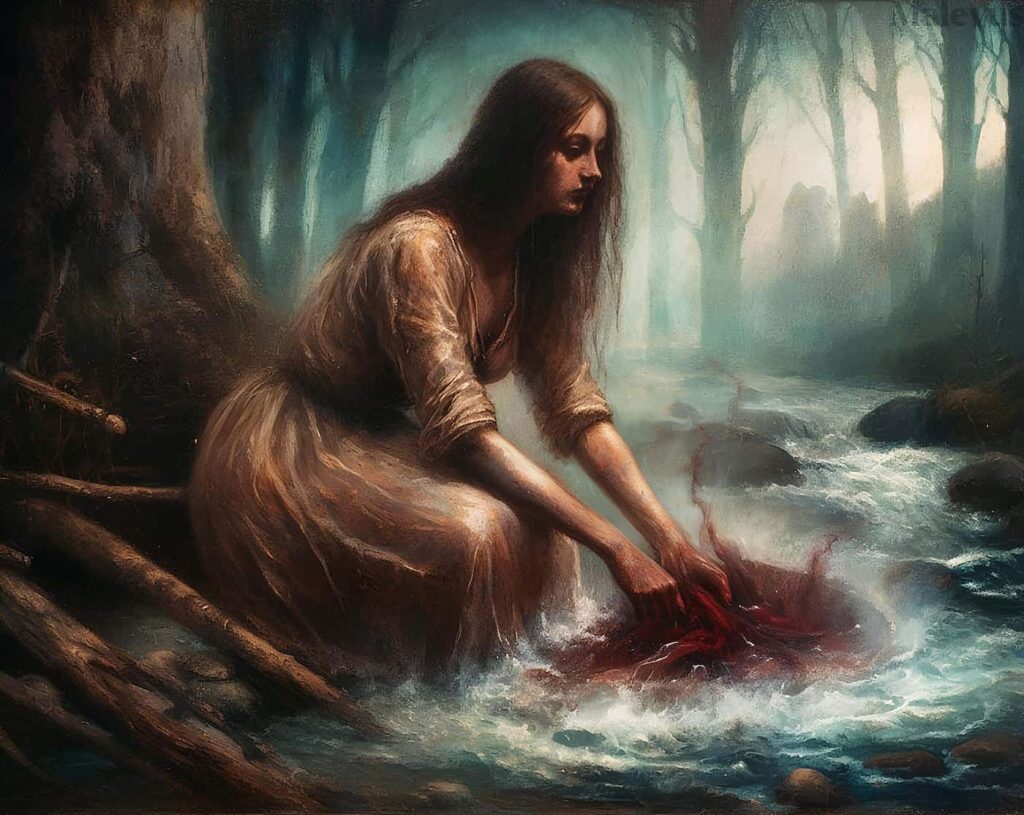
The washing may proceed if she reveals that the bloody garments were owned by an adversary but if they belong to the person or an associate, s/he should stop the washing right there to avoid the impending death. The bean-nighe can sing a lamenting dirge while washing the clothes and gets distracted.
At this point, if someone can sneak up on her and grab hold of her, she will grant three wishes and tell who is due to die, so the person can try to stop it from happening. However, the legend has it that she could amputate one of your limbs as a kind of retribution if she spots you first.
What Bean Nighe Means
The Scottish Gaelic words “bean,” meaning “woman,” and “nighe,” meaning “washer,” translate to washerwoman or laundress. Her other name among the locals is “The Washer at the Ford,” and seeing her wash bloody clothes is a portent of death.
Alternate names for the bean-nighe include “little washerwoman” (ban-nigheachain) and “little washer at the ford” (nigheag na h-àtha).
Characters Similar to the Bean Nighe
The Banshee is one figure from Irish mythology that is very similar to the Bean Nighe but there are more similar characters from other cultures:
Les Lavandières
In French legend, these specters are called the “night washerwomen” and they have a commonality with the Bean Nighe: they are seen washing the garments of the dying. The one difference is that they are three old women instead of one, and their origin lies in Celtic mythology. They are called the kannerezed noz in Brittany.
Cyhyraeth
The Cyhyraeth, a Welsh mythology monster akin to the Bean Nighe, is said to wash the bloodstained garments or armor of people destined to die. Cyhyraeth has a moaning voice heard before a person’s death. Her origin lies around the River Tywi in Wales.
Baobhan Sith
A lovely young lady in a long, verdant gown is the appearance of the Baobhan Sith, a vampire-like monster from Scottish tradition. She is known as a fairy who seduces her victims, and she shares features with Bean Nighe on occultism and death; however, their similarities are limited.
Each Uisge
Scottish mythology tells of a water-horse called the Each Uisge that, in order to trick humans into falling into Highland lochs, assumes the form of a beautiful man or a lovely pony. Death and deceit are traits shared by the Each Uisge and the Bean Nighe.
Bean Nighe’s Appearance and Behavior
Bean Nighe’s descriptions paint a picture of a little, hideous lady with a hooked nose and a single huge nostril. Along with red webbed feet and long drooping breasts, she allegedly has a huge tooth that sticks out. Her depiction is simply otherworldly. She is short, stocky, ugly and sometimes even childish. She always wears green clothes, and she throws her breasts over her shoulder while she’s doing the washing. This is because they interfere with her washing, and they hang down her back.
Variations
Isle of Skye
There are regional differences in the Bean Nighe’s look. For example, in Perthshire and the Isle of Skye, we have slightly different washerwomen of death.
- On Skye Island in Scotland, the Bean Nighe is said to have the build of a “small pitiful child” due to its squat appearance.
- She will tell the people their last destiny if someone catches her. Every one of your queries gets an honest response from her, but you have an obligation to do the same.
- On the other hand, people risk paralysis if the Bean Nighe spots them first.
Perthshire
- The Bean Nighe in Perthshire looks and behaves differently. She is again small but now she looks rotund and dresses in fully green clothes.
- Interestingly, you can now actually capture Bean Nighe if you position yourself between the stream and her.buy cialis soft online https://b-nutritious.com/support/php/cialis-soft.html no prescription pharmacy
- But she also has the power to paralyze people she encounters, which changes her interaction with humans.
- She can impart knowledge to people or fulfill their wishes.