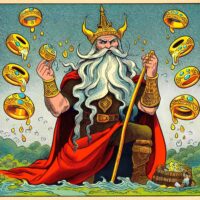
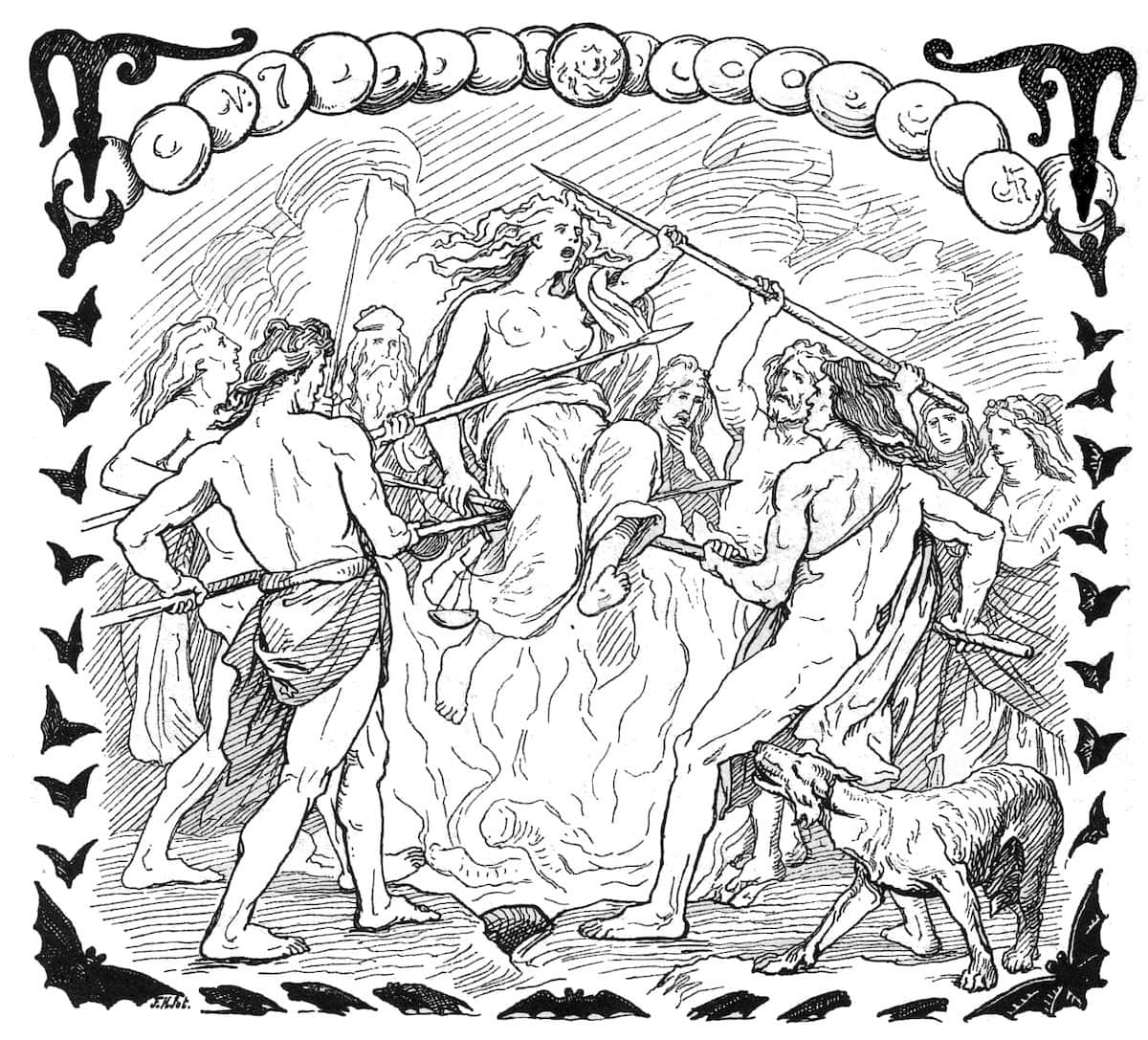
In Norse mythology, Hrungnir, also known as Hrugner (Old Norse, meaning “brawler”), is a giant who challenges Odin to a contest and is ultimately slain by Thor. The duel between Thor and Hrungnir holds significant importance in research, featuring the clash between the giant’s stone weapon (grindstone) and the god’s iron hammer, along with the noteworthy detail of Hrungnir having a heart made of stone.
Hrungnir is said to reside in Thrymheim, a giant’s dwelling in Jotunheim, one of the Nine Worlds in Norse cosmology.
In the encounter between Hrungnir and Odin, a dispute arises over who possesses the faster horse. Although Odin wins the race on Sleipnir, Hrungnir’s horse, Gullfaxi, is swift enough to storm into Asgard. Invited by the gods, Hrungnir attends a feast.
In his intoxicated state, the giant boasts of abducting Freyja and Sif, transporting Valhalla to Jotunheim, sinking Asgard, and killing all the Aesir. Tired of Hrungnir’s insults, the gods seek Thor’s assistance. Threatening Hrungnir, Thor proposes a duel, given the giant’s lack of weapons.
Thor, accompanied by his servant Thialfi, confronts Hrungnir with his three-pronged stone heart, assisted by the clay giant Mökkurkalfi with the heart of a mare. Thialfi cunningly warns Hrungnir that Thor will attack from below, prompting the giant to shield himself. Thor hurls his hammer, and Hrungnir throws a whetstone as a weapon, which shatters upon impact with the hammer. The hammer crushes Hrungnir’s head, causing him to fall. Thialfi slays the clay giant. However, Thor sustains a severe injury from a shard of the whetstone piercing his skull. Hrungnir meets his demise, but Thor is hindered by the fallen giant’s leg, unable to free himself.
His three-year-old son, Magni, comes to his aid and, in gratitude, receives Hrungnir’s horse.
The seeress Gróa attempts to free Thor from the shard in his head through spells. In the process, she forgets the necessary incantations due to her joy in recounting the tales of her husband, Aurvandill. As a result, Thor retains the shard in his head until the end of Ragnarök.
Sources
In the Prose Edda’s Skáldskaparmál, Snorri Sturluson recounts, in the form of a mythic narrative, the tale of Hrungnir. This is in contrast to earlier skaldic poems, notably Þjóðólfr’s Haustlöng, which presented the myth in a more concise form. The violent encounter with Thor, a theme resonating throughout the entire Scandinavian region, is well documented, attested not only in the Edda but also in skaldic poetry and the employed kennings. The Hárbarðslióð, Hymiskviða, and Lokasenna of the Poetic Edda make explicit references to Hrungnir.
Then Hrungnir shoved the shield beneath his feet and stood on it, and held the whetstone with both hands. Next he saw lightnings and heard great thunders.Then he saw Thor in an As-rage, he was travelling at an enormous rate and swung his hammer and threw it from a great distance at Hrungnir. Hrungnir raised the whetstone with both hands, threw it in return. It met the hammer in flight, the whetstone, and the whetstone broke in two. One piece fell to the ground, and from it have come all whetstone rocks. The other piece crashed into Thor’s head so that he fell forwards to the ground, but the hammer Miollnir hit the middle of Hrungnir’s head and shattered his skull into small fragments, and he fell forwards over Thor so that his leg lay across Thor’s neck.
Thialfi attacked Mokkurkalfi, and he fell with little glory. Then Thialfi went up to Thor and went to remove Hrungnir’s leg from him and was unable to manage it. Then all the Aesir came up when they found out that Thor had fallen, and went to remove the leg from him and could not move it at all. Then Magni, son of Thor and Járnsaxa, arrived. He was then three years old. He threw Hrungnir’s leg off Thor and said:
Isn’t it a terrible shame, father, that I arrived so late. I think I would have knocked this giant into Hel with my fist if I had come across him.’
Then Thor stood up and welcomed his son warmly and said he would grow up to be a powerful person.
‘And I have decided,’ he said, ‘to give you the horse Gullfaxi, which used to be Hrungnir’s.’
— Skáldskaparmál, 17, trans. Anthony Faulkes, 1987.
The Eddas are collections of Old Norse poems and prose that form the primary sources of Norse mythology. The two main Eddas are the Poetic Edda and the Prose Edda.
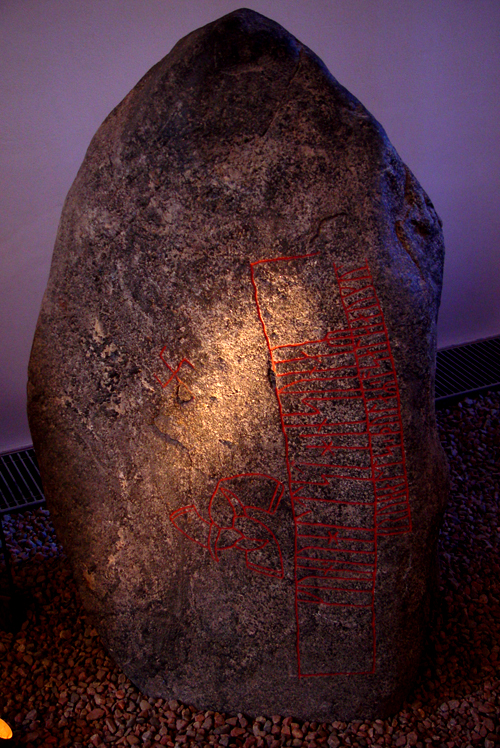
The depiction of Hrungnir’s three-pronged heart on runestones emphasizes the deep-rooted nature of this myth within the population.
Due to the unmistakable older elements within the myth, predating consistent oral transmission and eventual transcription, early 20th-century research pursued various interpretative approaches. Wolfgang Golther, among others, interpreted it as a naturalistic mythological battle between the thunder god Thor and the mountain giant Hrungnir. Rudolf Simek, however, argues that this interpretation does not fully do justice to the archaic pre-literary elements. Georges Dumézil, a French mythologist, proposed a different perspective, viewing these pre-scriptural elements in Snorri’s account as remnants of an initiation rite. However, this interpretation poses challenges, particularly concerning the figure of the initiate Thjalfi. A clear parallel is drawn between the battle of Thor and Hrungnir and the one waged by the Indian god Indra against a three-headed monster.