In Greek mythology, Phobetor (from the Greek phobétor: ‘the one who causes fear’) was one of the Oneiroi, the children of Hypnos (sleep), who personified dreams. According to Hesiod (in the 7th century BCE), Phobetor is the son of Nyx, the primordial goddess of the night, produced parthenogenetically. According to Cicero (106-43 BCE), his father was Erebus, the personification of darkness.
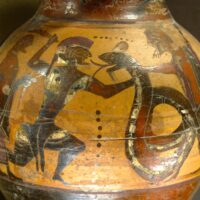
The gods called him Iquelo, Ikelos, Icelos, or Icelus (‘the one who is similar or alike’, in Greek). Specifically, Phobetor appeared in the dreams of the gods in the form of a snake, bird, or any other animal. While his brother Morpheus served as the messenger of dreams, he was the bearer of nightmares and occasionally represented prophetic dreams.
Mortals called him Phobetor (‘the one who scares’), while the gods referred to him as Iquelo. He was one of the main Oneiroi, along with his brothers Morpheus and Phantasos, who had the peculiarity of appearing only to kings, leaving the dreams of other mortals in the hands of the rest of the thousand Oneiroi.
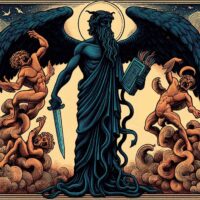
The offspring of Iquelo are the forms of the nightmares themselves, allowing him to extend his influence on all people in the world when they sleep. Like the other Oneiroi, Iquelo was a spirit with dark wings that emerged from his cave in Erebus every night, resembling a bat.
Abilities
He has the ability to devour the dreams of people and/or gods. He can also manipulate, capture, modify, or imprison dreams. He appeared in the dreams of mortals, disguised as animals or monsters like dragons, hyenas, and vipers, and could change his forms to interact with mortals in the real world.
The poem “Metamorphoses” by Ovid describes him as the one who “transforms into a beast, a bird, or a snake with a stretched-out body.
“
Role
With Hypnos and Pasithea, and as the brother of Morpheus and Phantasos, Phobetor is one of the three gods of dreams, personifying nocturnal nightmares. According to mythology, Phobetor could assume various forms, appearing in bad dreams as a monster, an animal, or any inanimate object.
His shape-shifting ability made him elusive and difficult for people to identify. His most significant trait was his ability to penetrate human minds during sleep. He was considered an evil and dark entity that instilled fear and anxiety in people’s hearts.
However, Phobetor was not merely a demon whose purpose was to inflict suffering. As the personification of dreams, he played a crucial role in Greek mythology, as dreams were seen as a means of communication with the supernatural world. Beliefs in the significance of dreams held great importance for the ancient Greeks, who sought to interpret their dreams for prophecies or guidance from the gods.
In a sense, he was also a prophetic being. According to myths, dreams induced by Phobetor could bring warnings or prophecies about the future. He had the ability to evoke fear as a means of protection against danger.
Although Phobetor was not one of the most well-known Greek deities, his role in mythology was significant. His character symbolizes not only the dark aspects of the human mind but also the ability of dreams to inspire, interpret, and foretell the future. Thanks to Phobetor, people have sought meaning in their dreams for centuries, and nightmares remain a source of endless fascination.