Sarafan (Russian: сарафан, sarafan, Persian: سراپا, sarâpâ) is a traditional Russian women’s sleeveless outer garment. It is a flared pinafore dress, the pattern, usage, and user base of which have evolved significantly throughout history. In terms of construction, two main types can be distinguished: the wedge-shaped sarafan primarily composed of wedges, and the straight sarafan mainly formed from straight pieces.
Originally, the word “sarafan” did not refer to women’s clothing, but to one type of men’s caftan; this meaning is known from written records from the 16th century. The name comes from the Turkic särapa (i) in Persian. سراپا, serāpā (“honorable garment”). Sarafans were mostly widespread in the northern regions of Russia. Women in the central and southern regions usually wore skirts instead of sarafans.
Origin and Spread
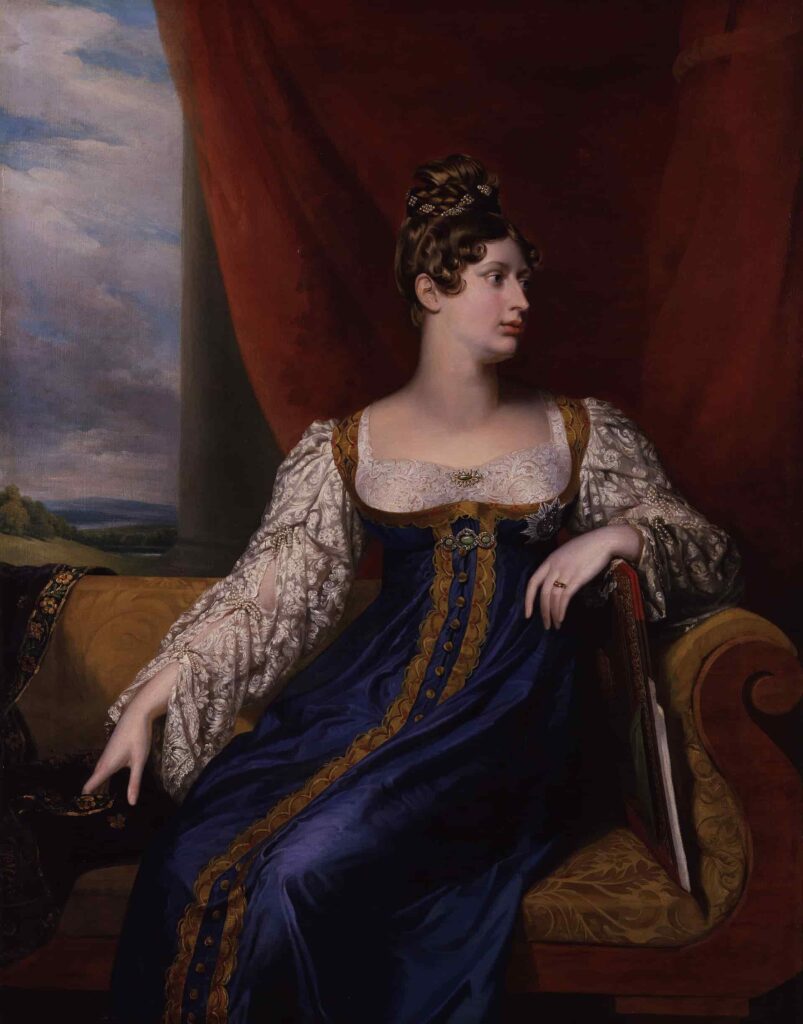
Originally coming to Russia from elsewhere in Europe, the sarafan is perceived as belonging to Russian costume tradition. It is indeed part of some Russian women’s folk costumes and is popular in many parts of Eastern and Northern Europe. The straight sarafan is also known in Karelian folk costumes and in the traditional attire of several other Finno-Ugric peoples. Different types of sarafans are also worn in many other European countries.
The sarafan is the national women’s clothing of the northern Russians. Dresses of a similar cut were also worn by women of the Finno-Ugric peoples in Russia, the Baltics, and Scandinavia. There are various views on the origin of the sarafan, as well as discussions about the existence of the sarafan in ancient Rus times. At least from the Kyivan frescoes of the Ruthenian period, it is evident that such clothing was not known in Ukrainian lands of the 11th-12th centuries, as well as in later centuries.

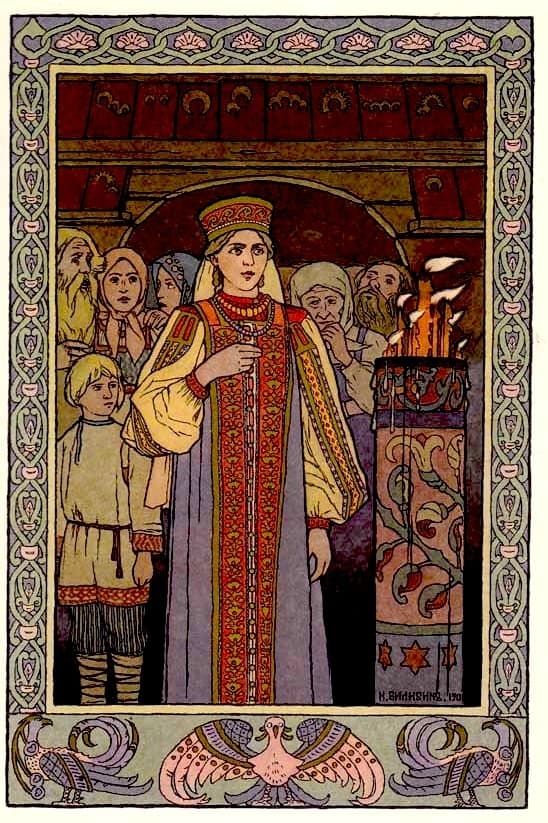
According to one version, clothing of a similar cut, together with the kokoshnik, was borrowed by the northern Russian population, that is, the Russians, from their closest neighbors – the Finno-Ugric peoples. This is supported by the absence of sarafans as a form of clothing among the rest of the Slavic peoples, including Belarusians and Ukrainians, and instead the spread of sarafans among Estonians.
According to another version, it has Eastern origins and was later adopted by Russians from the Finnish peoples. In favor of this hypothesis is the Persian origin of the word “sarafan” (Persian. سراپا sarāpā, literally “from head to toe”).
In the Moscow state itself, the first written mentions of the sarafan, albeit as men’s outerwear (and exclusively the name), date back to the 14th century.
The sarafan gained particular popularity among the Russians of Northwestern and Central Russia, especially in the Volga region. The sarafan was not only an element of rural but also urban culture for a very long time, including at the beginning of the 20th century. In some areas of Central and Northern Russia, the sarafan as rural attire is still in use today.
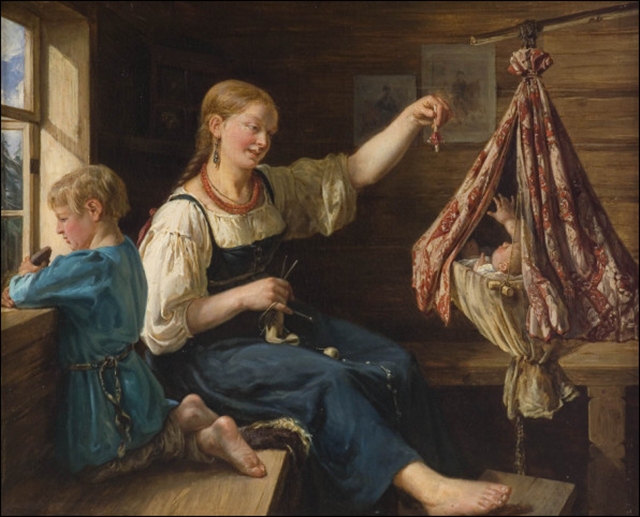
In Ukraine, the sarafan is exclusively women’s clothing worn by Russian settlers, which is why it spread in the east and south of the country, including Russian Old Believers who began to settle in Southern Bessarabia (Lipovans of Odessa and the border with Romania) and the eastern regions of the Left Bank from the late 18th century.
Cut and Types
A sarafan is traditionally a long women’s dress, usually sleeveless.

- Plain – the oldest type of sarafan, essentially a sleeveless dress worn over a shift. Most often, such a sarafan was straight and on straps – this form of sarafan is the most popular.
- Sarafan with a seam in front or with fasteners – a later cut of the sarafan; if there were fasteners (usually buttons) instead of a seam, they were made all over from top to bottom. The edges and middle of such sarafans were often decorated with braid. They could have detachable sleeves (especially sarafans with a “bishop’s sleeve”).
- Skirt with a bodice – the latest cut of the sarafan, popular in Southern Russia from the 2nd half of the 19th century to the beginning of the 20th century.

Modern Sarafans
The modern version of the sarafan is a lightweight women’s dress without sleeves, usually with straps or suspenders, as well as a dress of this cut made of warm fabric, worn over a shirt, sweater, etc.
History
Though the garment referred to as sarafan is now understood as part of Russian tradition, it is believed to have arrived there from elsewhere in Europe in the 13th century. At that time, it was called by another name, feresi, in Finnish attire, and it was a lightweight sleeved jacket for men, fastened at the front with buttons or hooks. The name sarafan was adopted for the garment in the 15th century, but it referred to a wide men’s outerwear made of wedge-shaped pieces.
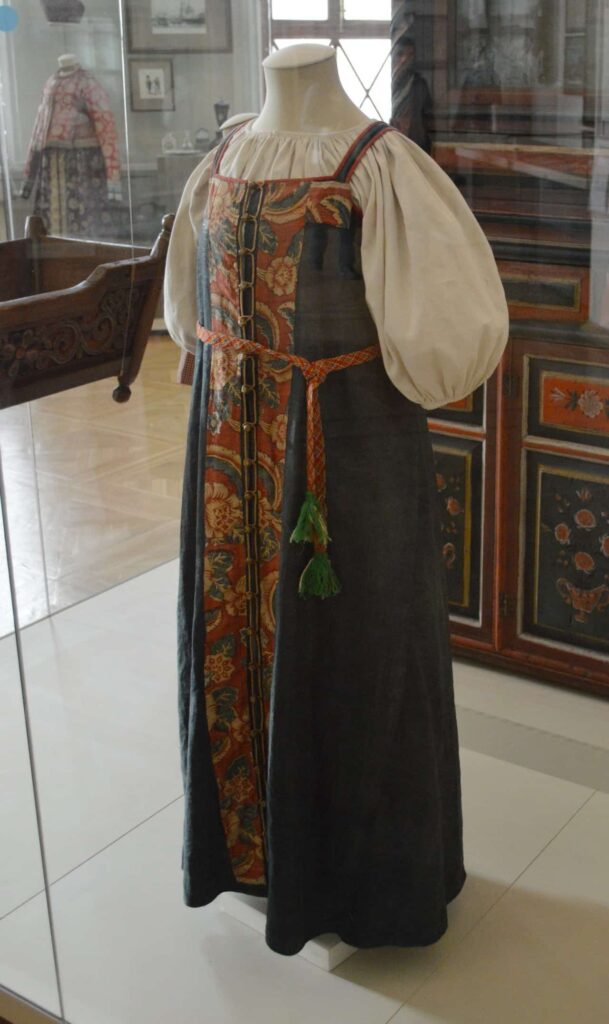
Women began wearing sleeveless sarafans in the 17th century, and for a while, both genders wore them until they became distinctly women’s attire in the early 18th century. The transformation into its current form went through four stages:
- Sleeves first became false sleeves and eventually disappeared entirely.
- The front edges of the garment began to be sewn shut, initially from the neck to the waist and from the 17th century onwards, completely closed. However, remnants of the previous style were visible until the early 20th century. In the 1910s, two vertical ribbons were sewn onto the center front of sarafans, resembling the decorative front edges of jackets from before. These were further adorned with buttons and stitches resembling buttonholes.
- The shoulders of the garment narrowed and eventually became straps.
- The back piece of the garment shrank and disappeared entirely in central and southern Russia. Only in the northern regions of Russia and around Lake Baikal did sarafans with a small back piece, called “frog,” survive.
Long sarafans became popular in central and northern Russia. They were common in rural areas but also worn extensively in cities. A typical outfit included a shirt or blouse, sarafan, belt, and apron. The decorations on the sarafan indicated the woman’s social status and wealth. For example, a merchant’s wife’s sarafan might be made of expensive imported fabrics like silk, satin, or brocade, trimmed with fur and adorned with gold buttons and embroidery with gold and silver thread. Rural women and those belonging to the lower middle class wore sarafans made of homemade linen and wool fabrics. These were decorated according to means with various braided or woven ribbons, embroidery, lace, wide belts, and braids.
Until the early 18th century, women and girls from all social classes wore it, but reforms initiated by Peter the Great changed the attire of women from the middle and upper classes. From the 19th century onwards, sarafans were mainly worn by rural women in the Volga region.
After the October Revolution, the sarafan was viewed as an unwanted relic of imperial Russia.
Sarafan in Finland
The sarafan outfit is traditionally associated with Orthodoxy in Finland, while Lutheran women wore waist skirts. The sarafan is indeed part of some Karelian folk costumes. For example, the äyrämöi costume of Rautu and Sakkola includes a gathered shoulder skirt reminiscent of the Russian sarafan: its waist extends higher than usual, supported by narrow shoulder straps merging from the back. The shoulder skirt is also included in the national costume adapted from folk costumes.
These types of outfits were in use in Viena Karelia, Aunus, and parts of present-day North Karelia until the 20th century. However, in some areas of Karelia and the eastern archipelago of the Gulf of Finland, elderly women still wore them in the early decades of the 20th century, and even later among evacuee women.
In present-day Finland, sarafan or feresi are primarily costumes worn for various Karelian traditional events.
In their selection, the wearer’s religion, age, or marital status no longer influences the choice of attire as they once did.
Sarafan and Feresi
The sarafan is also referred to as the feresi. The words originate from different languages, sarafan from Persian and feresi from Greek, and over time they have meant different things based on the materials used or the pattern. In Finland, these terms are now used interchangeably, completely overlapping in meaning. However, in costume terminology, a distinction can be made between the garment (sarafan) and the ensemble comprising, for example, a blouse, headgear, and jewelry (feresi), but the distinction is also made the other way around. There are also regional differences in the use of these terms.
The New Flourishing of Sarafan in Russia
In the 1950s, there was a revival of the sarafan in the Soviet Union when fashion magazines began to emphasize the versatility of the traditional garment. They presented women with various versions of the sarafan, starting with everyday workwear made of thicker fabric and ending with weekend outfits made of lighter and brightly colored fabrics. The new popularity can be traced back to the 1960s. In the 1970s, denim versions emerged, and in the 1980s, versions made of thin and small-patterned printed fabric with abundant skirts became fashionable. Nowadays, these models are especially worn in the summer.