By using this site, you agree to the Privacy Policy.
Accept
MalevuzMalevuz
  • HISTORY
  • SCIENCE
  • BIOGRAPHY
MalevuzMalevuz
Search
  • HISTORY
  • SCIENCE
  • BIOGRAPHY
Follow US
Malevuz > History > Usekh Collar: A Typical Ancient Egyptian Neck Ornament
History

Usekh Collar: A Typical Ancient Egyptian Neck Ornament

Hrothsige Frithowulf
ByHrothsige Frithowulf
History Editor
Hrothsige is a history writer at Malevus. He has a bachelor's in history from the University of Exeter. Hrothsige's areas of historical interest encompass the ancient...
- History Editor
6 June 2025
Share
4 Min Read
SHARE

The usekh collar is a typical ancient Egyptian neck ornament. It is mostly a wide collar consisting of several strands of beads, with various symbols at its ends. These symbols usually include falcon heads, vultures with spread wings, and falcons or uraeus serpents.

Contents
  • Development
  • Meaning
  • Other Forms

Development

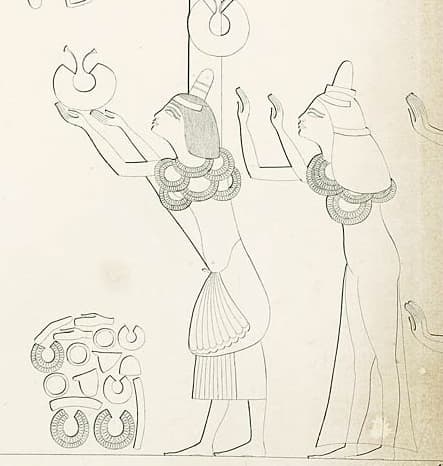
Ay and Tey in tomb 25 in Amarna receiving rewards from Akhenaten and Nefertiti.

Initially, the usekh collar was a decorative piece used by the king to reward his officials and by the landlord to reward his subordinates. Since the Middle Kingdom, usekh collars have been part of funerary equipment and were depicted on coffin friezes. Until the Late Period, collars with falcon heads could be found on mummy-shaped coffins. Since the Late Period, there has been a specific spell in the Book of the Dead for a “gold usekh collar, which is placed around the neck of the transfigured one on the day of burial” (Spell 158).

Amulet, Aegis of Isis in the form of a usekh Collar.

In later figures, the goddess Bastet held the usekh collar as a shield in front of her chest, and the cats of Bastet also wore the aegis as a neck cord. It is likely that the (erroneous) term “aegis” was derived from these Bastet figures because the term originally referred to the shield of the Greek gods Zeus and Athena.

Chenu, a usekh collar knotted from the Old Kingdom, is known by name.

More Read

Christmas in Denmark
Christmas in Denmark: Traditions, Celebrations, and History
Talisman of Charlemagne: An Old Relic with a Possibility of Truth
Christmas in England: Traditions, Celebrations, and History
Battle of Tolbiac: Clovis’ Triumph
buy finasteride online https://blobuyinfo.com/buy-finasteride.html no prescription pharmacy

Meaning

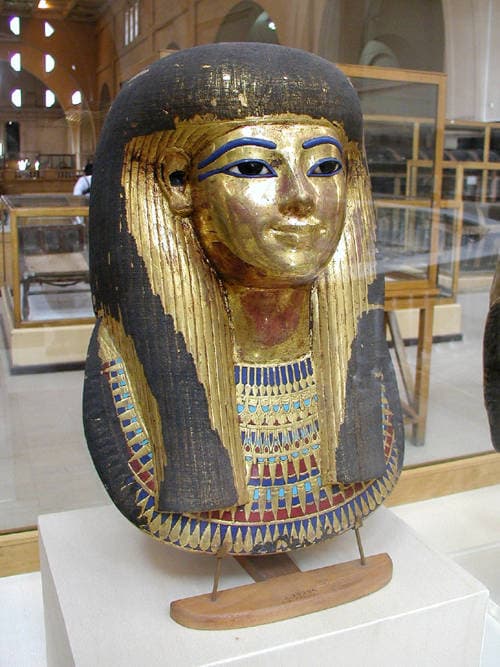
Gilded cartonnage mummy mask of Thuya, wife of Yuya and mother of Queen Tiye.

The usekh collar primarily served as a protective symbol and was often recited in spells for the Opening of the Mouth ritual and during the dressing of the deity’s statue. In the Temple of Seti I in Abydos, there is a depiction in the Chamber of Re-Horakhty where the king presents a usekh collar with a pectoral as clothing for a deity’s statue. This ritual probably belonged to the daily morning service. The usekh collar may also have served as a reminder of the god Atum, who spread his arms around Shu and Tefnut to impart his ka to them. Thus, putting on the collar was equivalent to being embraced by divine arms. It thus had the same significance as the vulture with spread wings on the sarcophagus of Thutmose I.

Other Forms

Furthermore, from the New Kingdom onwards, there were usekh collars as amulets (modernly referred to with the Greek term “aegis”), which bore the head of a god, a sacred animal, or the king, with female deities predominating in this form. Occasionally, a divine couple was also depicted, such as Onuris and Tefnut united.

buy voltaren online https://blobuyinfo.com/buy-voltaren.html no prescription pharmacy

The collars were not only found with mummies but also as chain links or decorations for fingers and earrings. In addition, small replicas existed as amulets for the deceased.

Originally, godheads over chest collars were already found on godstaffs as well as the prow and stern of godbarges. Thus, the aegis was actually just a representation of a god and the collar was merely an accessory. In the case of consecrated deities, the collar occasionally received a menit handle and possibly even served as a ritual instrument.
Share This Article
Email Copy Link Print
ByHrothsige Frithowulf
History Editor
Hrothsige is a history writer at Malevus. He has a bachelor's in history from the University of Exeter. Hrothsige's areas of historical interest encompass the ancient world and early Europe, along with the history of modern culture.
Previous Article Sarafan Sarafan: Traditional Garment of Russian Women
Next Article Sandal Maker Tomb of Rekhmire MET DP346330 1 Ancient Egyptian Clothing: History and Origin

Latest News

985px Landing of Lieutenant James Cook at Botany Bay 29 April 1770 painting by E Phillips Fox

Top 10: The Greatest Knights in History

Knights were the medieval equivalent of elite soldiers, and many…

List
3 November 2026
Charles Rolls driving a Peugeot 1896
List

10 of the Craziest Laws in History

For more than 4,000 years, humans have devised new laws…

18 October 2026
Ikinci Meksika Imparatorlugu
History

Why Did the Second Mexican Empire Collapse?

The Second Mexican Empire did not collapse because of a…

14 April 2026
A painting depicting Aboriginal Tasmanians attacking John Allen’s Milton Farm near Great Swanport in 1833.
History

Colonialism in Tasmania

The colonization of Tasmania was not a simple story of…

14 April 2026

You Might Also Like

pumpkins after halloween ends
History

What to Do with Pumpkins After Halloween? 30 Clever Ways

24 September 2024
cretinism
History

Salt, stupidity, iodine: How did iodine get into table salt?

5 November 2026
salvador allende 1
History

Latin America: Between coups and dictatorships

11 December 2025
uruk wheeled cart signs
History

Timeline of the Wheel: History and Invention

2 November 2026
  • Privacy Policy
  • About us
  • Editorial Standards

© Malevuz. All Rights Reserved.

Welcome Back!

Sign in to your account

Username or Email Address
Password

Lost your password?