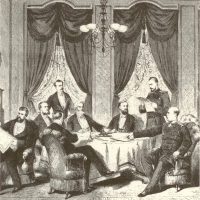
Signed on February twenty-sixth, 2001, along the sunlit French Riviera after four days and nights of marathon diplomatic bargaining—the longest European summit in history up to that point—the Treaty of Nice rarely wins prizes for inspiring prose. Yet beneath its dry mathematical tables of voting weights and seat quotas lay a vital geopolitical mission. Without the institutional overhaul enacted at Nice, the European Union’s aging decision-making machinery—originally built in 1957 for just six Western European neighbors—would have ground to a paralyzed halt when the EU welcomed ten formerly Communist Central, Eastern, and Mediterranean nations in the historic enlargement of 2004.
Solving the “Amsterdam Leftovers” Before the 2004 Big Bang
To understand why European leaders locked themselves inside the Acropolis convention center in Nice in December 2000, one must look at the map of post-Cold War Europe. Following the fall of the Berlin Wall in 1989 and the collapse of the Soviet Union, twelve candidate nations—led by Poland, Hungary, the Czech Republic, Slovakia, Slovenia, Estonia, Latvia, Lithuania, Cyprus, and Malta, followed closely by Bulgaria and Romania—were knocking at the door to join the European Union.
Expanding the EU from 15 member states to 25 or 27 states all at once posed an existential administrative nightmare that the earlier 1997 Treaty of Amsterdam had failed to solve (problems famously dubbed the “Amsterdam leftovers”):
- A Bloated European Commission: Under old rules, the five largest countries (Germany, France, the UK, Italy, and Spain) each appointed two European Commissioners, while smaller states appointed one. In a 27-nation EU, the executive Commission would have ballooned to over thirty-two commissioners—too big to function as an effective cabinet.
- The Veto Paralysis: On dozens of policy areas inside the Council of Ministers, a single country could cast a national veto to block laws desired by the other twenty-six nations.
- Population vs. Small-State Power: Reunified Germany had eighty-two million citizens, yet possessed the exact same council voting weight (10 votes) as France, Italy, and the UK (which had around sixty million people each), while tiny states enjoyed disproportionate voting leverage per capita.
The 3 Key Institutional Reforms of the Treaty of Nice
After fierce late-night arguments between French President Jacques Chirac (who fought stubbornly to keep France on par with Germany’s voting count) and German Chancellor Gerhard Schröder, the leaders signed the Treaty of Nice on February 26, 2001, instituting three major structural changes:

- The “Triple Majority” Qualified Majority Voting (QMV) System: Nice abolished national vetoes in roughly thirty additional policy areas and introduced a complex three-tier voting test in the Council of Ministers. To pass a law, a proposal now needed: (a) a qualified majority of weighted votes (where the Big Four got 29 votes each, Spain and Poland got 27 votes, and smaller states got 3 to 14 votes); (b) the support of a majority of member states; and (c) upon request, proof that the “yes” states represented at least 62 percent of the total population of the European Union (giving large Germany a demographic safety brake).
- One Country, One Commissioner: The Big Five countries agreed to give up their second European Commissioner so that every member state—big or small—would have exactly one Commissioner each, while granting greater executive authority to the President of the European Commission to assign and reshuffle portfolios.
- Reallocating the European Parliament and Reform of Courts: To make room for incoming Eastern European representatives, the cap on Members of the European Parliament (MEPs) was raised to 732 seats, while the overburdened European Court of Justice was allowed to create specialized judicial panels to clear its backlog of cases.
The Irish Referendum Shock and the Path to Lisbon
Before the Treaty of Nice could legally take effect, it had to be ratified by all fifteen existing member states. In June 2001, the treaty suffered a stunning blow when voters in the Republic of Ireland—the only country required by its constitution to hold a popular national referendum on EU treaties—voted 53.9% “No” on a low 35% voter turnout, driven by fears over losing Irish military neutrality and small-state influence in Brussels.
Only after EU leaders issued the Seville Declarations officially guaranteeing that Ireland’s traditional policy of military neutrality would never be compromised did Irish voters pass a second referendum in October 2002 by 62.9% “Yes,” allowing the Treaty of Nice to enter into force on February first, 2003. While everyone admitted Nice’s voting math was so convoluted that it needed to be simplified eight years later by the Treaty of Lisbon (2009), the Treaty of Nice fulfilled its historic purpose: unlocking the gates on May first, 2004, for seventy-five million citizens across ten nations to reunite Europe peacefully after half a century of Cold War division.