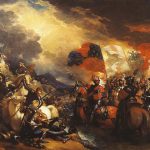
The Battle of Alesia occurred in 52 B.C., between the Gauls under the leadership of Arverni chief Vercingetorix and the Romans under the direction of proconsul Julius Caesar. The last major battle of Julius Caesar’s Gallic War campaigns was a two-month-long siege. The coalition of Gallic peoples tied together by Vercingetorix to confront the Roman soldiers has been utterly defeated. For all its symbolic significance, it also marks the origin of the Gallo-Roman culture and the arrival of Gaul into the sphere of influence of ancient Rome.
- Why did the Battle of Alesia take place?
- When was the Battle of Alesia fought?
- Where did the Battle of Alesia take place?
- Who won the Battle of Alesia?
- The art of the siege at Alesia
- The clever Roman defenses
- What were the results of the Battle of Alesia?
- What does the archaeological site of Alesia look like?
Why did the Battle of Alesia take place?
Repulsed at Gergovia, Caesar’s legions retired to the Roman Province in southern Gaul to regroup after Vercingetorix gave in to the temptation of delivering the decisive blow with his bolstered cavalry. Giving battle not far from Dijon and being defeated by the Romans, he is forced to beat a retreat and seek sanctuary in the closest and seemingly best-arranged place: Alesia. The Gallic leader feels confident, saying, “This place had all it needed to withstand an attack and even a pretty protracted siege” (height, sources, wells, provisions).
When was the Battle of Alesia fought?
The Battle of Alesia took place between July and September of 52 BC.
Where did the Battle of Alesia take place?
Alesia, located on Mount Auxois, is a Gallic oppidum, or a fortified city, that takes advantage of natural defenses thanks to its strategic location. Former capital of the Mandubians, a mystery people only described by Caesar in his book “Commentarii de Bello Gallico,” it is now one of the most important cities in Gaul throughout the Celtic and Roman eras. The Romans, following in the footsteps of the Gauls, would use the first military tactic documented by historians in that region.
Who won the Battle of Alesia?
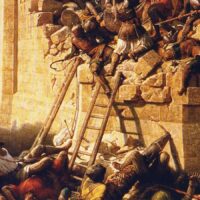
A month later, the army of help assembled in all of Gaul attacks the Roman fortifications at their weak spot, at the foot of Mount Rhea, and puts the warriors of Labienus to shame. Julius Caesar, though, strikes back. A bloody battle ends with the Gauls being vanquished and Vercingetorix’s first cousin being taken prisoner. They had no choice but to leave Alesia and the Arverni leader behind. Then he turns himself over to the proconsul. Following Caesar’s victory in 46 BC, Vercingetorix was captured and likely murdered in prison.
The art of the siege at Alesia
Almost 100 acres of Alesia have been fortified. It was protected by high rocks on the east and west, as well as by massive walls constructed in the Murus Gallicus style. Aside from the oppidum’s defenders, the Romans in 52 BC also had to deal with a Gallic force that had come to help the city’s defenders. The legionaries constructed a previously unheard-of system of fortifications in under five weeks. They erected two lines of defense out of stones and sods for further security.
To stop the 80,000 Gauls who are holed up within the oppidum from escaping, the initial defense was a 15-kilometer-long countervallation. The second was a 20-kilometer-long line that curled away from the center in an effort to prevent Vercingetorix’s army from gaining any ground. While it was thanks to 16th-century excavations that these lines could be identified and located, more modern studies have uncovered artifacts like prods, wolf traps, Celtic and Roman coins, and other evidence of the weapons and traps used. Today, we know that there were several layers of defense in place.
The clever Roman defenses
Each line of defense has barriers set up to halt the approaching Roman army. Both ditches measured 2.50 m in depth and 4.50 m in width. Holes are dug at an angle of 90 degrees, and pointed stakes are placed at the bottom of each hole in a staggered pattern. After the holes are drilled, a brush is used to cover them up. After that, five rows of ditches, each 1.50 m deep, connect the larger branches. There is a wooden rampart that is 24 meters high and 4 meters wide that runs along the top of the lines.
An estimated 70,000 legionnaires served in the Roman army, which was made up of 10 to 12 legions. Vercingétorix had 80,000 soldiers and could hold for a month until reinforcements arrived. Two months later, the Gallic army of 250,000 foot soldiers and 8,000 mounted warriors arrived, when the city was already suffering from a scarcity of food and water. Vercingetorix orders the residents to leave the area to reduce pointless casualties. Caesar’s Germanic cavalry came out in force and routed the Gallic relief horsemen that had attempted to invest the Roman fortifications.
What were the results of the Battle of Alesia?
The fight of Alesia was a turning point for Gaul, which ultimately yielded to Roman control. The Gallic resistance did not end with this fight; subsequent years saw a few smaller skirmishes but nothing of this size again. The fact remains that after a final revolt led by the Atrebate Commios in 51 BC, the Gauls will be definitively under Roman domination, and this for nearly five centuries, giving birth to the Gallo-Roman civilization.
For Julius Caesar, it was bringing proof to Rome of his military successes and conquests by returning to Northern Italy with his massive treasure. However, civil war was waiting for him beginning in 49 BC due to Pompey‘s hostility toward his rise to power.
What does the archaeological site of Alesia look like?
Alise-Sainte-Reine, on the Côte d’Or, is the modern-day name for the city that survived the calamity of 52 BC and transformed into a Gallo-Roman settlement. Napoleon III initiated the excavations, and they have been continuously conducted since then. As a result, several Gallic, Germanic, and Roman weapons were uncovered. The strategic encirclement created by Caesar’s Roman soldiers may be seen in the form of palisades, doors, embankments, ditches, and traps, all of which can be seen on this site that is otherwise exceptionally rich in antiquities.