In August of 1924, hundreds of people gathered outside the Washington, DC, headquarters of the Washington Star newspaper to check the results of a baseball game. Straw boaters, the hats that incited riots in New York in 1922, were still popular among American men. But the New York Times reported on September 20th, 1925, “Discard Date for Straw Hats Ignored by President Coolidge.”
Anyone can feel confused by this headline. Because when did it even become unacceptable to wear straw hats in public? But US President Calvin Coolidge disregarding the straw hat date had become newsworthy enough for the front page of the nation’s leading newspaper. To understand that, let’s look back at the evolution of straw hat fashion in the US.
How did straw hats come along in the US?
The original purpose of wearing hats and other head coverings was to, well, protect the head, hair, and scalp from the environment. However, a head covering was also used to express a person’s rank in Ancient Egypt and Rome. And hats have continued to have significance in modern culture.
Throughout European history, hats were worn as a mark of social prestige, especially at the beginning of the Middle Ages. Almost immediately, a specific kind of hat emerged for every social and occupational group. Starting in the 17th century, hats were a major fashion trend. For both sexes, hats came in a wide variety of styles, sizes, and ornamentations.

The tall top hat became the traditional headwear in Europe, whereas the Stetson, named after its manufacturer, was often considered the most recognizable kind of cowboy hat in the United States. Hats were mostly made of felt, although other materials like fur or leather were occasionally employed. However, in the 19th century in the United States, a material that had previously been used to manufacture hats—straw—became increasingly popular.
In the summer, the rounder, flatter boater joined the iconic Panama hat. In the early 20th century, the boater hat surpassed all others as the most common form of hat. American men might swapped their heavy felt hats for lighter straw ones when the weather became too hot.
There was a deadline for the straw hat
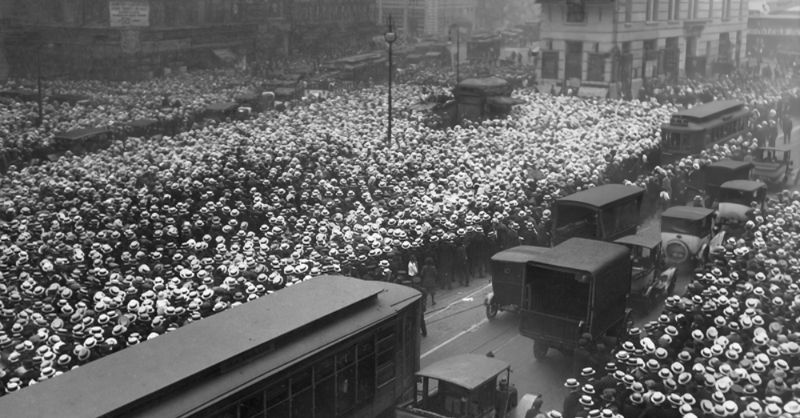
Without a doubt, this enhanced people’s quality of life, but there was still one crucial requirement to adhere to. The straw hat was OK throughout the summer, but it had to be switched back to the felt hat after a very particular date. This was beginning on September 15th. The “Felt Hat Day” was commemorated so thoroughly that it was written about in the press.
Young people made fun of the tradition in the days leading up to and including this “end date.” People swarmed the straw hat wearers and smacked their straw hats right off their heads. And nothing legal could be done against this since it was just a “joke.” But then came September 13, 1922. There was ongoing brutality against straw-hat-wearing factory employees in New York City. A group of youngsters in a neighborhood called Mulberry Bend in Manhattan ripped the straw hats from the heads of the workers and stomped on them.
The Straw Hat Riot begins
On the first day of what would become known as the “Straw Hat Riot,” violence spread, which continued for days. The youngsters had ridiculed a crew of dockworkers. Those males had done more than just put up with the jokes. They fought back to defend their hats, and the situation quickly developed into a full-blown fight. The whole flow of traffic over the Manhattan Bridge froze abruptly. The police action was needed to quell the rioting. Some citizens were arrested.
However, the violence continued. On the night of September 14th, groups of youngsters flocked to the streets in search of males wearing straw hats. Every person wearing a straw hat was met with a beating from the group as they swarmed them with sticks. At least a thousand young people reportedly ran wildly on one of Manhattan’s busiest thoroughfares, Amsterdam Avenue.
The violence lasted for three days
After another day of the Straw Hat Riot, numerous people were hurt and sent to hospitals, and a huge number of young people were taken into custody. The police did not intervene until late that night, and even undercover officers were reportedly attacked by the anti-straw hat mob.
As expected, “Felt Hat Day,” which fell on September 15, saw a continuation of the Straw Hat Riot the next day. Many of the young people who had been detained the night before were still in court, but large groups of them had already gone to Amsterdam Avenue to attack men wearing straw hats.
At least the city of Manhattan’s law enforcement was now on alert. The day after, on September 16th, chaotic pursuits and beatings finally came to a stop.
The Straw Hat Riot lasted only for three days, but it had a lasting impact on American culture. The Straw Hat Riot put an end to the custom of stopping wearing a particular hat and changing it for another every year.
The tradition nevertheless continued in the next three years but disappeared after that. This coincided with the time when the US president stopped paying attention to this informal “end date,” which became front-page news in the New York Times.
The stock market crisis of 1929 likely contributed to the demise of the straw hat. The boaters, formerly a symbol of the easygoing 1920s, have been supplanted by various hats, most notably the Panama hat and the Homburger hat worn by British King Edward VII.
Beginning in the middle of the 20th century, the hat business saw a steady decline. Less and less frequently did men dress formally, and new informal fashions emerged. Factories were also impacted by this shift in fashion, some ending their business in the 1930s.
The Straw Hat Riot at least saw one positive side effect: People could now safely wear straw hats while walking along Amsterdam Avenue in New York City without worrying about being knocked off their feet by rowdy youngsters.