At the dawn of the fourth century AD, Christianity remained an outlawed, periodically persecuted minority movement within the Roman Empire. Under the Great Persecution initiated by Emperor Diocletian in 303 AD, Christian churches were leveled to the ground, sacred scriptures were burned in public squares, clergy were imprisoned, and believers who refused to offer incense to the traditional Roman gods faced torture and execution in the arenas. Yet within the span of a single human lifetime, this hunted underground sect was transformed into the favored imperial religion of the Mediterranean superpower—a historical pivot engineered almost entirely by the military triumph and personal conversion of one man: Flavius Valerius Constantinus, known to history as Constantine the Great.
The Vision at the Milvian Bridge in 312 AD
Born around 272 AD in Naissus (modern Nis, Serbia) as the son of the Western Roman Caesar Constantius Chlorus and a woman of humble Greek background named Helena, Constantine grew up inside the high politics and military camps of the Roman Tetrarchy—the system of four co-rulers established by Diocletian. When his father died while campaigning in York, Britain, in 306 AD, the Roman legions immediately hailed the young Constantine as Augustus, plunging the empire into a series of civil wars among rival claimants for supreme power.
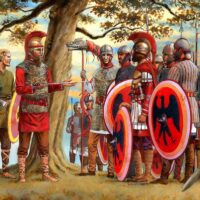
The decisive moment arrived in October 312 AD, when Constantine marched his outnumbered army of forty thousand Gallic and British veterans southward down the Italian peninsula to confront his chief rival, Maxentius, who held the city of Rome with nearly double the troops. According to Constantine’s biographer, Bishop Eusebius of Caesarea—who claimed to have heard the story under oath from the emperor’s own lips—on the afternoon before the battle, Constantine looked up at the sun and saw a cross of light shining above it, accompanied by the Greek words En Touto Nika, commonly rendered in Latin as In Hoc Signo Vinces: “In this sign, you shall conquer.” That night in a dream, Christ appeared to Constantine and instructed him to paint the heavenly sign—the Chi-Rho monogram formed by the first two Greek letters of the name Christ (X and P)—onto the shields of his legionaries. On October twenty-eighth, 312 AD, at the Battle of the Milvian Bridge just north of Rome, Constantine’s soldiers crushed Maxentius’s army, and Maxentius himself drowned in the Tiber River as his pontoon bridge collapsed. Marching into Rome, Constantine refused to ascend the Capitoline Hill to offer the traditional victory sacrifice at the Temple of Jupiter, crediting his triumph entirely to the God of the Christians.
The Edict of Milan and Imperial Patronage
Four months after his victory at Rome, in February 313 AD, Constantine met in northern Italy with his eastern imperial counterpart, Licinius, and issued the landmark agreement known as the Edict of Milan. While Emperor Galerius had issued a grudging edict of toleration on his deathbed two years earlier, the Edict of Milan went far further: it granted universal religious freedom across the Roman Empire, explicitly legalized Christianity, and ordered that all confiscated churches, cemeteries, and properties seized during Diocletian’s persecution be returned immediately to Christian communities at state expense.
Constantine did not stop at mere legal toleration; he elevated the Christian Church into a partner of the Roman state. He exempted Christian clergy from compulsory municipal taxes and public labor duties—privileges previously reserved only for pagan priests and elite physicians—granted Christian bishops the legal authority to act as civil judges whose court rulings could not be appealed, abolished crucifixion as a method of execution out of reverence for Christ, declared Sunday an official day of rest for courts and urban workshops in 321 AD, and poured vast sums of imperial gold into constructing monumental basilicas, including Old Saint Peter’s Basilica and the Basilica of Saint John Lateran in Rome, as well as the Church of the Holy Sepulchre in Jerusalem, where his aged mother Helena traveled to excavate the relics of the Passion.
The Council of Nicaea in 325 AD and the Quest for Unity
After defeating Licinius in 324 AD to become the sole, undisputed ruler of the entire Roman Empire, Constantine discovered that the eastern provinces were torn apart by a fierce theological controversy. In Alexandria, Egypt, a popular presbyter named Arius was teaching that because God the Father begat Jesus the Son, there was a time when the Son did not exist, making Christ a created, subordinate being rather than eternal God. To Constantine, who believed that the military prosperity of the Roman Empire depended upon maintaining the favor of Heaven through unified worship, a fractured Church was a direct threat to state security.
In the early summer of 325 AD, Constantine took the unprecedented step of summoning the First Ecumenical Council at his lakeside palace in Nicaea (modern Iznik, Türkiye). Paying for the travel and lodging of roughly three hundred bishops from across the empire—many of whom still bore blinded eyes and crippled limbs from past pagan persecutions—the unbaptized emperor sat on a golden stool in the center of the hall in his purple robes to moderate the debates. Under Constantine’s active guidance, the bishops condemned Arianism and drafted the original Nicene Creed, adopting the philosophical Greek term homoousios to declare that the Son is “of one substance” (consubstantial) with the Father. For the first time in history, doctrinal orthodoxy was backed by the coercive legal power of the Roman Emperor, who ordered Arius’s books burned and exiled bishops who refused to sign the creed.
Constantinople: A New Christian Capital and Deathbed Baptism
Recognizing that the ancient city of Rome was geographically too far from the vital Danube and Persian frontiers—and remained dominated by a stubbornly pagan senatorial aristocracy—Constantine decided to build a brand-new imperial capital from the ground up. Selecting the ancient Greek trading city of Byzantium on the European shore of the Bosporus strait connecting the Black Sea and the Mediterranean, Constantine dedicated “New Rome”—universally known as Constantinople—on May eleventh, 330 AD. Unlike old Rome, Constantinople was designed from its inception as a Christian metropolis, filled with magnificent churches such as the original Hagia Eirene and the Church of the Holy Apostles, while remaining largely free of active pagan blood sacrifices.

In May 337 AD, while preparing for a military campaign against Persia, the sixty-five-year-old Constantine fell terminally ill at Nicomedia. Only then, on his deathbed, did he finally receive the sacrament of Christian baptism from Bishop Eusebius of Nicomedia—having delayed the rite for twenty-five years in accordance with the common fourth-century belief that baptism washed away all prior sins committed by a ruler who had to wield the bloody sword of imperial statecraft. Putting aside his royal purple robes to pass away dressed in the white linen garment of a newly baptized initiate on the Feast of Pentecost, Constantine left behind a transformed world, setting the trajectory that saw Emperor Theodosius I declare Nicene Christianity the official, exclusive state religion of the Roman Empire just forty-three years later in 380 AD.