Some three hundred representatives of the Third Estate, but also of the aristocracy and the clergy, took the oath of the Jeu de Paume (Tennis Court) on June 20, 1789, swearing not to separate until a new French Constitution was completed. The agreement is purely symbolic in nature and has no legal weight. It was a crucial moment in the establishment of the French Republic. It was on the strength of this oath that a National Constituent Assembly was established. It will create a Declaration of the Rights of Man and of the Citizen and put an end to special treatment.
When and why did the Tennis Court Oath take place?
Popular unrest has plagued the French monarchy since its economic and financial crises began in 1788. On May 5th, 1789, King Louis XVI convened the Estates General in an effort to ease tensions. The church, the nobles, and the Third Estate all sent representatives to the Versailles conference. However, both the talks and the expectations of the cahiers de doléances (or simply cahiers) were challenging. As soon as the Third Estate deputies realized their numbers had doubled, the first thing they asked for was the ability to vote with their heads instead of following orders. On June 17, unauthorized by Louis XVI, they convened as a National Assembly with the help of certain obstinate members of the aristocracy and church. The latter had their meeting room closed to put an end to this affront. The famous oath was taken on June 20, 1789, in the gymnasium of the “Jeu de Paume.”
What was the text of the Tennis Court Oath?
A common quote from the Jeu de Paume oath goes like this: “(The National Assembly) decides that all the members of this assembly will take a solemn oath to never separate and to gather wherever circumstances require, until the Constitution of the kingdom is established and consolidated on solid foundations.” On the very first pages of the newspaper that would come to be considered “the voice of the Republic,” the oath was printed. Jean-Baptiste-Pierre Bevière penned the passage after being moved by the 1776 Declaration of Independence of the United States.
- The text of the Tennis Court Oath (Jeu de Paume oath)
The National Assembly, considering that it is called to fix the Constitution of the Kingdom, to operate the regeneration of public order, and to maintain the true principles of the Monarchy, nothing can prevent it from continuing its deliberations in some place that it is forced to establish itself, and that finally, wherever its members are gathered, there is the National Assembly; decides that all the members of this assembly shall immediately take a solemn oath never to separate and to gather wherever circumstances require until the Constitution of the kingdom is established and consolidated on solid foundations; and that the said oath being taken, all the members, and each one of them in particular, shall confirm by their signature this unshakeable resolution.
What were the implications of this oath?
The parliamentarians fulfilled their word and were joined by members of the aristocracy and the clergy, despite King Louis XVI’s efforts to subvert the Jeu de Paume pledge. The Count of Mirabeau famously said on June 23, 1789, “We are here by the desire of the people and we will only get away by the power of bayonets.” So as not to seem weak, Louis XVI acknowledged the National Assembly on June 27. On July 9, the deputies established the National Constituent Assembly. Separation of powers, national sovereignty, elimination of privileges, etc., are all essential concepts that will be spelled out in this one, just as they were in the Constitution of 1791. The Enlightenment provided the impetus for the creation of the Declaration of the Rights of Man and of the Citizen .
How should we analyze David’s painting?
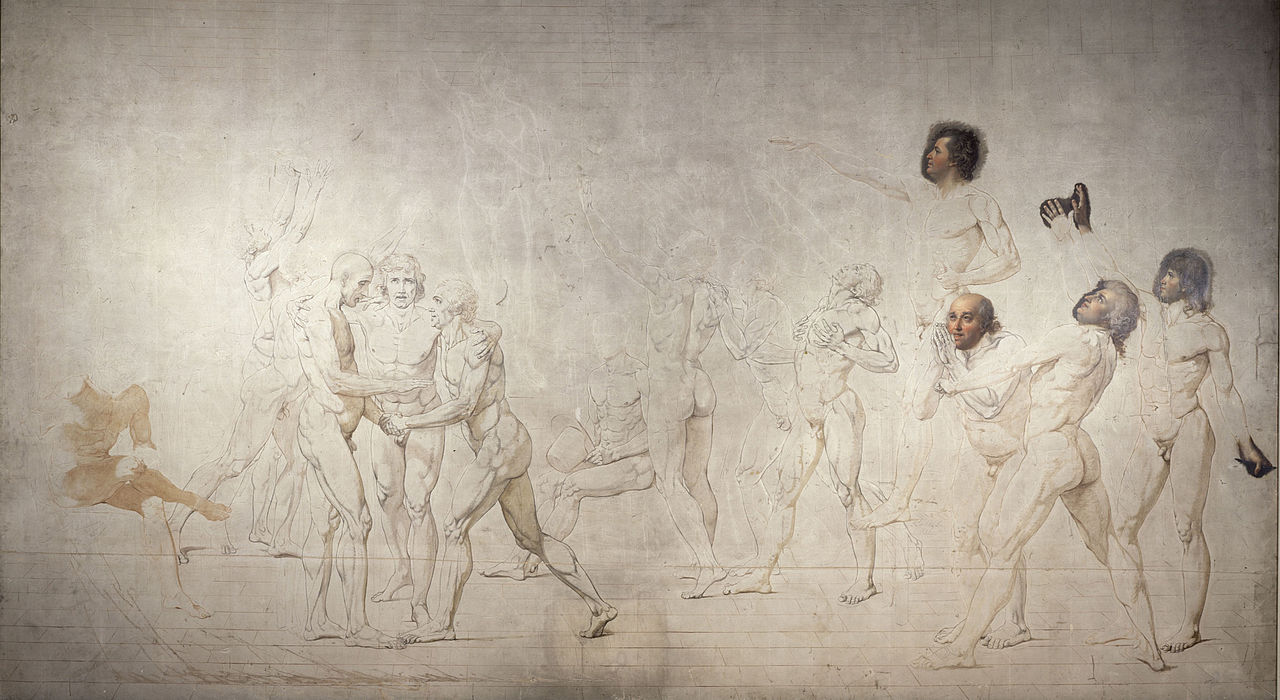
Due to the political unrest of the moment, Jacques-Louis David was unable to complete his painting of the Jeu de Paume Oath, which he had begun sketching in 1791 and 1792. While the players’ clothing is just as drawn, their exquisite physique lends them a heroic air. Like actors in a play, the deputies have been divided up into sections based on a made-up line. The focus is on Jean Bailly, the president of the Third State, who confronts the king’s representative. In the lower middle, a monk, an abbot, and a Protestant pastor stand together for the greater good of their country. The wind pushing the drapes in the upper left corner of the painting is a metaphor for the energy of the protesters who are blowing on the assembly. It’s like a revolutionary breeze from France (France Revolution).