In today’s world, it is almost impossible for an individual to develop an invention that will truly change our world. But famous physicist and computer specialist Tim Berners-Lee did this in 1990 and invented the World Wide Web (WWW).
World Wide Web, and CERN
Timothy Berners-Lee was born in London. Her parents were both computer engineers. Tim made circuits controlling model train sets as a child and later became interested in electronics. He studied physics at Oxford University. He made his first computer while he was a student. After graduating from school in 1976, he worked as a computer systems engineer at various companies.
In 1980, Berners-Lee worked for 6 months at the European Organization for Nuclear Research, which was founded in Geneva, Switzerland, and conducted research on particle physics. This organization is more commonly referred to as CERN, the abbreviation of its original name, “Conseil European pour la Recherche Nucléaire.” While at CERN, he created a personal computer system for storing and reusing information. The invention, which can be considered the pioneer of the internet, was called ENQUIRE. The ENQUIRE software was based on a system of hyperlinks that take a computer to another related document via the cross-references within the first document.
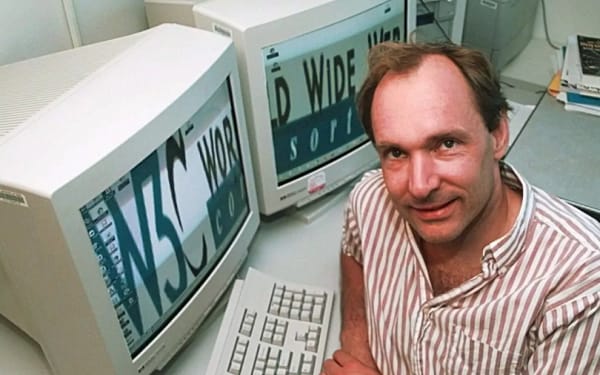
In 1984, Berners-Lee returned to CERN. He was disappointed by the incompatibility between documents created with different computer systems and different applications. In a brief note to his manager in 1989, Berners-Lee summed up his views on a “universally connected information system” to regulate the information produced on a large scale at CERN. He predicted that a structure designed in the form of a “connections network” would be much more useful than the existing “static, hierarchical system.” Thus, the documents found on the computers connected to the “CERN network” should have included hyperlinks to other documents, including other computers. In 1990, the manager gave his support to Berners-Lee to work on his ideas as a side project.
The first surfing on the web
In the autumn of 1990, Berners-Lee, along with his colleague, Belgian computer engineer Robert Cailliau (b. 1947), formed the essential elements of the World Wide Web of today. The universal language created for the software of linked documents—known as “web pages“—has become common with the abbreviation “HTML” (hypertext markup language). The software that responds to “requests” from hyperlink connections is called a “network server“. This term is also used for hardware on which web pages are located. The language or protocol used by computers to communicate with hyperlink requests is called “HTTP” (Hypertext Transfer Protocol). Berners-Lee also wrote the first web browser, the application that allows viewing documents held on network servers, called “WorldWideWeb.” Berners-Lee wrote and published the first web page on a server in December 1990. On the 25th of the same month, he made the first Internet “surf” from one web page to another via HTTP by clicking on a hyperlink in his browser.
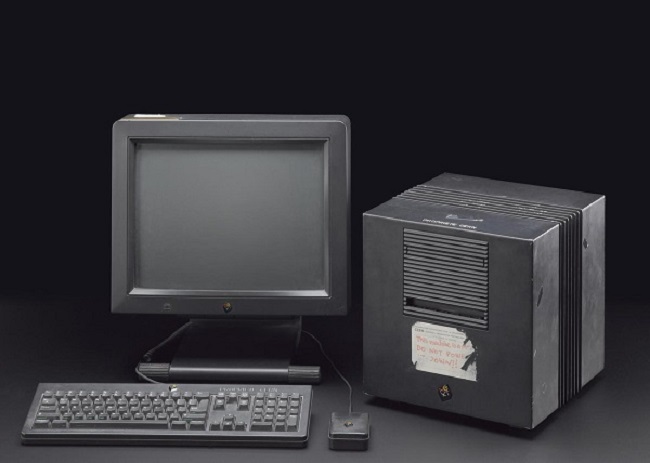
Berners-Lee’s first web page as well as the software needed to implement his idea are stored in this “NeXT cube” computer. The computer was connected to the local network in CERN. In the note affixed to the processing unit, it says: “This machine is a server. DO NOT POWER IT DOWN!”
URL
A year later, Berners-Lee introduced the network software he developed at CERN to the outside world, and his ideas were soon accepted. By 1994, the network became so widespread that a single “address” was required for each “resource” (for example, a document or an image) on the Internet. Having exchanged views with the network community, Berners-Lee created a format for network addresses: the URL (Uniform Resource Locator). After 1994, the network spread rapidly outside of academic and military circles. Within a few years, many people all over the world fell directly into the Network’s domain, and millions of people were already “surfing” from one document to another.
Tim Berners-Lee was praised for presenting his invention to the world without asking for any patent rights. In 1994, he founded the World Wide Web Consortium (W3C). The consortium aimed to maintain the functioning of the network without interruption and to assist its future development. On the other hand, Berners-Lee conducts campaigns to keep the internet “neutral,” that is, to connect any computer and not restrict its content.
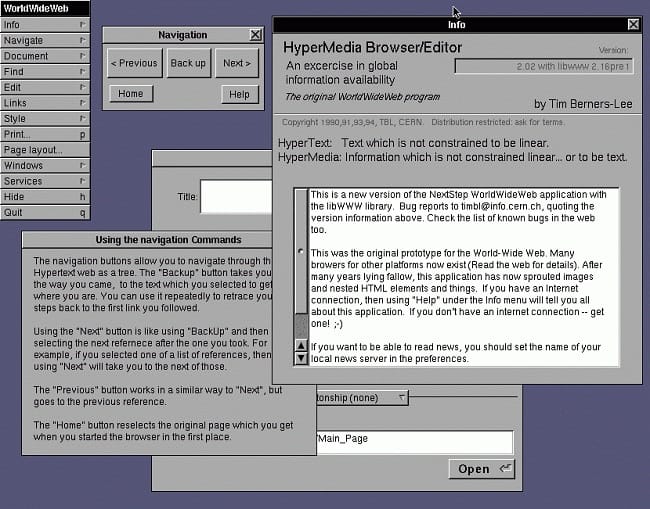
A screenshot of the first web browser was taken in 1994. Berners-Lee created the first browser specifically for use on NEXT computers, just like on the computer he uses at CERN. The pages written in “HTML” could be read and changed by the HyperMedia browser, linked pages could be viewed, and the linked computer could download the files.
Douglas Engelbart and the invention of the computer mouse
Tim Berners-Lee’s invention of the World Wide Web was supported by two key technologies: hyperlink and the computer mouse. American computer engineer Douglas Engelbart invented the computer mouse in 1967. Engelbart was also heavily involved in the development of hyperlinks. In the 1960s, Engelbart was the head of a team at the Augmentation Research Center within the Stanford Research Institute in California. Engelbart’s team was developing a “collaboration system” called NLS (On-Line System). The hyperconnections and the computer mouse that Engelbart invented in 1967 were used for the first time in this research. In 1968, Engelbart introduced NLS to a large community of computer experts. For the first time, ideas such as e-mail, video conferencing, and real-time collaboration of distant computer users, along with hyperlinks and the computer mouse, were introduced in a 90-minute presentation known as the “mother of all demos” today.