In the Hundred Years’ War, the Black Prince led the English to a decisive victory at the Battle of Poitiers (September 19, 1356), defeating the French king’s army that was three times greater. The meeting occurred at Maupertuis, which is southeast of Poitiers. John II, the Good, thinking he had learned a lesson from the defeat of the French knights at Crécy six years earlier, opted to meet his enemies on land, while the English hinted at a new military tactic by separating a company of archers. Transformed into infantrymen, the knights were handicapped by their heavy armor and inadequate weaponry and were slaughtered by the English. King John, who refused to retreat, and his son Philip were both taken during the battle’s climactic moments. The Valois kingdom was in jeopardy as a result of the new military tragedy that was about to rock France.
Learning from the defeat of Crécy
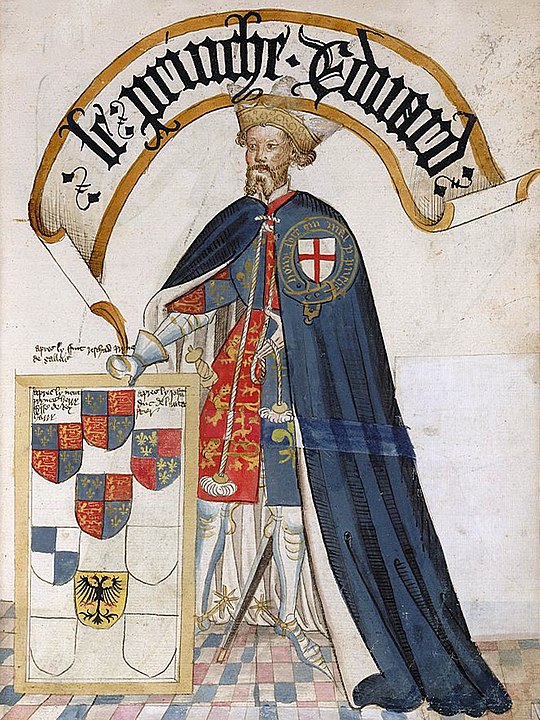
The renowned English “chevauchées” (a raiding method) increased in number after Crecy, challenging a French monarch who was virtually unable to stop them. Young Prince Edward III’s son, the Prince of Wales (later the Black Prince), was given the province of Guyenne and became infamous for plundering the region of Languedoc that year, 1355.
John II, king of France since 1350, learned the hard way from his father’s defeat at Crecy and made an effort to rebuild his armed forces on a more solid tactical footing, whether by reining in and organizing the chivalry or encouraging the use of the crossbow. As a response to Edward III’s Order of the Garter, a chivalric society, he established the temporary “Order of the Star,” his own image of the Round Table, whose knights, in line with a tactical heresy typical of the period, pledged never to retire before the enemy.
Preparations for the battle
While King John was busy with the troubles in Normandy in April 1356, the Black Prince led an Anglo-Gascon force north from Guyenne. The king mustered his vast army (about 30,000 men) and chased after the fleeing English, hoping to cut off their escape route at Bordeaux.
Maupertuis, located just south of Poitiers, served as the gathering location. The two armies met on September 18, 1356, a Sunday. King John, confident in his triumph thanks to his superior numbers and strategic location, agreed to the Sunday ceasefire requested by the Pope’s delegates.
In an effort to make his army more unified and well-disciplined than the feudal banners, he divided his troops into four distinct “battalions.” The Constable de Brienne, the Marshals of Clermont and Audrehem, and 300 specially picked troops would form the front line and lead the attack to “open and divide the archers.”
The majority of the army fought in two separate battles on foot in the second line, under the leadership of the Dauphin Charles and the Duke of Orleans. The “battle of the king,” which included the other French princes, was held in reserve. Equipment for the anticipated foot fight on the 19th was prepared on the evening of the 18th.
Battle of Poitiers (1356)
In order to get out of the French trap, the Black Prince’s inner circle, led by the clever Captain Jean Chandos, decided to march ahead of the royal army, concealed by the hedges at the edge of the woods. It was meant to provoke a reaction from the French so that the Welsh archers stationed on the column’s flank might annihilate the aggressor with their longbows.

The fords of the neighboring Miosson would provide safe passage for King John’s army and clear the way to Bordeaux if he withheld his forces. The front-line troops were led by Warwick, Suffolk, and Captain de Buch. To guard and advise him, Edward and Chandos commanded the center. Salisbury and Oxford closed the march.
King John wanted the Order of the Star to continue in the spirit he envisioned, so he delivered a powerful speech to its knights. Although the French were successful in the early skirmishes and even captured some Nassau soldiers, the Battle of Poitiers’ official start on the morning of the 19th was a disaster.
The English were marching in accordance with Chandos’ plan, but the French vanguard, unable to keep itself in check, abruptly bolted in opposite directions while the rest of the men remained in camp. “You will not be so bold today that you put the muzzle of your horse to the ass of mine” had said Clermont, who was killed in the assault, to Arnoul d’Audrehem (the Marshal of France). Constable de Brienne made a valiant effort to assault the lagging English column’s rear, but was ultimately unsuccessful.
The French troops, while engaged, charged headlong against the English. As a result of this initial victory, the latter group resolved to put up a fight. The archers wiped out the French on foot despite their superior numbers and weaponry.
Despite realizing that his triumph was at risk, the king sent a terrible signal of surrender when he ordered his sons to evacuate and kept just the young Philip with him. But he just couldn’t see himself making the break. Numerous knights abandoned their posts in imitation of the Crown Princes. King Chandos and the Black Prince, the last line of defense from here on out, rush to the front in their turn to launch an assault. Following a fierce hand-to-hand battle, the king surrendered with the future Duke of Burgundy at his side, having been vanquished but maintaining his knightly dignity.
The results of the Battle of Poitiers
France would have been in serious trouble if the Black Prince had become known as a brilliant leader in the Battle of Poitiers. In the aftermath of the nobility’s resounding defeat twice in a decade, the fragile peace of the kingdom was destroyed as the commoners accused them of cowardice. The future Charles V, a youthful dauphin who was more interested in literature than in battle, was thrust into the unenviable role of regent of a kingdom that was more fractured than ever before and would soon lose a fifth of its territory.
This apparently permanent peace, which was in fact a mere ceasefire in a still lengthy fight, was paid for in 1360 at the Treaty of Brétigny by the ransom of King John II, three million gold crowns, which was equivalent to two years of tax collection, and the cession to England of the south-west of the French kingdom.
Bibliography:
- Harari, Yuval Noah (1999). “Inter-frontal Cooperation in the Fourteenth Century and Edward III’s 1346 Campaign”. War in History. 6 (4): 379–395. doi:10.1177/096834459900600401. JSTOR 26013966. S2CID 59055741.
- Wagner, John A. (2006c). “Guines, Treaty of”. Encyclopedia of the Hundred Years War. Woodbridge, Suffolk: Greenwood. pp. 142–143. ISBN 978-0-313-32736-0.
- Jones, Michael J. (2019). The Black Prince : England’s Greatest Medieval Warrior. New York: Pegasus. ISBN 978-1-64313-229-7.
- Strickland, Matthew & Hardy, Robert (2011). The Great Warbow: From Hastings to the Mary Rose. Somerset: J. H. Haynes & Co. ISBN 978-0-85733-090-1.