Not even close. The writers who appropriated the Arthurian tale in the 12th century are responsible for creating these legendary Arthurian heroes. But across Europe, from the Middle Ages to the present day, King Arthur and his loyal knights of the Round Table have never ceased to exercise a profound fascination.
Wales is the birthplace of the Arthurian legend in the 9th century, while Western Europe is where the legend flourished around the year 1000. The tale of King Arthur had been passed down orally and in writing, in Latin and Welsh, for centuries until a clergyman of Welsh descent, Geoffrey of Monmouth, seized upon it in his “History of the Kings of Brittany” (“Historia Regum Britanniae”) in 1136.
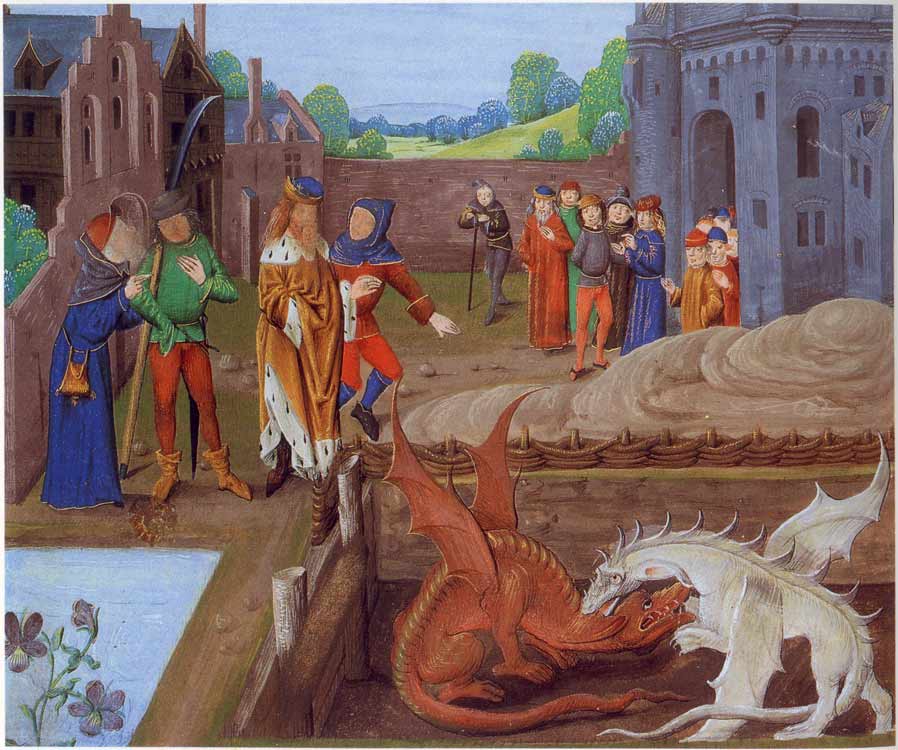
Before then, Arthur existed only in legend. Geoffroy de Monmouth immortalized him in print, and soon the fame of King Arthur spread throughout Europe. More than 200 copies of his “History of the Kings of Brittany” survived, making it the most widely circulated non-religious book written in Latin throughout the Middle Ages.
There was a resurgence of interest in the Arthurian cycle, which led to its adoption, translation, and enhancement. The legend of King Arthur and his brave knights inspired scores of works of literature and music, beginning in the 1150s and spreading throughout Western Europe.

From where did the legend of King Arthur and his noble knights originate?
The Arthurian knights you’re reading about don’t exist outside of literature. It was Geoffrey of Monmouth who rediscovered the Welsh and Breton heroes like Merlin, Guinevere, and Gawain and integrated them into the King Arthur story. Some were made up by Monmouth and his successors.
So, writers from the 12th and 13th centuries provided us with tales about Lancelot, Percival, and Morgan le Fay. A Norman writer called Wace created King Arthur’s Round Table and assembled his knights around it in 1155. His influence can be seen in the way that every author who continued the Arthurian legend adopted this picture, even if it meant introducing new knights each time.
Is it possible to say historically that neither King Arthur nor his knights ever existed? Since almost nothing survived from the 6th century, the historian accepts that maybe a king called Arthur really existed at the time. The information at hand, however, prevents us from drawing a firm conclusion.
It was a smash hit throughout Europe
Beginning in the 11th century, the whole ruling elite of Western Europe often referred to works of literature and art based on the Arthurian legend due to its tremendous popularity. In fact, they went so far as to host dinner parties disguised as the legendary Knights of the Round Table. In response to overwhelming popular interest, many new writers wrote books expanding on the Arthurian myth.
The adventures of the Knights of the Round Table were the subject of many chivalric romances. Staying true to the chivalric code, they vowed undying love to their lady, defended their monarch against monsters, giants, and pagans, and fought in combat. Shortly after that, a poet by the name of Robert de Boron picked up the mantle, fusing the Grail legend with Christian ideas to create an Arthurian narrative around religion.
Although King Arthur originated in Britain, the popularity of Arthurian writings written in Latin and French led to translations being published throughout Europe. Norwegian, Spanish, Portuguese, Icelandic, Occitan, Dutch, and Welsh are only a few of the languages that have their own translations.
English writer Thomas Malory, in 1460 with “Le Morte d’Arthur,” was the first author to compile the whole of the Arthurian cycle into a single work. It was a classic English-language chronicle of the Arthurian legend. By the time the printing press had made it to England, he had finished his book.
It was published right away, and it became a huge bestseller in bookstores. He took all the popular ideas from his predecessors, such as the Round Table, the Holy Grail, and the adulterous affair between Lancelot and Guinevere, and incorporated them into his own work.
Another legendary competitor for Arthur
However, King Arthur faced a formidable foe in the form of the flowery-bearded Emperor. During the Middle Ages, Charlemagne and Arthur were the two most legendary European rulers that everybody knew about. But it was difficult to draw comparisons between the two when just the first’s existence was established.
Charlemagne, as well, was a mythical character in the 12th century. As part of the legend of the Song of Roland, it was said that he not only fought at the Battle of Roncevaux Pass, but also embarked on a crusade and ultimately took control of Jerusalem. A number of European monarchs, including French and Germanic ones, claimed descent from Charlemagne. However, the English rulers couldn’t make the same claim since the Carolingian Empire never reached England.
So it’s no surprise that they looked to King Arthur for aid. For Christians, King Arthur exemplified what a monarch should be like. Everything hinged on how effectively Arthur ruled and how he treated his knights.
Throughout history, various English monarchs have used this depiction of King Arthur for official purposes. Edward I of the British Plantagenet dynasty, Henry VII of the first Tudor dynasty, and even Queen Victoria are all examples. Several sons of the English royal family were given the name “Arthur” to legitimize the monarchy’s hold on power. Even if none of them ended up becoming king or queen due to a chain of events.