In the traditional textbook model of astrophysics, stars and planets are born through two completely different processes: stars form when vast clouds of interstellar gas and dust collapse under their own gravity, while planets coalesce millions of years later out of the leftover debris swirling in a flat disk around that newborn star. By peering deep into the dusty stellar nursery of NGC 1333 with the unprecedented infrared sensitivity of the James Webb Space Telescope (JWST), astronomers have uncovered six enigmatic “ghost planets”—officially known as rogue or free-floating planetary-mass objects—drifting alone through the cosmos untethered to any parent sun.
Peering Into the Perseus Molecular Cloud (NGC 1333)
Located roughly nine hundred and sixty light-years from Earth in the constellation Perseus, the reflection nebula NGC 1333 is one of the most active, turbulent star-forming regions in our galactic neighborhood. In visible light telescopes like Hubble, much of NGC 1333 is hidden behind thick, opaque curtains of cold cosmic dust. Using Webb’s Near-Infrared Imager and Slitless Spectrograph (NIRISS), an international team of astronomers led by Adam Langeveld at Johns Hopkins University and Ray Jayawardhana looked straight through the dust veil to conduct the deepest census of sub-stellar objects ever performed in the cluster.
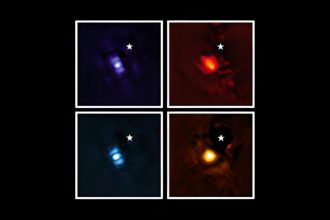
Scattered among the young stars, the team identified six newborn worlds possessing masses between five and fifteen times the mass of Jupiter that do not orbit any star at all:
- Too Small to Be Stars: Because these six worlds hold less than thirteen Jupiter masses of material, their cores never generate the crushing pressure and temperature required to ignite thermonuclear fusion of hydrogen or even heavy hydrogen (deuterium), which defines the lower boundary of brown dwarfs (“failed stars”).
- Born Like Stars, Sized Like Planets: Rather than forming inside a protoplanetary disk around a parent star and being kicked out by gravitational billiards, spectroscopic analysis proved these six worlds formed directly from the gravitational collapse of tiny, isolated pockets of gas—proving that nature can build planetary-sized objects in the exact same way it builds stars!
Finding the Absolute Bottom Limit of Star Formation
Perhaps the most astonishing discovery of the NGC 1333 survey wasn’t just what the Webb Telescope found, but what it didn’t find. Although Webb’s infrared instruments were sensitive enough to easily spot free-floating objects smaller than five Jupiter masses, the telescope detected zero objects below five Jupiter masses inside the nebula.
This sudden cutoff reveals a fundamental law of cosmic physics: five Jupiter masses appears to be the absolute smallest gas cloud capable of collapsing under its own gravity to form a standalone world like a star. Any gas cloud smaller than that lacks the gravitational pull to overcome internal gas pressure, meaning smaller worlds like Earth or Mars can only form inside the dusty protoplanetary disk orbiting an existing parent star.
Miniature Solar Systems Around Ghost Planets
Even more remarkably, the lightest of the six newly discovered rogue worlds—weighing in at roughly five Jupiter masses (about 1,600 times the mass of Earth)—was caught surrounded by its own glowing dusty circumplanetary disk.
Just as the early solar nebula around our infant Sun coalesced into the eight planets of our solar system, a dusty ring swirling around a giant free-floating ghost planet has the raw building blocks to form a retinue of rocky moons or mini-planets of its own—raising the breathtaking possibility of pitch-black, sunless miniature planetary systems drifting through the interstellar night, warmed only by the internal infrared glow and tidal friction of their giant central world.