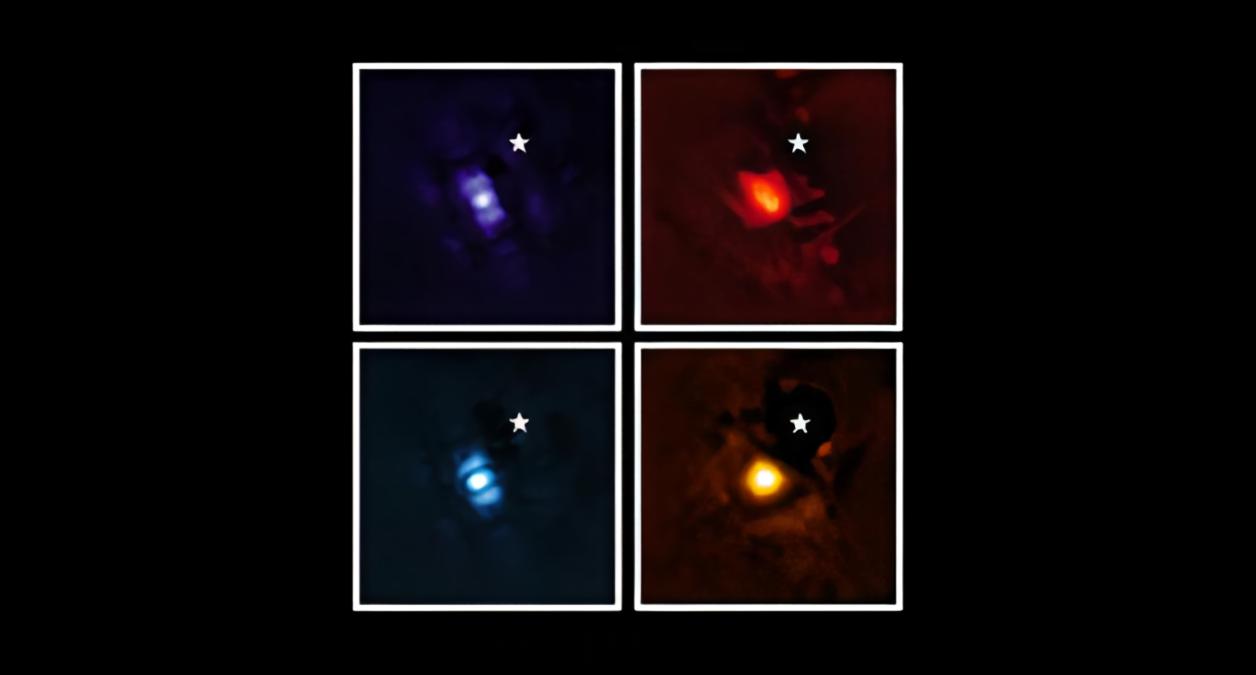
The James Webb Telescope has captured its first direct pictures of an exoplanet. More clearly than ever before, the infrared photos of the exoplanet HIP 65426 b, located 385 light-years away, indicate its capabilities. The gas giant, discovered in 2017, circles its star at a great distance and has six to twelve times the mass of Jupiter. This made it possible for the Webb Telescope to distinguish between its weak infrared radiation and the star’s brightness.
It is crucial that the James Webb Space Telescope currently function as expected since it is the biggest and most costly piece of astronomical equipment ever launched into space. Even its first photographs were groundbreaking, revealing the oldest known galaxies, the deepest infrared vision of space, and the first identification of carbon dioxide on an extrasolar planet.
Seeing A Young Gas Giant
© NASA/ESA/CSA, A Carter (UCSC), ERS 1386 team and A Pagan (STScI)
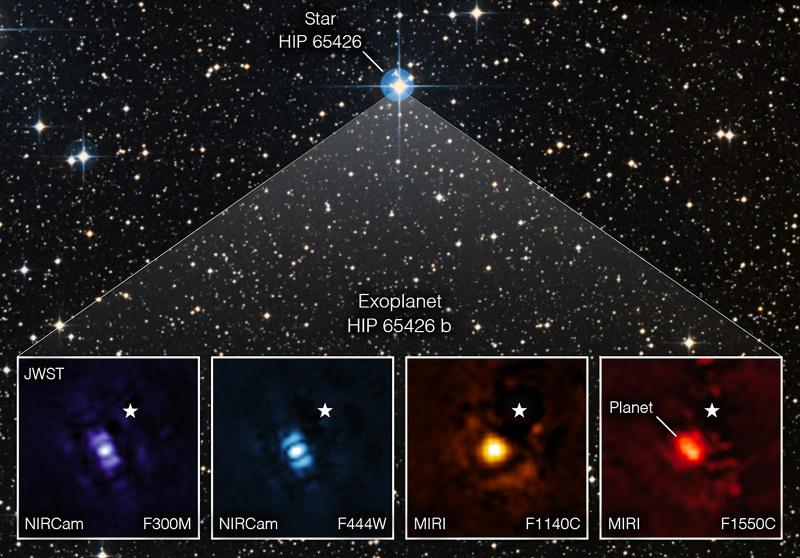
Another first has just been made with the creation of the first exoplanet picture by the Webb Telescope. The principal scientist for this sighting, Sasha Hinkley of the University of Exeter, calls it a momentous moment, not only for Webb but for astronomy in general. The planet in the image, HIP 65426 b, is located in the Scorpius-Centaurus association, which is dominated by young stars, and is located around 385 light-years from Earth. Additionally, the planet is just 10–15 million years old.
It is around 1.5 times the size of Jupiter and 6–12 times heavier than the planet. It was found in 2017 by the Very Large Telescope of the European Southern Observatory. Initial spectral measurements had previously shown that it was a gas planet with reddish clouds and water vapor in its atmosphere. Its surface is most likely between 1,000 and 1,300 degrees in temperature. HIP 65426 b is nearly 100 astronomical units away from its star which makes it especially ideal for a direct image.
10,000 Times Fainter Than Its Star
Two of the Webb Telescope’s optical instruments, the Near-Infrared Camera (NIRCam) and the Mid-Infrared Instrument (MIRI), were used to focus on the exoplanet for the portrait images. Both feature a coronagraph, which is a tiny mask that is placed over the brilliant star to prevent it from overpowering the planet’s weak light. That’s because the planet HIP 65426 b is thousands of times fainter in the mid-infrared and around 10,000 times fainter than its star in the near-infrared.
In these images, Webb coronagraphs were able to filter out the light from the parent star in an amazing way. The gas giant could be seen as a slightly different-shaped point of light in each of the four infrared channels through which the telescope viewed the planet. For astronomers like Aarynn Carter of the University of California at Santa Cruz, who was in charge of the image processing, getting these images was like discovering a treasure.
New Insight Into Extraterrestrial Planets
These pictures do not represent the very first direct views of exoplanets: The Hubble Space Telescope has already taken the first visible-light image of an exoplanet in 2008. In 2021, the youngest and smallest exoplanet planet has since been directly seen by the infrared telescopes of Hawaii’s W. M. Keck Observatory.
But new possibilities for understanding much more about these far-off planets are now emerging thanks to the Webb Telescope’s high-resolution infrared photos. Soon, there will be a ton more photos of exoplanets that will deepen our knowledge of their physics, chemistry, and genesis. We could even find previously unidentified exoplanets using this method.
Sources:
- NASA – Exoplanet Exploration: Planets Beyond our Solar System. (n.d.). Exoplanet
- Exoplanet HIP 65426 b in Near and Mid Infrared. (n.d.). Webbtelescope.