A hitherto unseen structure in the Sun’s corona, a dynamic network of interwoven plasma filaments, has been discovered by astronomers. Researchers claim in Nature Astronomy that a structure only observable in ultraviolet light could be found in the solar atmosphere’s middle layer, and that it contains key information about the slow solar wind’s origins. Scientists found that solar wind particles are accelerated by magnetic energy released when this plasma network interacts.
As the solar system’s driving force, the solar wind could strip planets of their atmospheres, change their surface chemistry, and distort their magnetic fields. At the same time, the heliosphere, which is a protective bubble encircling our solar system, is formed by the constant flux of charged particles and the solar magnetic field. However, the genesis of the solar wind is poorly understood despite its significance for our cosmic home.
New studies and calculations suggest that the fast, energetic portion of the solar wind originates from very hot, magnetic areas in the chromosphere, the lower solar atmosphere. The solar corona looks darker in UV light in these regions. Up until recently, however, the origin of the solar wind’s slower, steadier component remained unknown.
The first view of the corona’s central region
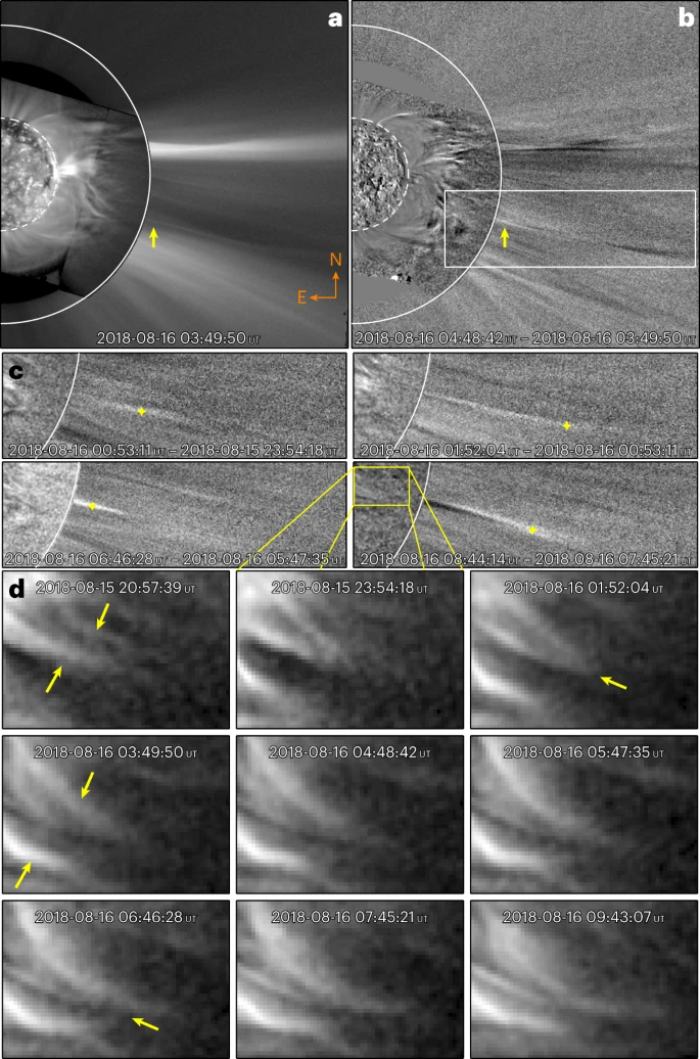
An observation of the solar corona has now yielded the first hints as to the cause of the sluggish solar wind. This is thanks to the first-ever imaging and analysis of the complete middle corona in UV light, which was made possible by the efforts of a team led by Pradeep Chitta. In the past, this layer, which starts at a height of around 220,000 miles (350,000 km) above the solar surface, went unnoticed since space missions and solar observatories mainly examined layers deeper or higher up.
To examine the middle solar corona in greater detail for the first time ever, it required the launch of just three new weather satellites of the U.S. GOES system. That’s because, in order to foretell space weather, they also carry UV cameras aimed at the Sun. After a particular measuring effort, scientists have examined the data obtained by these sensors.
Tangled network of plasma filaments
For the first time, photographs of this layer of the solar corona showed its intricate, dynamic structure. Threadlike, braided plasma structures were seen in the corona above locations where black coronal holes bordered zones of intense magnetic activity. Above their peaks, they discovered highly organized and varied streams of sluggish solar wind, indicating ongoing interactions and enduring remodeling in this coronal network.
Data from the Solar Dynamics Observatory (SDO) and the Solar Telescope Array (SOHO) showed that the plasma filaments in this coronal web seem to follow magnetic field lines, and that these lines continually cross and interact with each other. Initially disjointed magnetic structures converge and eventually shut into loops. Earlier simulations have indicated that energy is released during such magnetic reconnection processes.
Solar wind slowing mechanism
Scientists may have uncovered a key mechanism responsible for the sluggish solar wind. It’s because their research indicates the recently uncovered coronal network aids in the acceleration of charged particles in the solar wind. They postulate that the magnetic field’s structure gets conveyed to the sluggish solar wind and performs a significant function in propelling the solar wind particles into space at high velocities.
New observations of magnetic “switchbacks” in the solar wind by the Parker Solar Probe and the Solar Orbiter solar probes are consistent with the finding of the coronal network and magnetic reconnections in the core solar corona. These transient increases in the coronal magnetic field lines could possibly be the result of ongoing network changes in the corona.
The findings provide evidence in favor of reconnection-based theories of the weak solar wind. Additional data from the presently operational solar probes, as well as future missions, is needed to provide researchers with a deeper understanding of the processes occurring in the middle solar corona. As part of their mission, several of the future probes will carry sensors designed to study the middle corona.