Saturn’s rings and current wobble in its rotating axis may have their origins in a “lost” moon. The research claims that Saturn’s hypothetical moon Chrysalis was broken apart by Saturn’s gravity when it went out of orbit around the planet 160 million years ago. This altered the planet’s axial tilt, which in turn disrupted Neptune’s resonance and produced sufficient debris to create the rings. It’s possible that this is also the reason Saturn’s rings are not that old.
No other planet in the solar system has such a large and intricate ring system as Saturn. Recent measurements imply that the thick bands of frozen pieces only formed around 100 million years ago, rather than simultaneously with Saturn.
It’s a puzzle why the axis is tilted
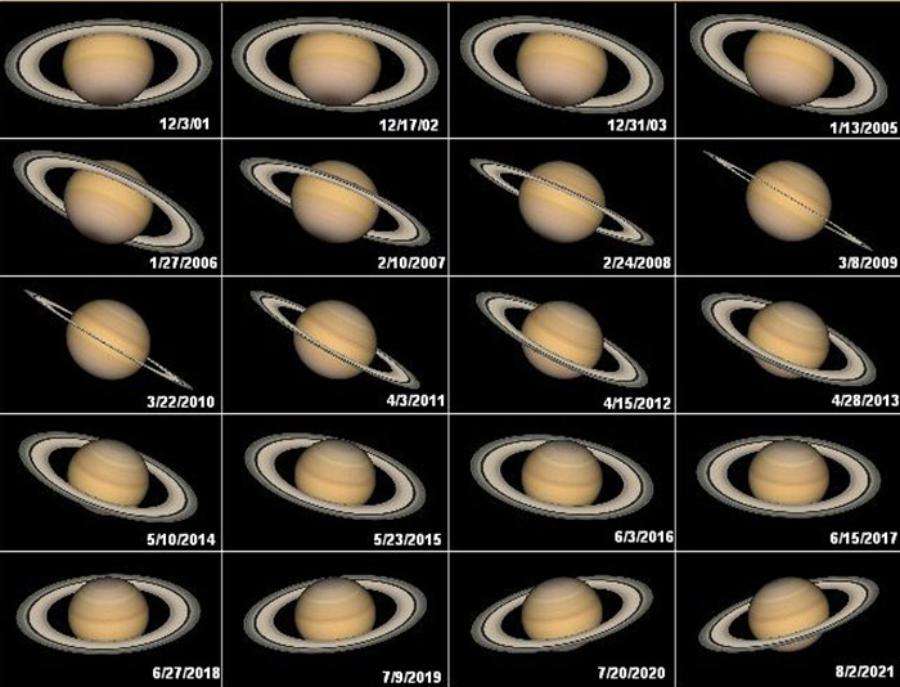
The rings and axis of rotation of Saturn are inclined 26.7 degrees with respect to the plane of its orbit around the Sun, giving it a somewhat powerful tilt. The known formation mechanisms in the protoplanetary disk or early collisions on the planet are insufficient to account for such a great inclination. Numerous hypotheses have been put forward, but none of them are very compelling.
There’s a suggestion that Saturn’s axial tilt is due to gravitational interactions with Neptune. As a result, Saturn’s axis wobbles nearly in time with Neptune’s orbital period, which may be indicative of a resonance effect. Scientists have assumed that Saturn’s rotational axis became as large as it is now due to a gravitational interaction between the planet and one of its moons.
To the limits of resonance
However, the angular momentum of Saturn is a vital quantity in determining whether or not the resonance theory is right. It affects how readily a planet may be knocked off of its orbit by natural or man-made disturbances. Neptune may be responsible for Saturn’s asymmetrical rotation if the angular momentum is too high. A decreased angular momentum, however, renders the whole situation implausible, necessitating the search for an alternative theory.
Jack Wisdom, Burkhard Militzer, and coworkers have recalculated Saturn’s angular momentum using a combination of observed data from NASA’s Cassini mission and theoretical considerations. Their finding was unexpected: the two planets do not resonate with one another. Regardless of the model assumptions or rotation period, the system is close to the resonance area but always outside of it. Their findings indicate a variation of about 1%.
Planetary scientists draw the conclusion from this that Saturn and Neptune were in resonance for an extended period of time. Nonetheless, this bond has obviously been compromised during the previous 200 million years.
Why is the moon Chrysalis missing?
But how exactly? The researchers used a model to replicate Saturn’s moon’s and its neighbors’ evolution to find out. Initially, they investigated whether the resonance break may have been caused by a shift in the orbits of Saturn’s moons. Although Titan, Saturn’s largest moon, has migrated further from the planet over time, this was not enough to disrupt the resonance between Saturn and Neptune.
If Saturn had a second moon in the past and subsequently lost it, the system could have been able to break free of resonance. It’s possible that this missing moon was swept away by a gravitational storm, or that it approached Saturn too closely and was shattered by the planet’s tidal forces. Each of these factors might disrupt the synchronization of Neptune’s orbit with Saturn’s axis.
Ejected from orbit
Based on their models, Wisdom’s team is able to piece together the following scenario: The new moon, Chrysalis, weighed nearly as much as Saturn’s third biggest moon, Iapetus. In theory, Chrysalis should be around 910 miles (1,470 kilometers) in circumference. Chrysalis’s orbit was predicted to lie between Titan and Iapetus, where it would have remained stable for a considerable amount of time. But then Titan started to move further and farther away from Earth.
The moon Chrysalis got into an unstable orbit due to this event sometime between 100 and 200 million years ago. In some simulation runs, this factor led to the moon being expelled from the system. The moon was ripped apart by Saturn’s tidal forces because it passed too near to the planet on previous orbits. Saturn would have lost resonance in either scenario.
Newly-formed ring explanation
Moreover, the rings were formed as fragments of the moon continued to circle Saturn. Their theory also explains the young age of Saturn’s rings, which has long been a mystery. Those icy rings might be what’s left behind from when Saturn had a huge ice moon. If the mythical moon Chrysalis existed and was eventually destroyed, it would account for a number of anomalies in Saturn’s system.
This explanatory mechanism for both Saturn’s proximity to a precessional resonance with Neptune and for its young rings seems quite plausible. Yet Wisdom and his colleagues acknowledge that further testing of the scenario is now necessary.