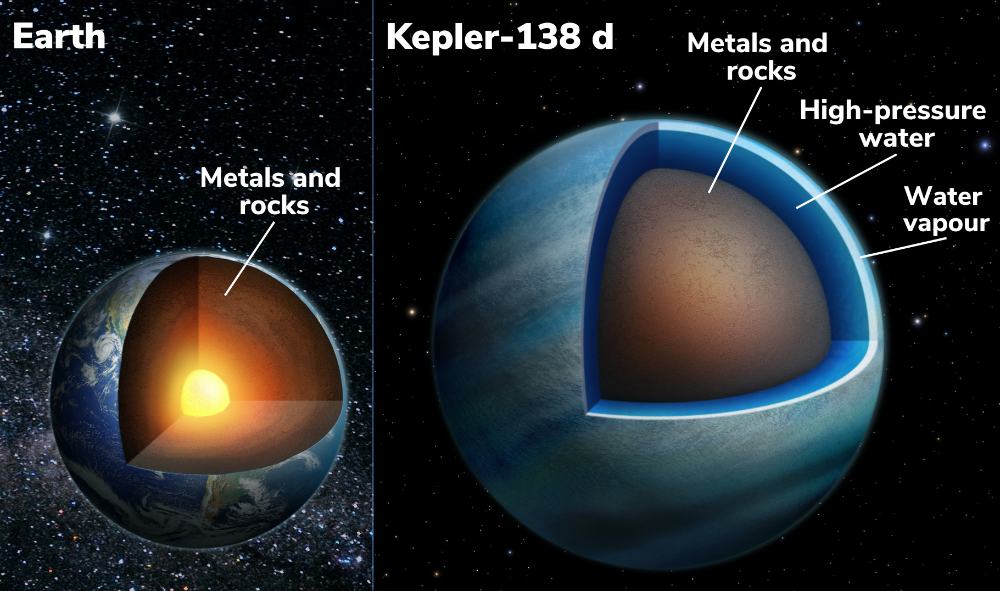
We now know that two super-Earths located just 218 light-years away are really ocean planets with no rocky interiors. They could be composed of mostly water and other easily evaporated compounds. The heated twin planets Kepler-138c and Kepler-138d presumably conceal an ocean roughly 1,243 miles (2,000 km) deep behind their dense vapor envelope, as researchers report in “Nature Astronomy.” The conventional wisdom on super-Earths has them being predominantly terrestrial big brothers of Earth; these exoplanets disprove that idea.
Super-Earths are hypothetical extrasolar planets that are 10 times heavier than Earth but else structurally quite similar. So far, astronomers have found a large number of instances of this kind of extrasolar planet. Super-Earths like TOI-1452b and K2-18b may contain an ocean larger than Earth. There are many more Earth-like planets that may be habitable as well. Water planets have been hypothesized to be more common in the Milky Way than rocky planets by certain scientists.
Earth’s oceans are only around 2.5 miles (4 km) deep
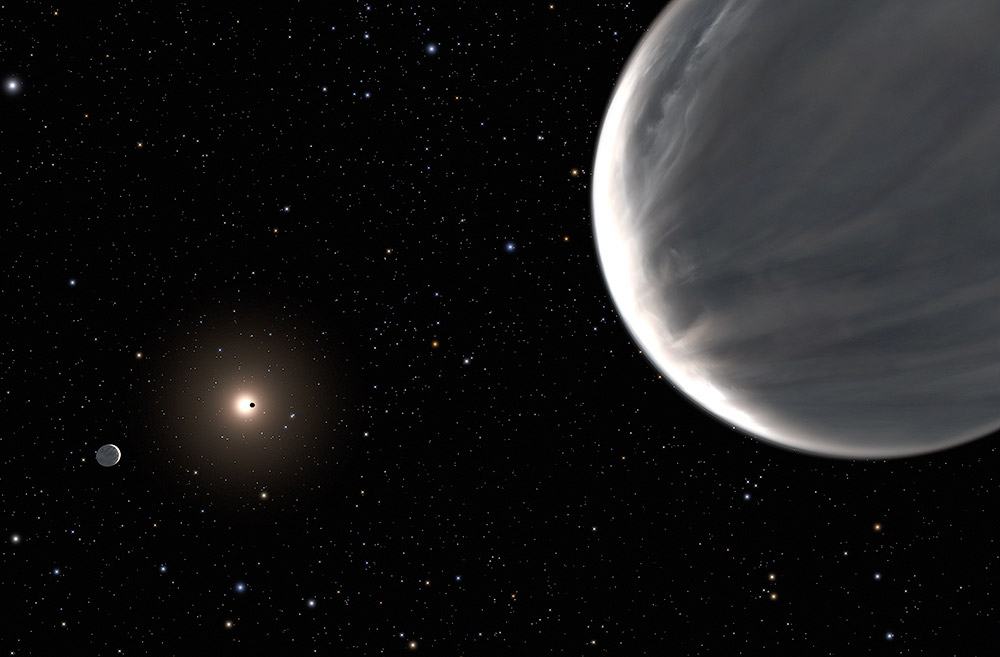
Observers headed by Caroline Piaulet of the University of Montreal have discovered two new ocean worlds. The red dwarf star Kepler-138 is around 218 light-years distant, and in 2014, the Kepler Space Telescope identified two super-Earths orbiting it. At the time, observations suggested that they were two approximately Earth-sized exoplanets with radii of 1.17 and 1.2 times that of Earth, respectively.
Kepler 138c and 138d are two super-Earths that circle their star in close proximity. Therefore, it is likely that their surfaces have equilibrium temperatures of 136 and 72 degrees Celsius; these are heated but not necessarily exceedingly hot planets. The other, innermost planet in this system has roughly the same mass as Mars and orbits much closer to the star. Details regarding the three planets were sketchy at best.
Less dense than expected
With the help of the Hubble and Spitzer space telescopes, scientists have seen 13 more transits of these planets. In addition, they analyzed information on Kepler-138’s radial velocity. This demonstrates the extent to which the gravitational influences of the circling heavenly bodies affect the star’s movements and, by extension, its mass. The density of the planets, in turn, may reveal their composition by using their size and mass.
A startling result emerged from the analyses. The two Kepler-138c and Kepler-138d super-Earths are less dense than expected, despite their large size. It follows that if these two super-Earths have the same kind of iron-rich core as Earth and the other terrestrial planets, then the remainder of their bodies must be rather lightweight. Kepler-138d has a little over 11 percent by mass and 51 percent by volume of volatiles, whereas Kepler-138c has a little less than 11 percent by mass but a little more by volume.
This, however, suggests that water makes up a significant portion of both worlds’ total mass. This is the first time planets have been definitively classified as water worlds. Data suggests that the super-Earth Kepler-138d may contain an ocean some 1,243 miles (2,000 km) deep, and scientists assume the same for Kepler-138c, which is extremely similar to Kepler-138d but slightly warmer.
Picture the ice moons of Jupiter and Saturn, Europa and Enceladus, but much bigger. Kepler-138c and Kepler-138d may have substantial water envelopes rather than icy ones due to their tighter orbits around their star. The water in these global seas is probably pressured to the point of becoming supercritical because it lies behind a thick vapor envelope that raises the surface pressure to extremes. Here, water has the density of a liquid but the viscosity of a gas.

Super-Earths with liquid water than rocky planets
The two super-Earths in Kepler-138’s neighborhood go against the grain of what we usually expect from exoplanets of this kind. Until recently, they have been seen as terrestrial, bigger equivalents to Earth. However, the existence of two ocean planets with a low density indicates that not all super-Earths need to be structured like Earth. This suggests there is significant diversity within the super-Earth population.
Light water planets with a large concentration of volatile compounds may instead make up a considerable part of super-Earths. There may be many more ocean worlds with a water content of 25 to 50 percent than rocky planets in our galaxy. In particular, several super-Earths and mini-Neptunes may satisfy the necessary conditions.
A fourth habitable planet
In addition, Piaulet and her team found evidence of a previously undiscovered fourth planet in the Kepler-138 system when analyzing the new data. Having a mass of just around 0.43 Earths, this planet is far less massive than its inner neighbors, and it may be located inside the red dwarf’s habitable zone. Unfortunately, more precise information on the size and composition of Kepler-138e is still lacking since the planet does not transit in front of its star.