Late this night at about 1:47 am ET, the Artemis-1 mission lifted off – it is now on its way to the Moon. The 320-foot-tall (nearly 100 meters) Space Launch System – the most powerful launch vehicle ever built – and the Orion space capsule, which was partially built in Europe, will orbit the Moon and then return. The still-unmanned lunar mission serves as a dress rehearsal for the manned return to the Moon, with only three dummies on board this time.
50 years after the last Apollo mission, the Earth’s satellite has once again become the target of manned space flight. With the Artemis program, the USA and Europe want to land humans on the Moon satellite again by 2025. This time, a space station in lunar orbit and later a lunar base are intended to enable a long-term presence of astronauts on the Moon. But other nations – including China in particular – also have their eyes on the Moon and are preparing a manned return to the Earth’s satellite.
Launch finally successful
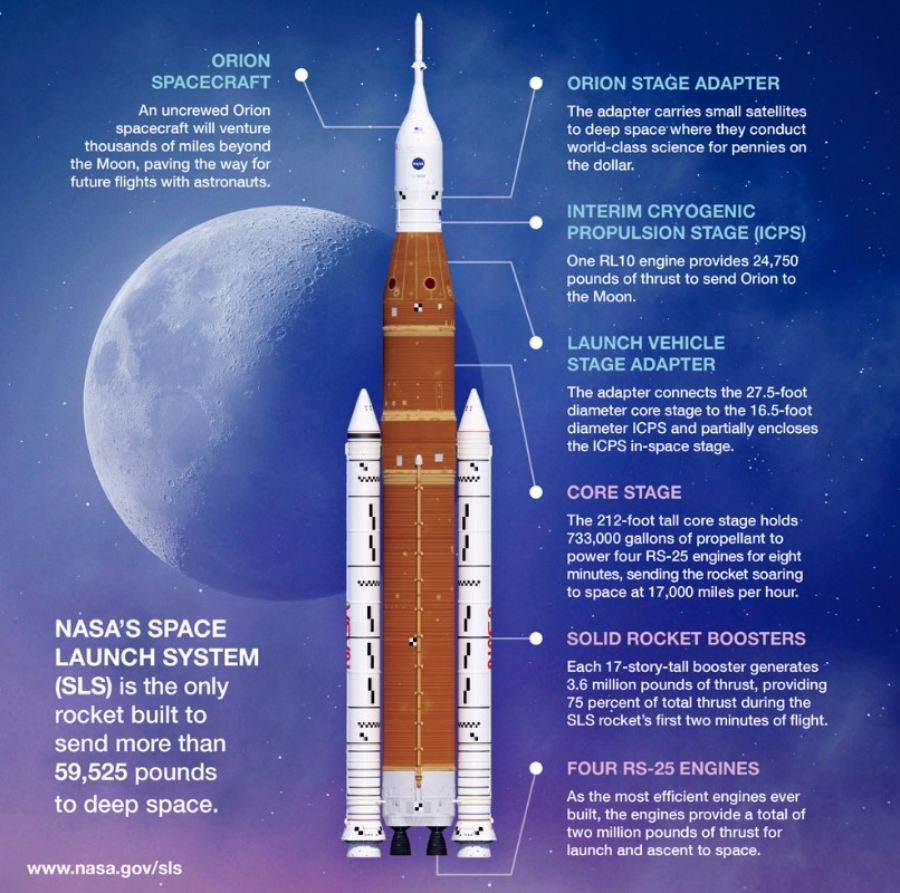
Artemis-1 launched to the Moon from Cape Canaveral on November 16, 2022, at 6:47 am UTC. The countdown and launch were broadcast live by both ESA and NASA. For the first time, the Space Launch System (SLS) launch vehicle developed by NASA specifically for lunar missions and the Orion capsule designed and built in Europe will now fly together to the Moon, orbit it, and return to Earth.
But the development of the SLS in particular had its difficulties: its completion was delayed by years and in 2022 there were repeated problems with refueling – the launch of Artemis-1 had to be postponed several times. The excitement with which the launch of the giant was followed around the world was correspondingly great. Powered by four engines fed with liquid hydrogen and oxygen and two solid rockets, this 321 foot-tall vehicle is the most powerful launch vehicle ever built. It surpasses even the legendary Saturn-V of the Apollo missions.

The “crew” of Artemis-1
On board the Artemis-1 mission is a crew of a special kind. Three dummies are taking part in the first lunar flight of the Artemis program and, with the help of numerous sensors and measuring instruments, recording the stresses to which human astronauts will be exposed. The pilot dummy, named “Moonikin,” will test not only sensors for radiation, vibration, and pressure forces, but also the space suit that the astronauts will later wear during critical mission phases.
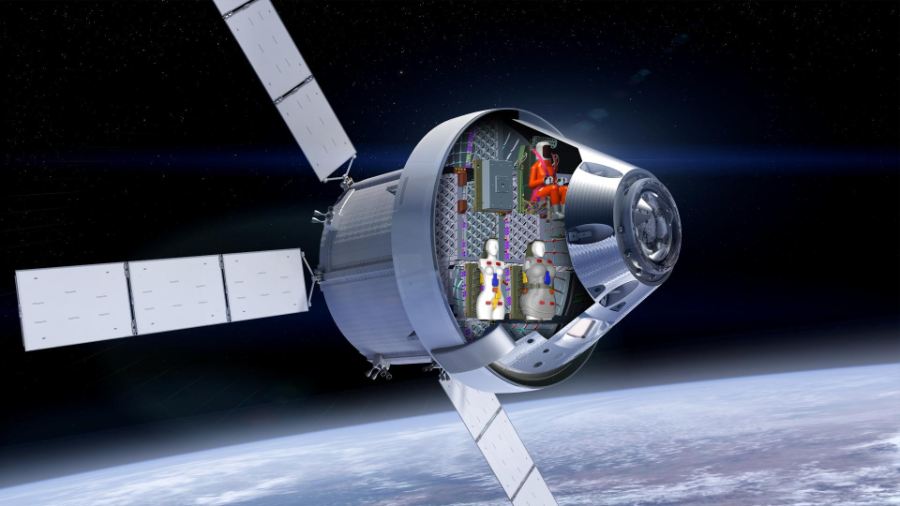
The two passengers, “Helga” and “Zohar,” are torso dummies whose materials are modeled on those of the female body – because the next Artemis flights will be the first time female astronauts fly to the Moon. Zohar wears a special radiation protection vest, while Helga does not. Several thousand radiation sensors determine the level of cosmic radiation to which the dummies are exposed during the flight.
The flight to the Moon
The SLS launch vehicle is designed to accelerate the Orion module to a good 22,350 miles (36,000 kilometers) per hour. After about eight minutes, the solid rocket boosters and the four engines of the first rocket stage burn out and are jettisoned. Artemis-1 first reached orbit around Earth and the Orion capsule deployed its two solar sails.
Next, to give the spacecraft the thrust it needs to leave Earth’s orbit and fly to the Moon, the rocket’s upper stage, called the Cryogenic Propulsion Stage (ICPS), kicks in. Its engine, also fed by liquid hydrogen and oxygen, puts the Orion spacecraft on a lunar course. About two hours after launch, the Orion capsule separates from the ICPS burn stage. The Orion capsule now receives enough thrust to continue on its own to the Moon.
Meanwhile, the ICPS releases ten mini-satellites, known as CubeSats. These carry various small measuring instruments and sensors with which they investigate, among other things, the lunar surface and the radiation, particles, and magnetic fields between the Earth and the Moon. One CubeSat is also designed to land on the Moon, and another will fly to a near-Earth asteroid using a light sail.
Around the Moon and back
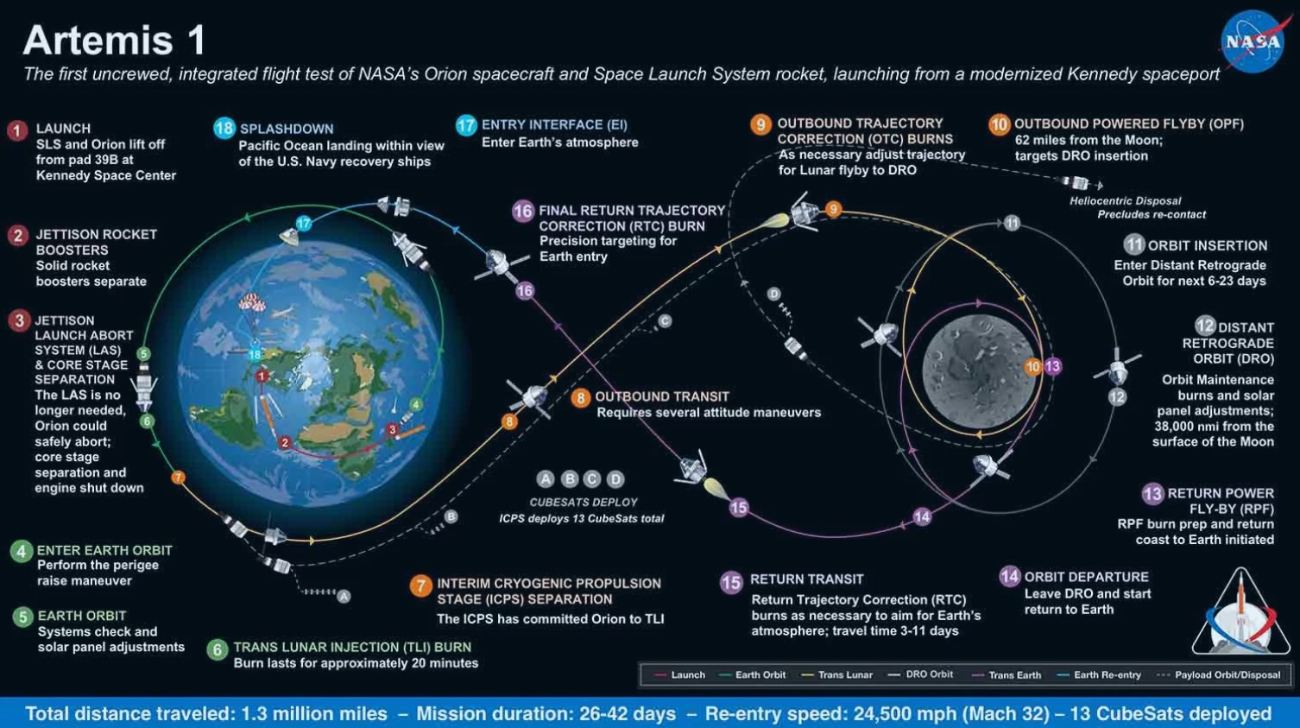
The Orion capsule needs several days to reach the Moon. On the sixth day after launch, it is expected to pass the closest point to the Moon on its trajectory: It will fly over the lunar surface at an altitude of around 60 miles (100 kilometers). The space capsule will then ignite its propulsion jets to enter an elliptical orbit around the Moon. This takes Orion around 40,000 miles (64,000 kilometers) above the Moon. It will then be about 280,000 miles (450,000 kilometers) from Earth – farther than any spacecraft designed for manned missions before it.
To bring the spacecraft back out of lunar orbit and on course to Earth, the engines of the Orion service module will be fired again about a week later. 26 days after launch, Orion will reach Earth again and enter the Earth’s atmosphere. This marks the beginning of the crucial test for the Orion module’s newly developed heat shield.
Re-entry and landing
Because the capsule will enter Earth’s atmosphere at nearly 25,000 miles (40,000 kilometers) per hour during its return to Earth, it will heat up to nearly 5,000 degrees Fahrenheit (2,800°C)—far more than it would if it were returning from the International Space Station in low Earth orbit. The Orion heat shield, like the Apollo lunar missions, therefore uses a material that is consumed by the heat but allows little of it to pass through to the capsule. An additional layer of insulation and cooling systems in the walls of the spacecraft ensure that the Orion capsule is not damaged.
After the heat shield and the friction of the atmosphere have slowed the space capsule from about 25,000 miles to 300 miles (40,000 to 480 km) per hour, the first pair of special parachutes is triggered at an altitude of about 25,000 feet (7,600 meters). A short time later, the three large main parachutes take over and allow the capsule to glide gently down to the sea. The landing site is not far from the California coast in the Pacific Ocean.
The next steps in the Artemis program
If the flight of Artemis-1 is successful, the next manned steps in the Artemis program will now follow. The follow-up mission Artemis-2 is expected to take place in 2024. For the first time, four humans will then fly to the Moon in the Orion capsule and orbit it on a similar trajectory to Artemis-1. Unlike Artemis-1, however, this mission will probably not enter a lunar orbit, but will fly an eight-shaped loop in which the spacecraft is deflected by lunar gravity alone and returned to Earth’s course.
Artemis-3—probably in 2025 or 2026—will be the first time humans set foot on the Moon. On this mission, two astronauts will fly down to the lunar surface with a landing module and land. The remaining two astronauts will remain in lunar orbit. Whether all this will happen, however, depends crucially on how the dress rehearsal for the Artemis-1 mission goes.