On 1969, the first man landed on the Moon. Missions planned for the Moon landing required long preparatory works because getting from Earth to the Moon was not going to be in a straight line. During this time, the space agency not only developed the necessary technology for space flight but also had to find the best possible route to the Moon. This is because, unlike on Earth, the start and end points in space change their position relative to each other during the course of a journey. But everything is in constant motion: The Earth revolves around itself and orbits the sun. And the destination – in this case, the Moon – also revolves around the earth and, together with it, around the sun.
A Curvy Trajectory
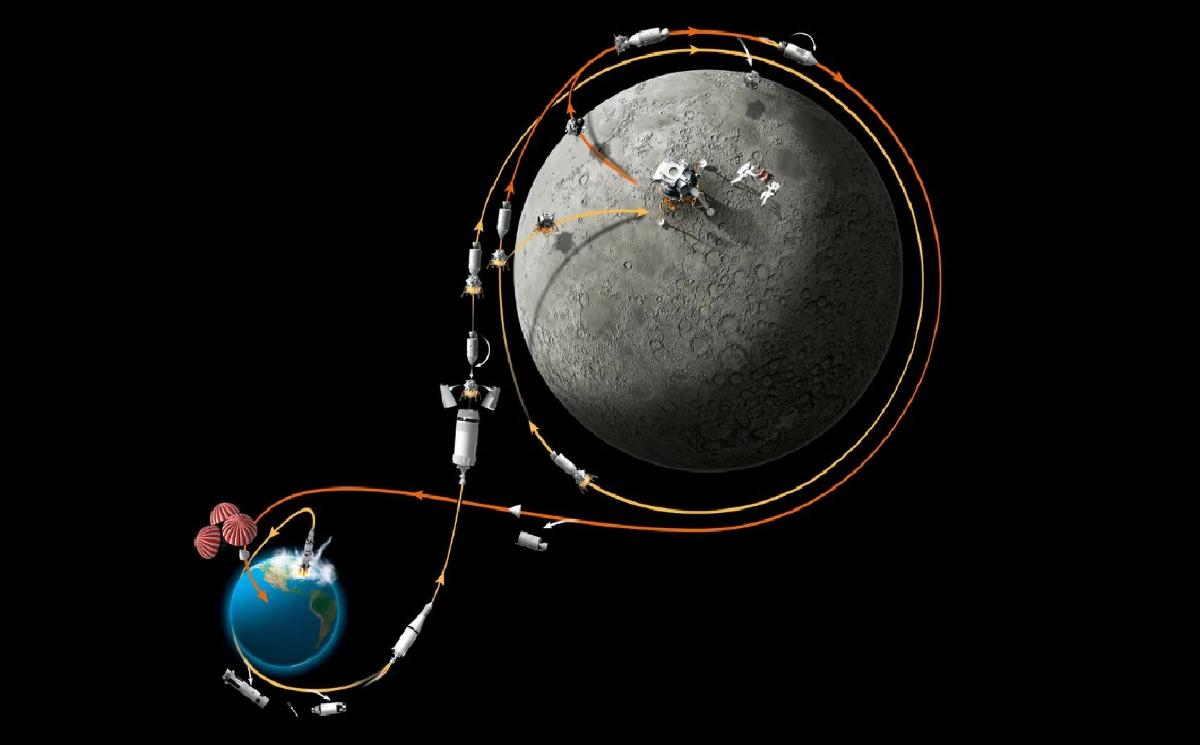
Couldn’t a rocket still simply fly from the Earth directly to the Moon? Physically, there is nothing to be said against it. But such a flight would require an extremely powerful engine and a lot of fuel. And so space scientists are trying to make the best possible use of the celestial bodies’ own motions and gravitational forces to save some energy.
This starts with the launch: Rockets are preferably launched into space near the equator and in the direction of the Earth’s rotation. This alone gives a rocket a speed of 1040 miles (1674 km) per hour. However, for a typical orbit around the Earth at an altitude of 185 mi (300 km), a spacecraft must reach a speed of 17.400 mi (28.000 km) per hour.
In order to get from an Earth orbit to a more distant one like the Moon – in the most energy-saving way possible, there are different ways. One is the so-called Hohmann orbit: This is an ellipse with the Earth at its focal point. The point closest to the Earth in this ellipse touches the original orbit around the Earth, and the point farthest from the Earth in the ellipse is in the desired orbit – the orbit of the Moon. Already in 1925, the German space pioneer Walter Hohmann described this transition between two orbits in his book “The Attainability of Heavenly Bodies”.
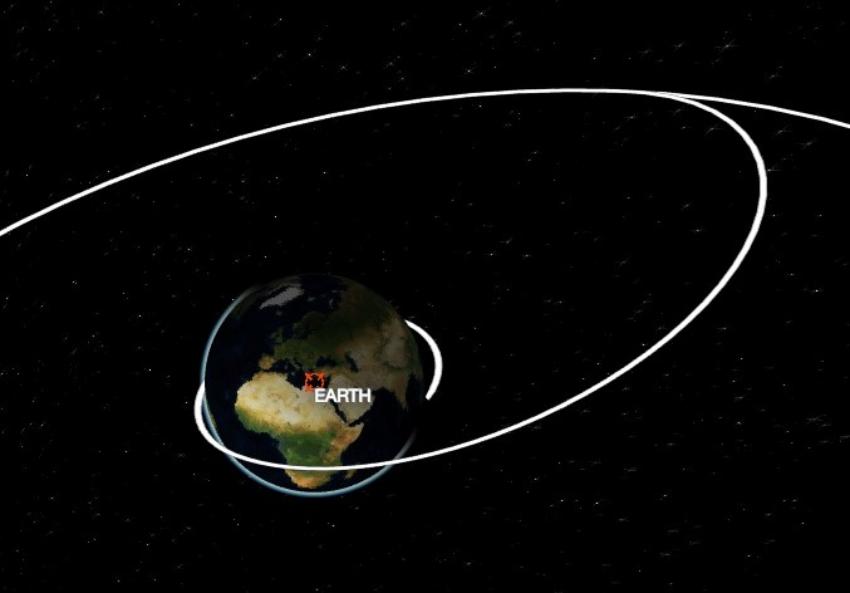
To reach such an elliptical orbit leading to the moon, the spacecraft must be accelerated to a speed of about 24.850 mi (40,000 km) per hour. The thrusters must ignite at exactly the right moment so that the Hohmann orbit actually intersects with the moving Moon at the furthest point from Earth. This flight maneuver was both technically and computationally challenging in the 1950s and 1960s. Any smartphone today is a million times superior to the NASA computers used for the Apollo missions. And getting into orbit around the Moon or landing smoothly on the Moon requires following an even more complicated trajectory.
Why Do Space Rockets Not Go Straight Up?
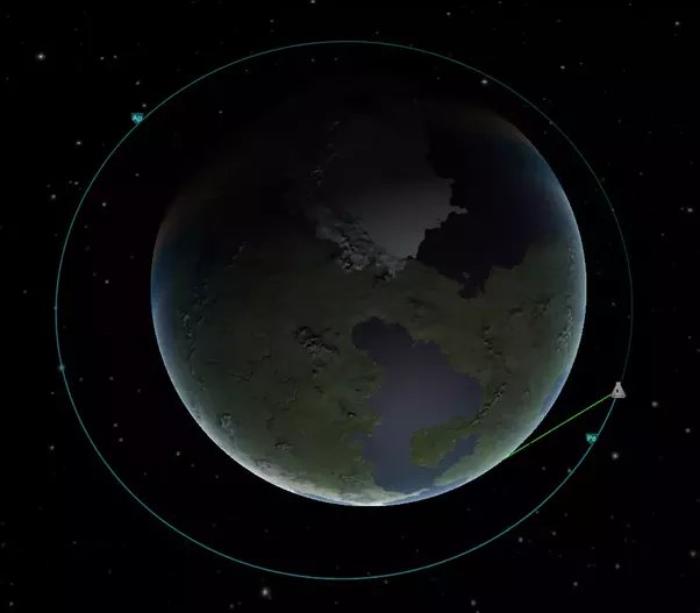
Reaching orbital velocity, which is around 20 times the speed of sound, is the most challenging component of space travel. At first, rockets make a wide arc to get away from the takeoff site, and then they begin gaining horizontal velocity. Their precise trajectory is a careful balancing act between the forces of gravity, air resistance, and aerodynamic loading.
When a rocket points vertically upward, gravity acts in the other direction, slowing it down. To reduce this, rockets are launched at an angle immediately after leaving the launchpad.
In order to enter orbit, or a circular route of motion around the Earth, rockets must tilt to the side as they ascend into the sky. A gravity turn is a steering maneuver that makes advantage of the Earth’s gravity to assist save rocket fuel and lessen stress on the spaceship. To aid the spacecraft bend its course into orbit, the spacecraft is rotated until its heavier side is facing down.

Numerous Attempts Until the Landing
The Apollo astronauts’ journey to the Moon took three days and four hours. A short flight time is a decisive criterion for manned missions because it means less radiation exposure for space travelers. For unmanned probes, flight time plays a minor role. Flight routes that take months but cost little in terms of energy are also conceivable. Such orbits initially usually lead far out of the Earth-Moon system and make use of the gravitational pull of the Sun to finally head to the Moon.
Another major advantage of the space probes is that they approach the Moon at a relatively low velocity, which means that only minor corrections are required to enter an orbit around the space object.
There have been a total of 124 known attempts to fly to the moon. Of these, 55 failed in a variety of ways, from explosions on launch to unplanned crashes on the Moon. However, it is possible that some failed flights have not entered the official records. As part of NASA’s Apollo program, there were nine flights to the Moon and six successful Moon landings from 1968 to 1972 – a total of twelve people have walked on the Moon’s surface.
In numerous attempts, the space agencies slowly felt their way toward the moon: After several false starts, the Soviet probe Lunik 1 raced past the Moon on January 4, 1959 – at a distance of about 3730 mi (6000 km). On September 12, 1959, Lunik 2 was the first space probe to hit the Moon. The first soft landing on the Moon was made on February 3, 1966, by Luna 9, also a Soviet probe, and on April 3 of the same year, Luna 10 swung into orbit around the Moon for the first time. On December 24, 1968, Apollo 8 was the first manned spacecraft to reach the Moon, orbiting it a total of ten times within twenty hours. And just seven months later, NASA’s Apollo 11 was the first manned lunar landing.