Whether it’s a twin in space, Achilles racing against the tortoise, or Schrödinger’s cat, scientists and philosophers have been using thought experiments for thousands of years to illustrate abstract concepts or make open questions more vivid. To this day, such analogies are important tools of science.
Many famous thought experiments are still used today to convey complex and abstract concepts, and are even part of the school curriculum. But such thought experiments are also helpful for researchers to approach a solution to their problem. In modern science, computer simulations now often take over the role of such virtual scenarios or help to concretize and verify thought experiments.
Spaceman twins and an ancient turtle
Twins and a spaceship that is almost as fast as light. One of them travels in his spaceship at breakneck speed through the galaxy, and the other stays at home. When the space traveler returns after a long time, he is surprised to find that his twin brother on Earth is now years older than he is.
Analogy for real phenomena

Of course, this is not about a real event. The so-called “twin paradox” is a thought experiment. It was invented a good 100 years ago by Albert Einstein, who used it to illustrate the consequences of his theory of relativity. It states that time can be stretched by acceleration and gravity, a prediction that results from the absoluteness of the speed of light.

The stretching of time described in the twin paradox has been proven experimentally ever since – first by measuring time aboard an airplane. In the meantime, highly accurate atomic clocks can measure these effects down to tiny fractions of a second. Because the atomic clocks on board the GPS satellites are also subject to time dilation, satellite navigation would not work without taking this principle into account.
Thought experiments since antiquity
Thought experiments are a tool of the imagination that help you look at the nature of things from new angles. They are usually done because an actual experiment is not possible, whether for physical, technological, financial, or ethical reasons. Sometimes thought experiments illustrate very abstract concepts and thus contribute to the process of understanding. They’ve been around since ancient times, in all fields: philosophy, but also economics, history, mathematics, and the natural sciences, especially physics.
Achilles and the tortoise
One of the most famous thought experiments of antiquity came from the ancient Greek philosopher Zeno of Elea, who described it in the 5th century BC. It has puzzled generations of thinkers ever since. The story goes like this: Achilles, the fastest runner in the ancient world, is challenged to a race by a tortoise. Sure of his victory, he gives the turtle a head start. The race starts, and both run off.
But when Achilles reaches the turtle’s starting point, the turtle has already covered another stretch of road. Achilles must therefore overcome this stretch before he can overtake the tortoise. But if he has succeeded, the turtle has again gained a smaller lead. The lead of the turtle thus becomes smaller and smaller, but it always remains a lead. Achilles can thus never catch up with the tortoise and thus never overtake it.
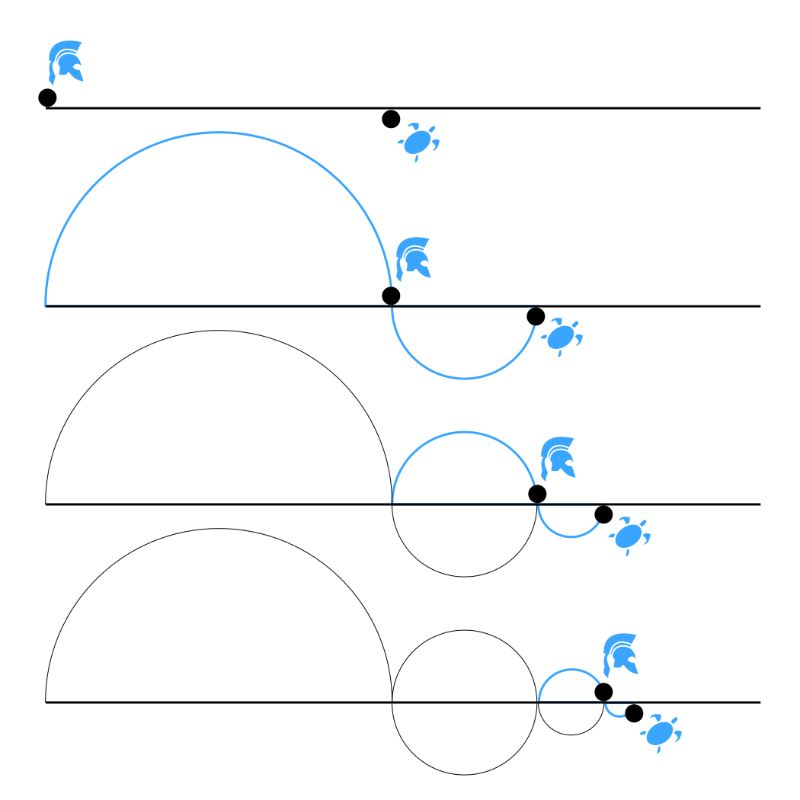
Obviously, any amateur runner would overtake the tortoise with ease, but Zeno’s logical reasoning is not so easily shaken.
Thought experiments of quantum physics
That thought experiments can help to understand processes better is also shown in quantum physics. Because objects do not behave there as we know them from everyday life. They do not assume a tangible, stable state, but obey the laws of probability.
So an atom, for example, in terms of its decay, is in a so-called superposition of states. It has decayed and not decayed at the same time, as long as we don’t observe it. This is also the point of the famous thought experiment about Schrödinger’s cat, which can be dead and alive at the same time.
Schrödinger’s cat: Dead and alive at the same time
In this world-famous 1935 thought experiment by Austrian physicist Erwin Schrödinger, a cat is placed in a box. To this is added a small amount of a radioactive substance, a detector, and a jar of poison. Then the box is closed. If even a single atom of the substance decays, the detector strikes and automatically releases the poison, and the cat dies. But it is equally possible that no atom decays. In this case, the cat remains alive.
As long as one does not look into the box, the cat’s state is undetermined; it is both alive and dead at the same time. Of course, a cat cannot be dead and alive at the same time. However, an unobserved atom can certainly be in two states at the same time, according to the rules of quantum mechanics. Scientists have already demonstrated these superposition states in photons, electrons, and molecules. A mobile version as well as a “quantum cat” that sits in two boxes at the same time have also already been implemented.
The enigma of entanglement
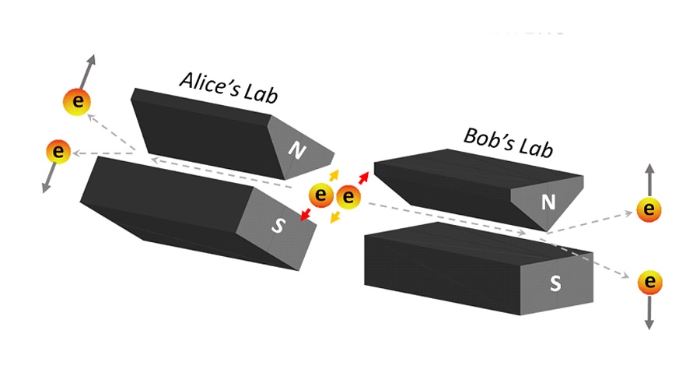
Quantum scientists use thought experiments as hypotheses that they then test with scientific tools. They, for instance, use computer simulations to better understand a particular phenomenon in quantum theory: quantum entanglement. This was described in 1935 in a thought experiment called the Einstein-Podolsky-Rosen paradox (EPR paradox). Quantum entanglement means that two particles are linked together, even if they are far apart.
But how does this linkage work over such great distances? How do the particles know about their respective states? Do they exchange information, and “communicate” with each other? Albert Einstein doubted this possibility to the end, famously calling quantum entanglement “spooky action at a distance.” This is because it would mean that information is exchanged faster than the speed of light.
Not all of his colleagues agreed with Einstein—to this day, there are a variety of different interpretations of how quantum entanglement works. Discussions about it have filled countless books, journal articles, and now Internet sites for 80 years.
Mind games on the computer
With the help of their computer simulation, scientists checked the thought experiment and found that Einstein might have been right: There must be causes other than “communication” for the states of entangled particles to affect each other. Being able to use computer simulations to verify thought experiments is a major, relatively recent advantage for science.
With a computer simulation, we can play with particles and test hypotheses in a kind of protected setting. We can look at everything without affecting or even destroying our object of study. That’s often different in the lab. There, the necessary apparatus—for example, particle sources and detectors—must also be implemented in a technically correct way. That can’t always be realized.
Laboratory experiments have also been conducted on the EPR paradox since the 1970s. It is always difficult in this situation to unambiguously assign two particles to a linked pair. For example, particles that do not belong to the experiment at all, such as cosmic rays, can be mistakenly registered. In addition, procedures are necessary in the laboratory that Einstein never intended in his thought experiment. Both lead to false conclusions, as scientists were able to prove. In a simulation, scientists can precisely control all these framework conditions.
Thought experiments on AI
Thought experiments can also influence and stimulate research. Take the “Silicon Brain” thought experiment, for example: in a person’s brain, each neuron is replaced one by one by an electrical circuit. One after the other. In the end, the biological brain would be replaced by a technical one. Would the human being still be the same in the end, with the same consciousness?
How does the brain work?
This is just one of a whole series of thought experiments dealing with the human brain. They often deal with complex and sometimes highly philosophical topics such as consciousness, artificial intelligence, or the role of sensory impressions. However, there is always a fundamental question behind it: How does the human brain work?
Thought experiments show where assumptions and hypotheses ultimately lead, especially when you think beyond what you can actually do or determine in practical terms. Because, of course, a thought experiment like the Silicon Brain can’t be tested in the lab. And physicists also use computer simulations for their research.
100,000 neurons in the computer
Researchers are working on a simulation of the human brain. They describe a nerve cell with a few equations and use them to build networks that should be as similar as possible to the human brain. They believe that the cooperation of the nerve cells in a network is what’s really interesting here.
Scientists spent years simulating a cubic millimeter of a human brain: About 100,000 cells, each with about 10,000 contacts leading to other cells. The philosophical question of consciousness naturally takes a back seat for the time being.
The Silicon Brain is about identity and self-awareness. As with many thought experiments, however, there is an ethical component here.
The Chinese Room
The Chinese Room is one of the famous thought experiments. A person who does not know Chinese sits in a closed room. In front of him is a text written in Chinese characters, to which he receives question cards – also in Chinese – through a slit in the wall and is supposed to answer.
In addition, he has a manual in his native language and Chinese scripts that contain the information necessary for the answer. The manual contains instructions on which characters he should answer in response to certain characters in the question. The human executes these instructions in a purely mechanical and formal way, without understanding the meaning, and passes the answer cards back through the slit to the outside. And the people outside? They assume there’s someone sitting in the room who knows Chinese.
American philosopher John Searle used this thought experiment to illustrate that a seemingly intelligent computer need not possess or develop consciousness to perform its functions. In his view, even passing the Turing test would not prove that an artificial intelligence possessed real intelligence in the human sense. Whether Searle was right is still highly disputed today.