Quasars are cosmic lighthouses, and astronomers have figured out how they produce their powerful radiation that can be detected over billions of light-years. Particles driven by these black holes and then encountering a shock wave and being quickly decelerated create the most intense fraction of this radiation, according to this research. The resulting synchrotron radiation is most prominent in the X-ray spectrum. According to their findings published in “Nature,” researchers have shown that longer-wavelength radiation components do not appear until much later in the process.
Quasars shine brighter than anything else in the universe. Active galactic nuclei emit powerful cones of radiation that may illuminate the surrounding space for billions of light-years, rivaling the brightness of hundreds of trillions of suns. The supermassive black hole at the heart of these distant galaxies is the source of this tremendous radiant power, which it generates by ingesting vast quantities of matter and then releasing this energy in the form of accelerated particles and radiation. Blazars are another name for quasars, whose radiation and particle jets are directed at our planet.
Extra energy when they are slowed or diverted
However, until recently, it remained unclear exactly how quasars generate their radiation. In both observations and simulations, the massive jets of highly accelerated particles have been implicated as the origin of the energetic emissions. It is possible for these particles to radiate extra energy when they are slowed or diverted, much as particles are accelerated in particle accelerators or synchrotron facilities with X-ray lasers.
Whether the rapid particles in the jet of the quasars are slowed down all at once at a shock wave or more gradually throughout the jet in turbulence is yet unknown. The polarization of the radiation is one way to tell them apart; if the quasar’s radiation is very directed, then the source must be highly concentrated and uniform across the jet.

However, until recently, the polarization of quasar radiation could only be detected in the radio and optical wavelength ranges, and these measurements looked to reveal relatively dispersed, turbulent source zones. There was a shortage of data like this for high-energy X-rays.
Blazars
However, in December 2021, a new space telescope was deployed into orbit, making it possible for the first time to determine the polarization of cosmic X-rays. As a result, the Imaging X-ray Polarimetry Explorer (IXPE) offers a more detailed view of the emission zone of quasars than was previously feasible.
The researchers analyzed the radiation from the blazar Markarian 501 using data gathered by the IXPE spacecraft. Since it is “just” 450 million light-years away, the radiation from this active galactic nucleus is unusually strong and may be easily measured. In March of this year, it became the first blazar to be seen using an X-ray polarimeter. Simultaneously, a plethora of additional observatories managed to record this quasar’s light at the remaining wavelengths.
Particles driven by the black hole’s magnetic fields
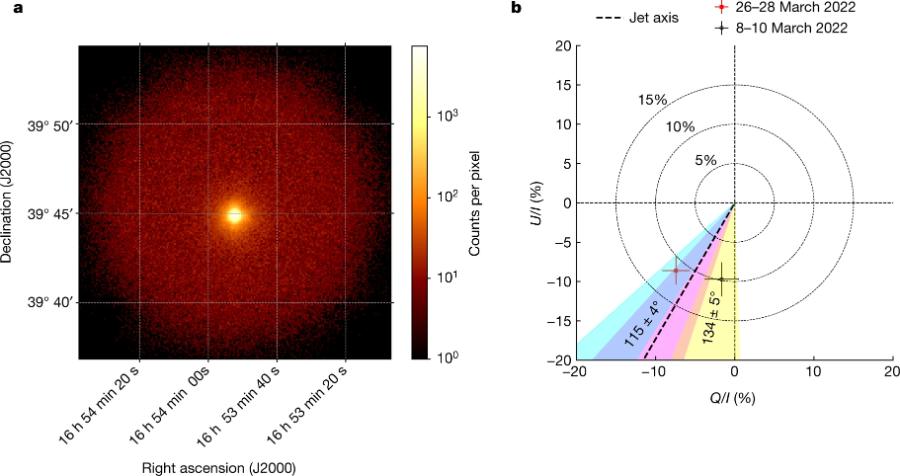
According to the results of the tests, the radiation from the quasar is weakly and unevenly polarized at lower energies. But in contrast, the polarimeter detected polarization of more than 10% in the high-energy X-ray band, at an angle that is consistent with the quasar jet’s direction.

The source of this X-ray emission can be better understood with the use of these data. According to the scientists, this argues for a shock wave as the cause of the particle acceleration. Particles driven by the black hole’s magnetic fields crash with a zone of slower particles in the jet, releasing this high-energy radiation. They suddenly lose speed and the X-rays are discharged in this shock wave.
After passing through the quasar jet’s shock wave, the particles keep racing, although at a reduced speed. Therefore, as they recede from this zone, they are now releasing radiation of longer and longer wavelengths. Scientists draw the conclusion that the jet is becoming more turbulent in this area from the fact that the polarization of this lower-energy radiation is not uniform.
Major step forward
Thus, astronomers have learned, for the first time, what drives the most powerful radiation sources in the galaxy. The findings prove that multiwavelength polarimetry provides a novel method of investigating the physical environment close to supermassive black holes. IXPE and other devices’ future measurement data may shed light on the inner workings of these processes.
When it comes to comprehending these powerful particle accelerators, many astronomers and physicists consider these findings as a major advancement in our knowledge of blazars. With X-ray polarimetry, scientists can find out whether or not these processes are universal to all quasars, and what part electrons and protons play in the jet during beam formation.