On Saturday, November 26th, the Orion space capsule from the Artemis lunar mission surpassed the previous record distance of 248,655 miles (400,171 km), which had been held by Apollo 13. The spacecraft’s journey around the Moon was the furthest any human spacecraft has ever ventured from Earth. Orion was at the farthest point of its orbit from Earth at 4:13 p.m. Eastern time on Monday. As of that time, it was more than 270,000 miles (434,500 km) away.
Already, robotic spaceships have previously explored almost every planet, and Voyagers 1 and 2 have even left our solar system. For almost 50 years, human spaceflight has been restricted to low Earth orbit. Only the Apollo lunar missions put people on flights that went beyond orbit. The furthest distance from Earth was achieved by the Apollo 13 mission, which was unable to land because of a fault but traveled 248,654 miles (400,171 km) while circling the Moon.
Apollo 11’s Moon trip
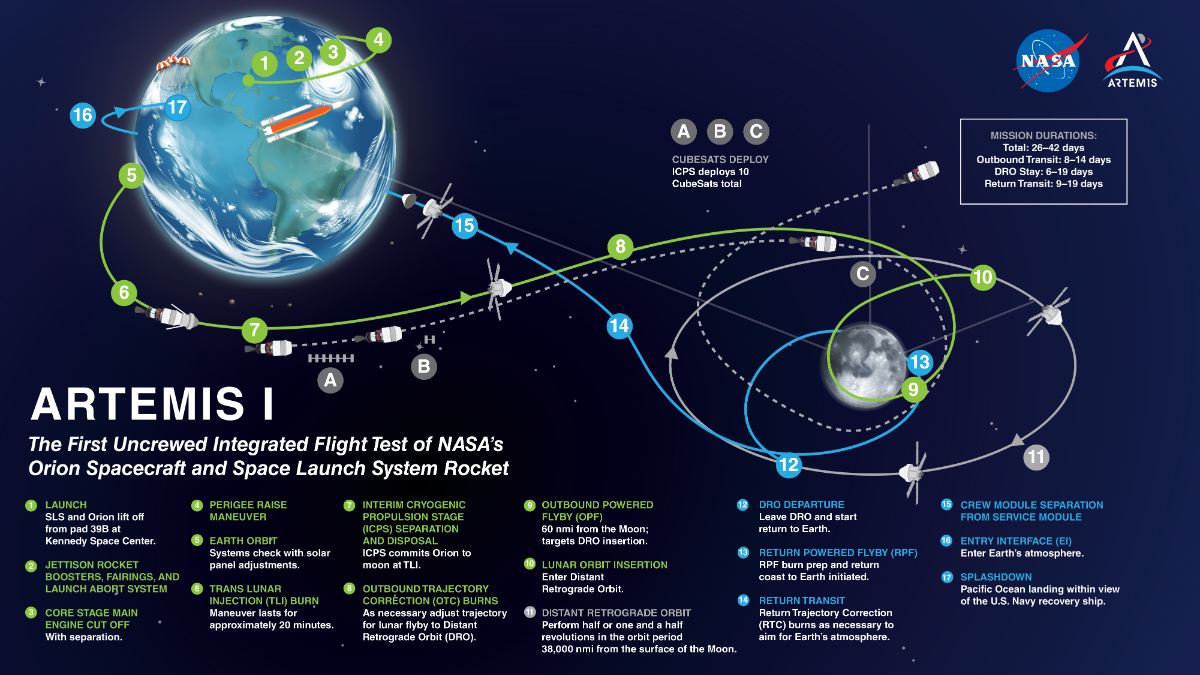
The NASA Artemis project has now achieved even greater success. The Orion space capsule, which lifted off from Cape Canaveral on November 16, 2022, is currently unmanned, consisting of just three dummies. However, the following voyage of this space capsule, its SLS launch vehicle, and the European service module is planned to take people to the Moon. Under preparation for this, the Artemis 1 flight is now in progress. Artemis-1 follows a more complicated lunar orbit than Apollo 8 and Apollo 13, although all three spacecraft aimed at the lunar orbit.
Artemis-1 has completed its first lunar orbit, bringing it within 81 miles (130 km) of the Moon’s surface. The Orion spacecraft also flew directly over the landing location used by the Apollo 11 mission, the first human journey to the Moon. On November 25, the spacecraft entered what is known as a “distant retrograde orbit” around the Moon, which is an orbit that is very high above the lunar surface and moves counter to the Moon’s orbit around Earth.

Breaking the record for the furthest distance and entering a retrograde orbit
On Saturday, November 26, 2022, the Orion capsule flew further from Earth than any spacecraft constructed for human spaceflight before it, surpassing the previous record established by Apollo 13. On Monday, the Artemis-1 probe went farther than it ever has before. At an altitude of about 40,400 miles (65,000 km), it was more than 270,000 miles (434,500 km) from Earth as it orbits the Moon. Half an orbit around the Moon takes the spacecraft a full six days to accomplish.
NASA’s Artemis-1 mission manager Mike Sarafin has described the mission as a “true stress test in deep space” for the Orion spacecraft. With no personnel on board for the initial trip, Orion is able to spend more time in deep space on its far retrograde orbit, testing the spacecraft’s systems to ensure they are ready to carry humans safely on future flights.
To Earth by the 11th of December
The Orion spacecraft is programmed to fire its thrusters once again to cause itself to exit lunar orbit after completing a lengthy retrograde round of the Moon. Artemis-1 will begin its journey back to Earth after making another close flyby of the lunar surface to increase its velocity. The spaceship is slated to return to Earth on December 11, 2022, and this time land in the Pacific Ocean.