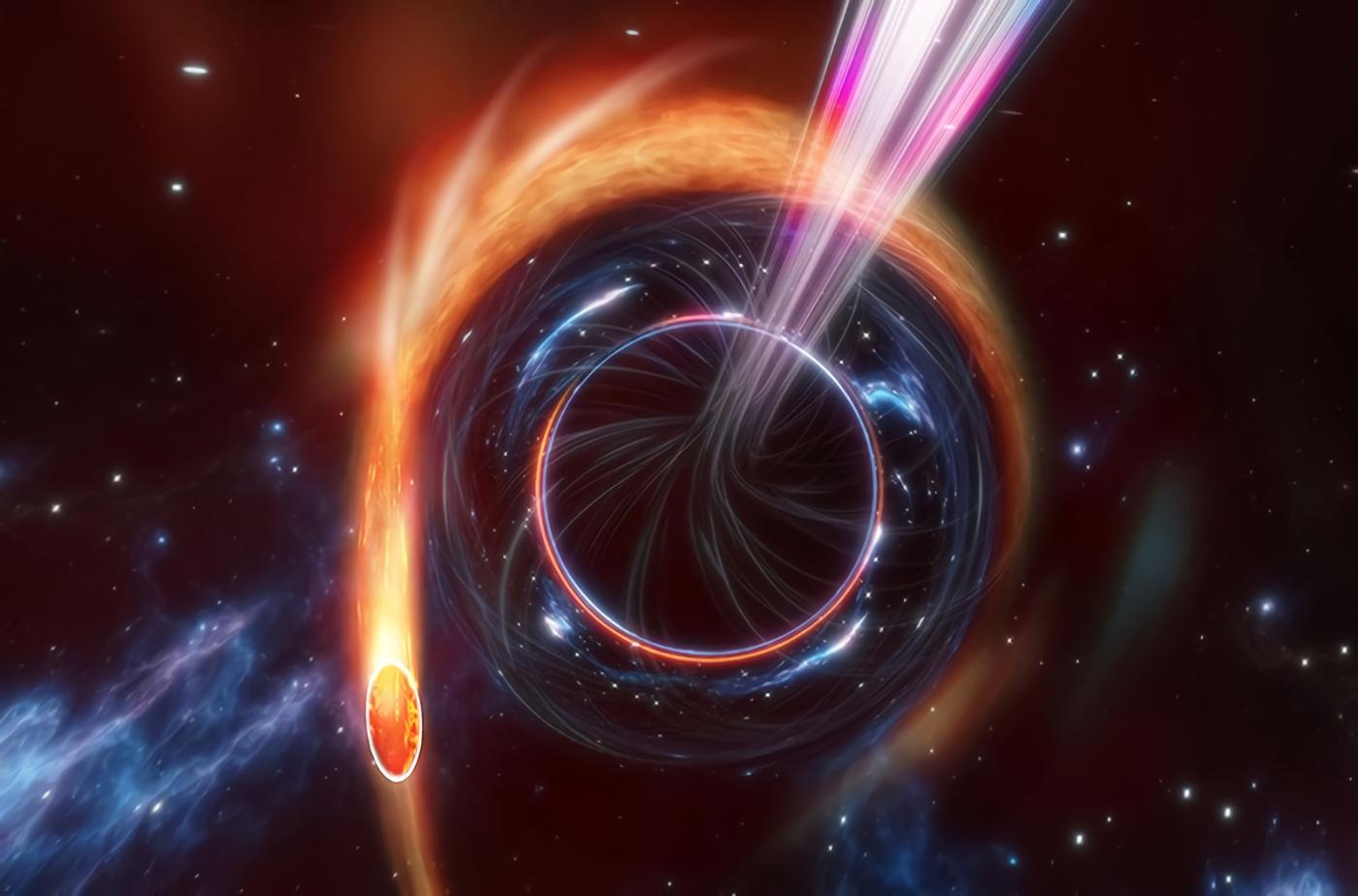
Astronomers have seen a rare occurrence of stellar death around a black hole, with the star rupturing and sending forth jets of plasma and radiation. A tidal disruption event (TDE) was initially seen in all wavelengths, from radio to gamma rays, because one of these jets was directed straight toward Earth. This is an extremely rare occurrence. These findings provide the first hints as to why black holes only create a jet in roughly 1% of these star deaths.
The star AT2022cmc’s death is so remarkable.
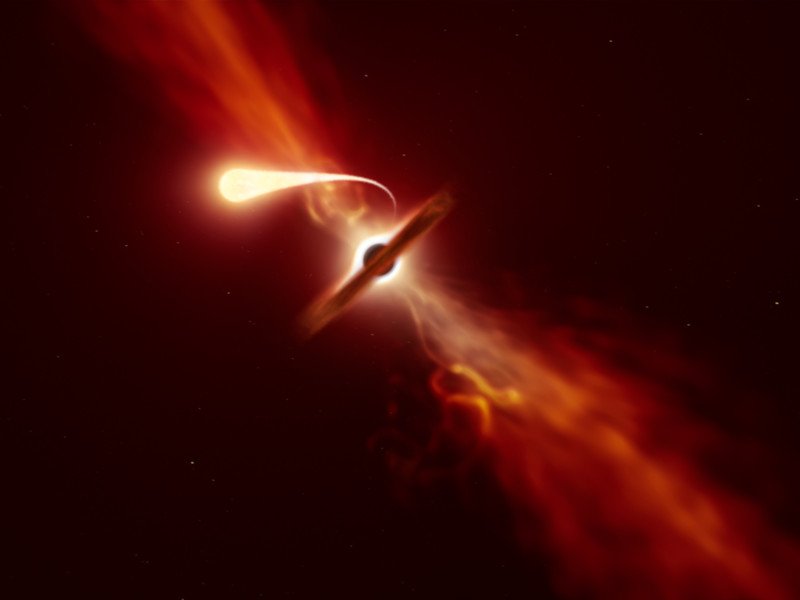
When a star approaches too closely to a supermassive black hole, it is “spaghettified” into spaghetti-like strands by the tidal forces of the black hole’s tremendous gravity. Part of the star’s material forms an accretion disk that rotates around the event horizon and is progressively consumed in a “tidal disruption event” (TDE). One percent of the time, extra paired jets are generated, which are clusters of highly accelerated plasma and high-energy radiation that go far into space.
However, it is not understood why these powerful jets manifest themselves in just a subset of TDEs. Since we have only witnessed a few of these jet TDEs, as coauthor Nial Tanvir of the University of Leicester puts it, they remain an exceedingly exotic and poorly known phenomenon. Only a small fraction of the radiation spectrum was able to detect the last such event in 2011, therefore we still don’t know much about the mechanisms behind these stellar deaths.
An Unexpected Explosion in a Faraway Galaxy
This may have altered, however, thanks to an example of such a stellar death that is both severe and instructive. A telescope at California’s Zwicky Transient Facility (ZTF) saw it on February 11, 2022. Initially, researchers headed by Igor Andreoni of the University of Maryland assumed a gamma-ray burst was the cause of a sudden, very intense flash of light picked up by the telescope.

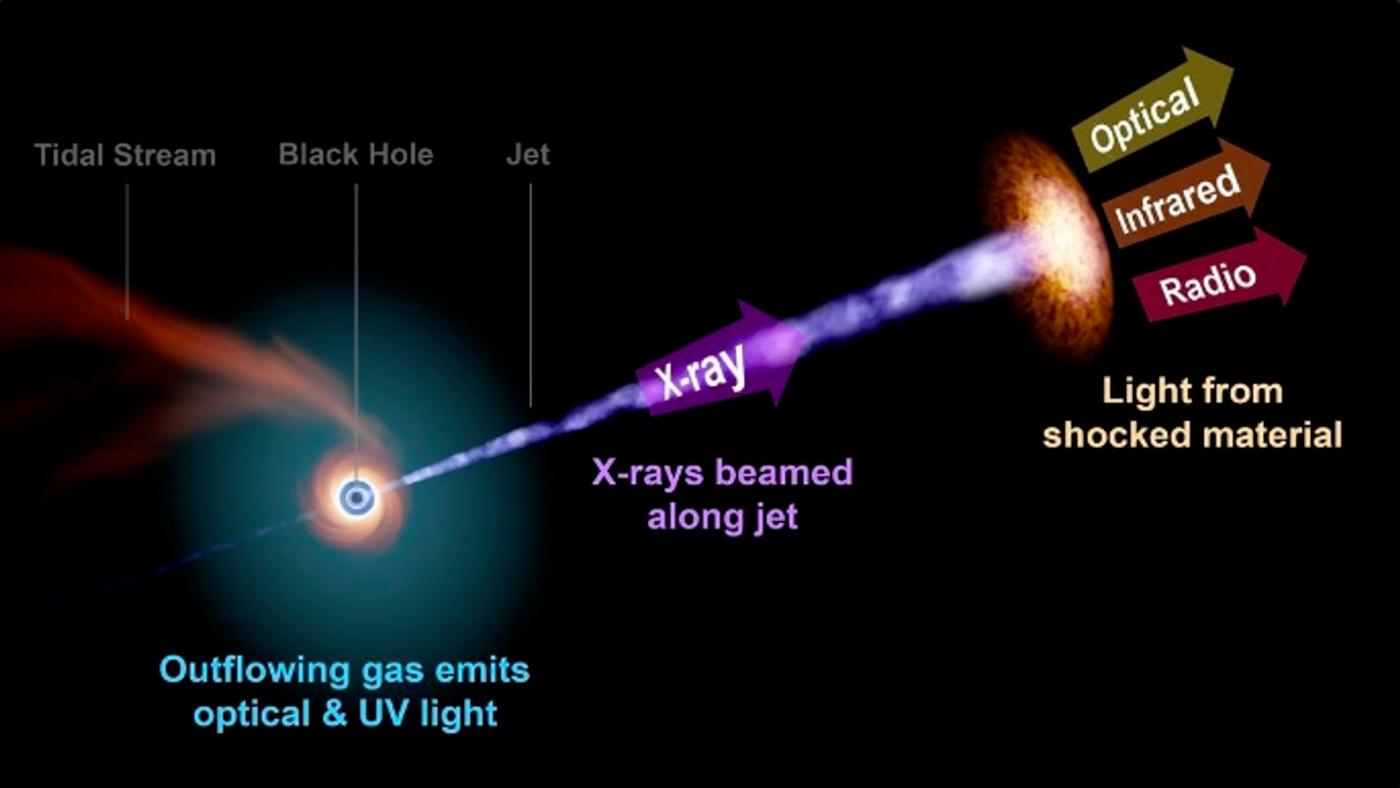
The scientists notified other observatories that saw the radiation burst, which they named AT2022cmc, in all wavebands, from long-wave radio radiation to infrared and optical light to short-wave X-rays and gamma rays, to determine its origin. Initial spectral investigations placed the origin of this radiation at a distance of about 8.5 billion light-years from Earth.
Odd Characteristics
However, AT2022cmc’s X-ray, radio, and submillimeter beams are among the brightest ever seen at such a redshift. These high levels of radiation intensity lasted for weeks, unlike a gamma-ray burst. Dheeraj Pasham of the Massachusetts Institute of Technology (MIT) claims that this event was one hundred times brighter than the brightest previously recorded gamma-ray burst afterglow. Furthermore, the X-ray intensity remained wildly changing instead of progressively reducing.
The visible and ultraviolet light trends were also unexpected. After dramatically varying for days, it finally settled into a plateau where it was still extremely bright but had a slightly blue hue. Andreoni and coworkers note that the AT2022cmc stands out even among the growing list of transient astronomical phenomena due to its very high brightness across all wavelengths and fast spectral and temporal variation.
A Death Ray From a Star Aimed Right at Humanity
All of these attributes point to a tidal disruption event involving a distant black hole as the likely cause of the AT2022cmc’s bright appearance. According to researcher Benjamin Gompertz of the University of Birmingham, AT2022cmc’s brightness and duration were so extreme that they suggested the presence of a supermassive black hole. High-energy jets, one of which was pointed straight at Earth, were created when a star similar in size to the Sun exploded near the black hole.
This is not only one of the very unusual examples of a shattered star with accompanying jets, after all. It’s also the farthest-away event discovered so far, at a staggering distance of 8.5 billion light-years. Coauthor Giorgos Leloudas of the Technical University of Denmark adds that the increased brightness and visibility throughout a larger range of the electromagnetic spectrum is due to the fact that the relativistic jet is pointed in our direction.
At Almost the Speed of Light
For the first time, astronomers were able to get insight into the circumstances surrounding a star’s death and the jets that resulted. The chain of events started when a star on its deathbed flew dangerously close to the supermassive black hole on a nearly parabolic trajectory, ripping itself apart into a jet of gaseous debris. The accretion ring around the black hole was severely heated and accelerated to almost half the mass of the shattered dwarf star.
Two polar jets of high-energy particles and radiation were formed as a result of the turbulence and shock waves. Matteo Lucchini, also from MIT, reveals that, based on the calculations, the jet travels at a speed that is 99.9 percent as fast as light. However, contrary to popular belief, the presence of a high magnetic field was not the driving reason behind the massive acceleration necessary for this kind of TDE with a jet. This field was hardly noticeable in AT2022cmc.
The Role of the Black Hole’s Rotational Axis
On the contrary, the data point to the black hole’s spin as a key factor in the development of the plasma and jet bundles. This means that such jets might occur whenever the supermassive black hole revolves around itself after ripping away a star. Given that not all black holes exhibit this property, TDEs accompanied by jets are very uncommon.
More of these occurrences should be observable in the future. Lucchini adds that this would allow us to explain why and how black holes trigger these jets.
The studies may be found in Nature (2022): 10.1038/s41586-022-05465-8 and Nature Astronomy (2022): 10.1038/s41550-022-01820-x.