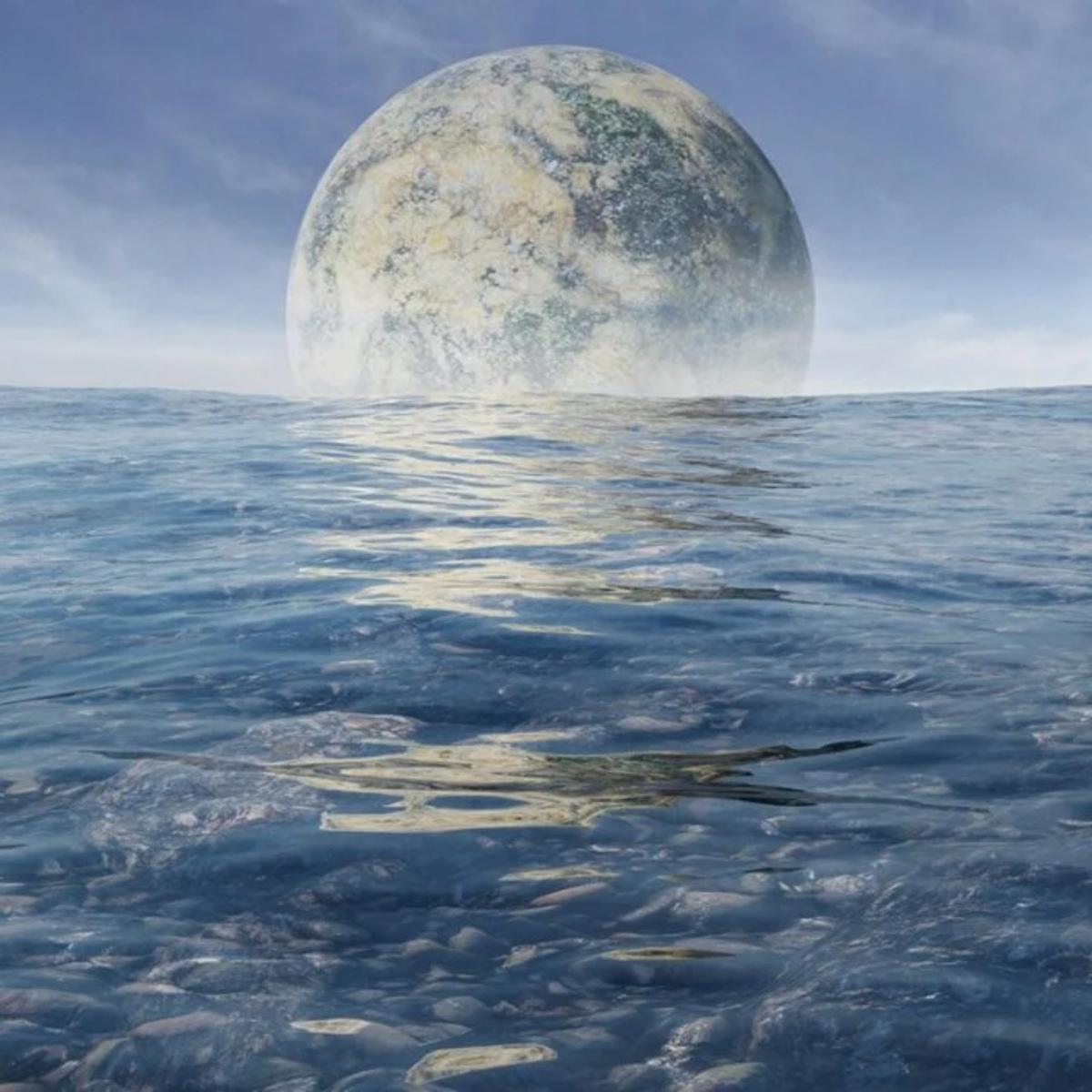
A super-Earth entirely engulfed in water that is just 100 light-years away from us may be a planet that supports life and is habitable by water. Astronomers have discovered an exoplanet called TOI-1452 b that is roughly 1.6 times as big as Earth and circles one of two dwarf stars in a binary system. Due to its low density, this planet may contain over 30% water. At moderate temperatures of just a little over 50 degrees, this would have to be liquid.
The majority of currently known exoplanets are either massive gas giants or rocky planets similar to Earth. But scientists think there may be a lot of other, as of yet undiscovered water planets amid the super-Earths and mini-Neptunes. These ocean-covered worlds may be more prevalent and habitable for life than rocky planets. The first prospective examples of such water worlds are the super-Earths K2-18b and GJ1214b, which is close.
Does Toi-1452 Have a Planet?
Astronomers headed by Charles Cadieux of the University of Montreal may have recently found another neighboring water planet. Data from NASA’s TESS space telescope, which discovered startling brightness variations in a binary star system about 100 light-years away in the constellation Draco, served as the inspiration for this. The light from the two dwarf stars TOI-1452 and TIC 420112589 dims for a brief period once every 11.1 days. Such regular shadowing is often a sign of a transit, which is when a planet passes in front of its star.
Astronomers used the Canada-France-Hawaii Telescope on Mauna Kea and the high-resolution SPIRou spectrometer at the Mont Megantic Observatory in Quebec (OMM) to study the binary star system to confirm this. The OMM was very important in determining the nature of this signal. The measurements show that a planet is really orbiting the system’s somewhat bigger star, TOI-1452.
Strikingly Low-Density Super-Earth
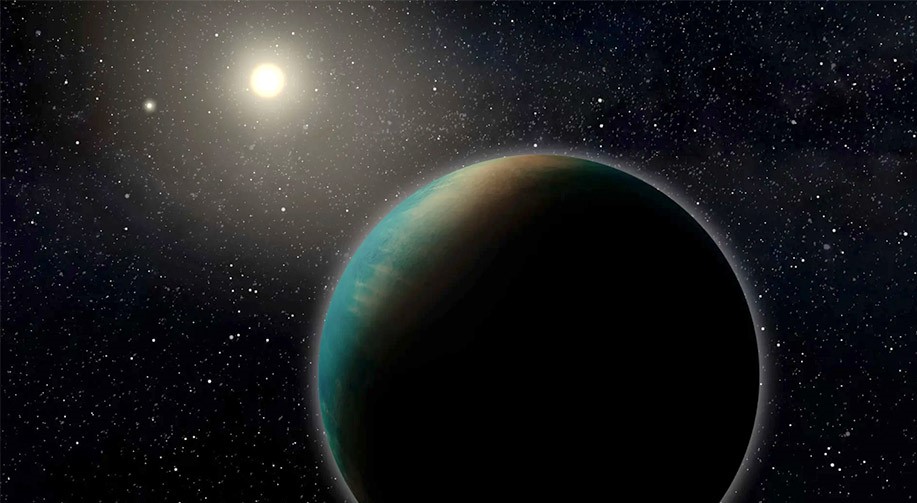
The spectral data analysis showed that the newly named planet TOI-1452 b is a super-Earth, being 4.8 times more massive and 1.6 times larger than Earth. Strangely, scientists note that the resultant density of 5.6 grams per cubic centimeter (0.2 lbs/in3) is rather low for a planet of this size. The density would need to be greater for a traditional super-Earth with an iron core and a thick rocky shell.
Three possibilities are feasible: It’s possible that TOI-1452 b is an ocean planet. It might also be made nearly completely of rock with no iron core. Or the planet has a thin but extensive atmosphere and is around the size of Earth. But the parent star also includes iron, making the absence of an iron core implausible. It is challenging to form a planet that is so deficient in iron relative to its star. It would go against accepted theories of planet creation.
An Earth-Like Planet Made of Water or Gas
Therefore, the astronomers conclude that it is considerably more plausible that TOI-1452 b’s low density is caused by a large concentration of water or hydrogen. As a result, the planet is either a water world or a rocky planet with a high atmosphere. However, it is believed that a water planet is more plausible since the super-Earth’s temperature is just 122 degrees Fahrenheit (50 Celsius) degrees, which is rather moderate.
TOI-1452 b is one of the most promising prospects for a water planet. The researchers’ estimates suggest that it may contain roughly 30% water, which would be sufficient for a deep ocean to round the whole planet. On Earth, the oceans’ total water volume is merely 1%, despite the fact that they cover 75% of the planet. Oceans on TOI-1452 b would consequently need to be far deeper than those on Earth.
The James Webb Space Telescope May Clarify It
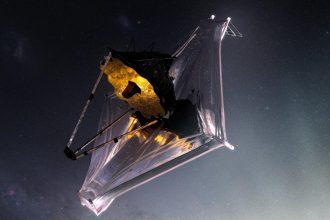
If this is verified, the exoplanet—which is just 100 light-years away—might provide an abundance of liquid water and suitable surroundings, which would be ideal for the birth of life. Whether TOI-1452 b is a water planet will soon be determined by the James Webb Space Telescope. This is due to the fact that its high-resolution infrared spectrometers are ideal for clarifying the make-up of extraterrestrial planets and their atmospheres.
The team of astronomers intends to shortly submit an application to get observation time on the James Webb Space Telescope. To fully comprehend TOI-1452 b, observations with the Webb telescope will be crucial.
Sources:
doi:10.3847/1538-3881/ac7cea (The Astronomical Journal, 2022)