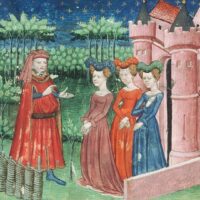
In the political philosophy of the European Middle Ages, human society was not designed as an egalitarian competition where everyone did the same work; instead, eleventh-century bishops like Adalbero of Laon and Gerard of Cambrai taught that God had divided Christian society into three harmonious, mutually dependent Estates: Oratores (“Those Who Pray,” the clergy), Laboratores (“Those Who Work,” the peasant farmers and artisans who fed everyone), and at the top of the secular pyramid, Bellatores (“Those Who Fight”)—the warrior Aristocracy and Nobility. Evolving from the armed horsemen who defended fractured ninth-century kingdoms against Viking, Magyar, and Saracen raids into a hereditary caste of castle lords, dukes, and chivalric knights, the medieval nobility governed the land, courts, and battlefields of Europe for over seven hundred years.
Why the Stirrup and the Warhorse Created a Ruling Class
How did a tiny minority of less than **two to three percent of the European population** come to own the vast majority of the continent’s farmland and rule over millions of peasants? The answer began with the crushing financial cost of ninth- and tenth-century military technology.
Following the collapse of Charlemagne’s Carolingian Empire in the 800s, central tax systems vanished. When fast-moving Viking longships and Magyar horse-archers raided deep into France, Germany, and England, slow peasant foot-soldiers could not catch them. The only effective defense was the heavily armored mounted knight (miles) fighting on horseback with a lance and sword, braced securely in the saddle by iron stirrups:
- The Cost of a Medieval Tank: A single trained destrier warhorse, a chainmail hauberk forged from thirty thousand hand-riveted iron rings, a steel helmet, a sword, and squire support horses cost the equivalent of twenty to forty oxen—a sum no ordinary farmer could save in ten lifetimes!
- The Feudal Bargain (Vassalage and the Fief): Because kings had no cash in their treasuries to pay salaries to professional cavalrymen, they paid them with land. In a solemn ceremony of homage and fealty (kneeling with hands clasped between the lord’s hands and swearing an oath on holy relics), a warrior became a vassal and received an estate of agricultural land worked by peasant serfs—called a fief (feodum). The peasants farmed the land to pay for the knight’s armor and castle, and in return, the noble lord was legally obligated to protect the peasants from bandits and ride to war for forty days a year whenever his king summoned him.
The Ladder of Peerage: From Emperor and Duke Down to Baron and Knight
By the High Middle Ages (1100–1300 AD), what had started as temporary land grants for military service had hardened into hereditary blood nobility passed from father to eldest son under the law of primogeniture (preventing family estates from being chopped into tiny pieces across six brothers), organized into a strict pyramid of noble titles:
- King (or Holy Roman Emperor): The anointed suzerain at the apex of the feudal pyramid, who theoretically owned all the land in the realm under God.
- Duke (Dux): The highest non-royal noble rank (from the Roman military title for a regional commander), ruling over a vast semi-independent province or duchy—such as the Dukes of Normandy, Burgundy, Aquitaine, or Bavaria, who often possessed larger armies and richer treasuries than the King himself!
- Marquess / Margrave (Marchio): A high nobleman entrusted with defending a dangerous frontier borderland (a March), such as the Welsh Marches or the eastern border of Germany, requiring extra military authority.
- Count / Earl (Comes): Derived from the Roman “Companion of the Emperor” (and called an Earl in Anglo-Saxon/Norman England, though his wife was still called a Countess!), governing a county or shire.
- Viscount (Vicecomes) and Baron (Baro): The backbone of the castle-holding aristocracy—barons held their estates directly from the King as tenants-in-chief and sat in the King’s Great Council (the ancestor of the House of Lords).
- Knight (Chevalier / Ritter): Originally a landless household soldier, by the twelfth century knighthood was elevated into the prestigious bottom rung of the chivalric aristocracy—requiring years of childhood training as a page (age seven) and squire (age fourteen) before the vigil and dubbing ceremony with the flat of a sword.
Heraldry, Tournaments, and the Code of Chivalry
By the late twelfth century, because enclosed steel helmets (such as the flat-topped great helm) completely hid a nobleman’s face on the battlefield, the aristocracy invented the visual language of heraldry (coats of arms)—painting geometric lions, eagles, and crosses in high-contrast colors onto their shields, horse trappers, and linen surcoats so allies and heralds could identify them in the dust, while strictly forbidding commoners from bearing arms.
Simultaneously, the Church and court troubadours worked to tame the violent brutality of feudal warlords through the code of Chivalry (from Old French chevalerie, “horsemanship”) and Courtly Love (fin’amor): teaching that a true nobleman was defined not merely by swinging an axe, but by franchise (nobility of character), generosity (largesse), sparing surrendered noble prisoners for ransom, protecting widows and orphans, and competing in peacetime jousting tournaments to win the favor of noble ladies—privileges of tax exemption, private castle courts, and social precedence that the European nobility guarded jealously until gunpowder cannons and the French Revolution finally toppled the feudal order.