In the quiet parlors of Amish, Mennonite, and Hutterite homes across North America, three books consistently occupy a place of honor on the family table: the Bible, the Ausbund hymnal, and a colossal, twelve-hundred-page folio volume titled Martyrs Mirror. Originally published in Holland in 1660 by the Dutch Mennonite pastor Thieleman Jansz van Braght, this monumental historical compilation documents the lives, trials, letters, and executions of more than four thousand Christians—beginning with the Apostles in the first century and culminating in the brutal sixteenth-century persecution of peaceful Anabaptists who refused to bear arms or baptize infants.
Thieleman Jansz van Braght and the 1660 Dutch First Edition
The full original Dutch title of the book—Het Bloedig Tooneel, of Martelaers Spiegel der Doops-Gesinde of Weereloose Christenen—translates to The Bloody Theater, or Martyrs Mirror of the Defenseless Christians. By the mid-seventeenth century, the Dutch Republic was entering its prosperous Golden Age. For the Mennonites (descendants of the sixteenth-century Anabaptist movement), the torture racks and execution stakes of the previous century had given way to religious toleration, thriving merchant wealth, and comfortable urban living.
Van Braght, a pastor in Dordrecht, feared that wealth and comfort were making young Anabaptists forget the immense price their grandparents had paid for their convictions regarding adult believer’s baptism and strict nonviolence. Expanding upon an earlier 1562 martyrology called Het Offer des Heeren (The Sacrifice of the Lord), van Braght spent years combing through municipal court archives, prison letters, and inquisitorial records across the Low Countries, Germany, and Switzerland to compile a permanent historical monument in two massive parts:
- Part I (First to Fifteenth Centuries): Traces the martyrdom of the twelve Apostles, the early Roman persecutions under Nero and Diocletian, and medieval dissident movements like the Waldensians, arguing that a continuous thread of nonviolent, faithful believers had existed across every century of Church history.
- Part II (The Sixteenth-Century Anabaptists): Chronicles the lives and deaths of thousands of men and women executed between 1525 and 1660 by both Roman Catholic authorities and rival Protestant magistrates in Zurich, Germany, and the Habsburg Netherlands simply for practicing adult baptism and refusing to swear civil oaths or take up the sword.
Jan Luyken’s 104 Copper Etchings and the Story of Dirk Willems
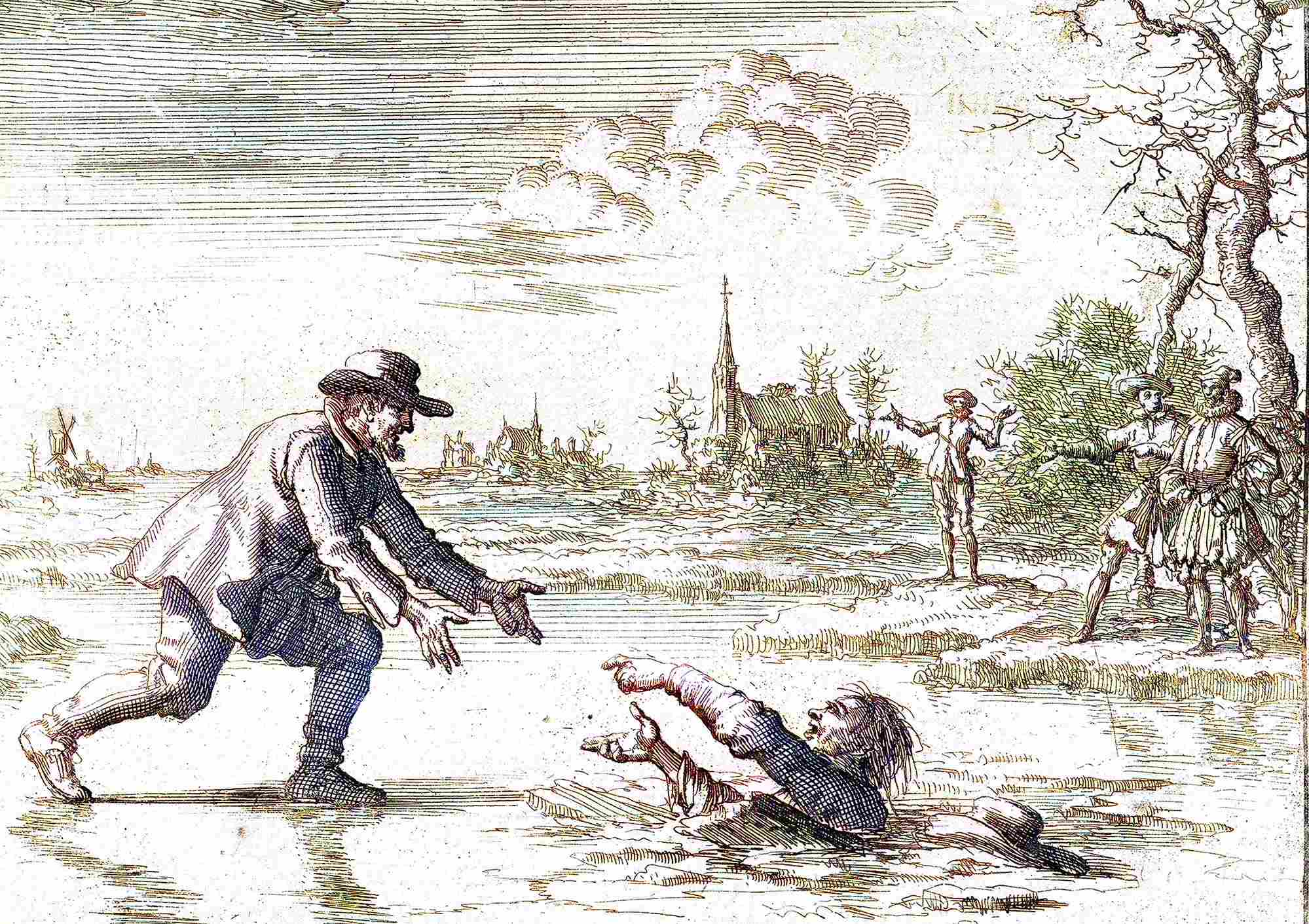
In 1685, twenty-five years after the first text-only edition appeared, Amsterdam printers issued a magnificent second edition illustrated with 104 intricate copperplate etchings by the Dutch master artist and poet Jan Luyken. Luyken’s illustrations became instantly iconic, capturing not just the grim mechanics of sixteenth-century executions—burnings, drownings inside barrels, and burials alive—but the extraordinary serenity, forgiveness, and courage of the victims.

By far the most famous account and etching in the entire book is the story of Dirk Willems of Asperen in 1569. Arrested for his Anabaptist faith and locked inside a residential palace prison, Willems knotted torn strips of cloth into a rope, lowered himself out a window during the dead of winter, and fled across a frozen body of water known as the Hondegat. Because weeks of meager prison rations had made Willems light on his feet, he crossed the thin ice safely. However, the heavier armed palace guard chasing right behind him crashed through the ice into the freezing water and cried out for help as he began to drown.
Rather than running away to save his own life, Dirk Willems stopped, turned back across the cracking ice at great peril to himself, grabbed the hand of the man hunting him, and pulled his enemy safely ashore. Although the grateful guard wanted to let Willems go free, the burgomaster standing on the bank reminded the guard of his sworn oath, forcing him to re-arrest his rescuer. Weeks later, on May sixteenth, 1569, Dirk Willems was burned to death over a slow fire, leaving behind the ultimate visual symbol of Anabaptist love for one’s enemies.
The Ephrata Cloister Translation and the Missing Copper Plates
In the 1740s, as German-speaking Mennonite families in colonial Pennsylvania faced pressure to take up arms during the French and Indian wars, community elders worried that their youth could not read the Dutch editions of Martyrs Mirror. In 1745, Pennsylvania Mennonite leaders commissioned the German Seventh-Day Baptists of the Ephrata Cloister in Lancaster County to translate the entire twelve-hundred-page Dutch book into German and print it locally.
Led by Prior Peter Miller, fifteen brothers at the Ephrata Cloister labored for three solid years—manufacturing their own paper from linen rags, boiling linseed oil and lampblack to make ink, translating every page by hand, and setting tens of thousands of lead type characters—to produce the 1748 Ephrata Märtyrer-Spiegel, the largest book printed in America prior to the Revolutionary War. Remarkably, thirty of Jan Luyken’s original 1685 copper etching plates survived into the modern era after being rediscovered in a European attic in 1975, touring North American museums to connect modern readers directly to a five-hundred-year legacy of conscience.