By the summer of 1945, the Allied powers had defeated Germany and turned their full attention to Japan, with over 2 million troops ready to fight to the end and 9,000 airplanes ready for suicide attacks. US experts estimated that an attempt to invade Japan could result in the deaths of 500,000 American soldiers and several million Japanese.
Why Did the US Use the Atomic Bomb?
Unable to risk such incredible losses, the Americans proposed using the atomic bomb. On July 26, 1945, the United States, Britain, and China called on the Japanese to surrender unconditionally and warned them that otherwise, they risk “immediate and total annihilation”. There was no mention of the atomic bomb.
The Japanese, anxious to buy time, ignored these demands. Some of the advisers of President Truman insisted on the atomic bomb to be detonated in an unmanned area to display how deadly the new weapon was; while others tried to pressure him to use it on Japan without prior warning. On August 6, the world learned of Truman’s decision.
The use of the atomic bomb on Hiroshima and three days later on Nagasaki has long been debated. Some adherents believed it ended the war and saved the lives of Allied soldiers. The feared Japanese could be defeated, no matter how mercilessly.
Who Invented the Atomic Bomb?
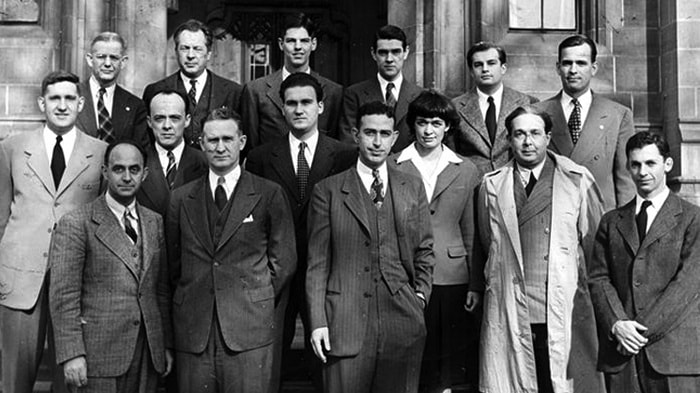
As early as 1939, Albert Einstein and several prominent scientists had written a letter to President Roosevelt suggesting that the United States should launch a special research program to develop an atomic bomb. The Americans only needed such a weapon after Japan attacked Pearl Harbor in 1941. Since the first atomic bomb studies had begun at Columbia University in Manhattan, a top-secret atomic bomb development program called the “Manhattan Project” was launched in 1942.
With the Manhattan Project, thousands of scientists set to work in various parts of the country to build atomic bombs. Security at the Manhattan Project was extremely tight; only a few of the scientists knew what their colleagues were doing. At the Manhattan Project’s purpose-built facilities in Los Alamos, New Mexico, the scientific director of the atomic bomb Dr. Robert Oppenheimer oversaw the drawing and preparation of the bomb, or “The Beast” as it was code-named.
Three years later, at 5:30 a.m. on July 16, 1945, in a remote corner of the New Mexico desert, the first Manhattan Project atomic bomb was tested. A huge fireball lit up the sky above the desert and a mushroom cloud rose to a height of 7,580 miles (12,200 meters). Oppenheimer interpreted the event by quoting a Hindu sacred text: “Now I am become Death, the destroyer of worlds.”
The Manhattan Project team that invented the atomic bomb consisted of the following scientists: Robert Oppenheimer, David Bohm, Leo Szilard, Eugene Wigner, Otto Frisch, Rudolf Peierls, Felix Bloch, Niels Bohr, Emilio Segre, James Franck, Enrico Fermi, Klaus Fuchs and Edward Teller.

How Does An Atomic Bomb Work?
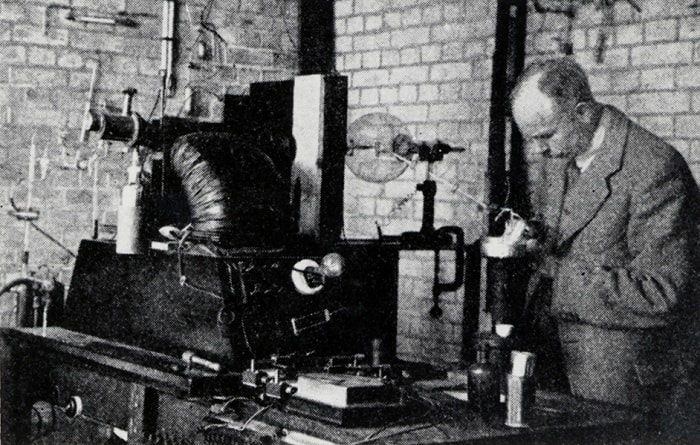
The atoms that make up matter consist of a central nucleus surrounded by electrons. The nucleus is held together by strong binders that are difficult to break. In 1919, New Zealand-born physicist Ernest Rutherford, working at the University of Manchester, showed that the nucleus of an atom could be broken apart if bombarded with extremely powerful energizing particles. However, he was skeptical that there was a source of energy on Earth that could produce this kind of transformation, as it would take a great deal of energy to break apart the binding forces in the nucleus.
However, Ernest Rutherford had not taken uranium into account. In a way, like a drop of water that stretches and finally splits in two, the uranium nucleus wobbles when it reaches the very edge of instability, and it only takes a slight collision with a neutron to shatter it. Discovered in 1938 in Berlin by Otto Hahn and Lise Meitner, this so-called “nuclear fission” produced two lighter elements from a heavier one which released a huge amount of energy and demonstrated how an atomic bomb could work.
Enough Uranium
What made this discovery so revolutionary was this: In the process of fission, the uranium nucleus releases two neutrons, which are enough to fission two more nuclei, thus freeing four neutrons, and so on indefinitely. All that is needed for a self-sustaining chain reaction was to use enough uranium so that the neutrons produced would not escape until they had caused more fission.
This “enough” which is called the “critical mass” was different for each element. The intriguing result of fission was that two lighter atoms were produced from the heavy atom that was scattered, and their combined mass was lighter than the heavier atom. This mass was converted into energy according to Albert Einstein’s equation E=mc2.
So, to make a nuclear bomb, it was necessary to create a critical mass of uranium, known as uranium-235, which is only 0.7 percent of naturally occurring uranium. Another route to the atomic bomb was to use plutonium, an element that could be produced by neutron bombardment of U-238, a more abundant form of uranium that does not occur in nature. The atomic bomb on Hiroshima used uranium, and the atomic bomb on Nagasaki used plutonium. But both worked by fusing the critical mass at the moment of detonation.
Who Are The Hibakusha?

In Japan, hibakusha, meaning “bomb-affected person”, is the name given to the thousands of Japanese who survived the atomic explosions in Hiroshima and Nagasaki. Although deaths from the immediate effects of radiation ended within the next two months of the bombs being dropped, many hibakusha who were exposed to radiation at the time went on to die from bomb-related diseases such as cancer and leukemia. Others, disfigured beyond recognition, lived in pain and torture for years.
Because no one knows for certain how many of the hibakusha died of bomb-related diseases, the Japanese have never released a complete list of atomic bomb deaths. The experiences of these unfortunate people have since become the basis for the limits of trust in X-rays or other forms of radiation emission and the radiation applied. Based on the dose received by the victims and the level of radiation-induced illnesses, a limit was set for the radiation that people could tolerate, including those working in the nuclear industry.
What Happened After?
The atomic bombs dropped three days apart on the cities of Hiroshima and Nagasaki forced Japan to surrender on August 10, 1945. In an unexpected radio broadcast, Emperor Hirohito addressed his nation, many hearing his voice for the first time: “We have resolved, by enduring the unendurable and bearing the unbearable, to pave the way for a grand peace for all generations to come.”
The Soviet Union detonated its first nuclear bomb in 1949. Britain followed in 1952. More and more sophisticated and deadly atomic bombs were built. The bombs dropped on Hiroshima and Nagasaki were toys compared to these new ones. Today, at least ten nations in the world belong to the “nuclear club”.
| Country | Warheads | First test | Number of tests |
|---|---|---|---|
| United States | 5,428 | 16 July 1945 (Trinity) | 1,054 |
| Russia | 5,977 | 29 August 1949 (RDS-1) | 715 |
| United Kingdom | 225 | 3 October 1952 (Hurricane) | 45 |
| France | 290 | 13 February 1960 (Gerboise Bleue) | 210 |
| China | 350 | 16 October 1964 (596) | 45 |
| India | 160 | 18 May 1974 (Smiling Buddha) | 6 |
| Pakistan | 165 | 28 May 1998 (Chagai-1) | 6 |
| North Korea | 20 | 9 October 2006 | 6 |
| Israel | 90 | 1960–1979 | N/A |
Atomic technology has also been used for the benefit of humanity. Nuclear reactors produce energy all over the world and radioactive isotopes are used in research, industry, and especially medicine. The most valuable lesson to be learned from the events in Hiroshima is that nuclear weapons should be seen as a last resort deterrent in future wars. Using a nuclear weapon could be the end for both sides or a catastrophe for the whole world.