What is the timeline of the history of money? The evolution and development of currency have been integral parts of human history. As civilizations became increasingly complicated, an exceptional instrument of trade was required in order to exchange goods. Money was created to play this role, and it evolved from herd animals to precious metals and finally to coins and banknotes. Nowadays, money is changing hands abstractly through electronic transactions.
- The Origin of Money
- Timeline of the History of Money
- Prehistoric – Cattle as capital
- 1200 BC – Shell money
- 1000-500 BC – Instrument money
- 640-630 BC – The first real coins
- 465-454 BC – Greek coins
- 27 BC-AD 14 – The aureus of Augustus
- 806-821 – Paper money
- 1158 – Monetary change
- 1519 – Taler
- 17th-century – Modern check
- 1694 – First banknote
- 1862 – First dollar bill
- 1949 – Credit and debit cards
The Origin of Money
The earliest forms of money, used in ceremonial exchanges (for instance, as a drahoma or “dowry given in money”) and as penalties, included common, valuable things such as herd animals. They were barters. The growth of trade in Egypt and Mesopotamia in the 4th millennium BC led to more portable forms of money. For thousands of years, precious metals have been used in the form of ingots or rods. The code of Babylonian King Hammurabi (c. 1755–1750 BC) mentions the debts paid in silver.
The first coin (electrum) was invented by the Lydian Kingdom of Asia Minor in 640 BC. The Greek world quickly adapted to this new method of payment. A similar system was later adopted in the Roman Empire. They used gold, silver, and bronze (the least valuable) as exchange currencies. All the coins were stamped with the ruler’s face, both for propaganda and authenticity.
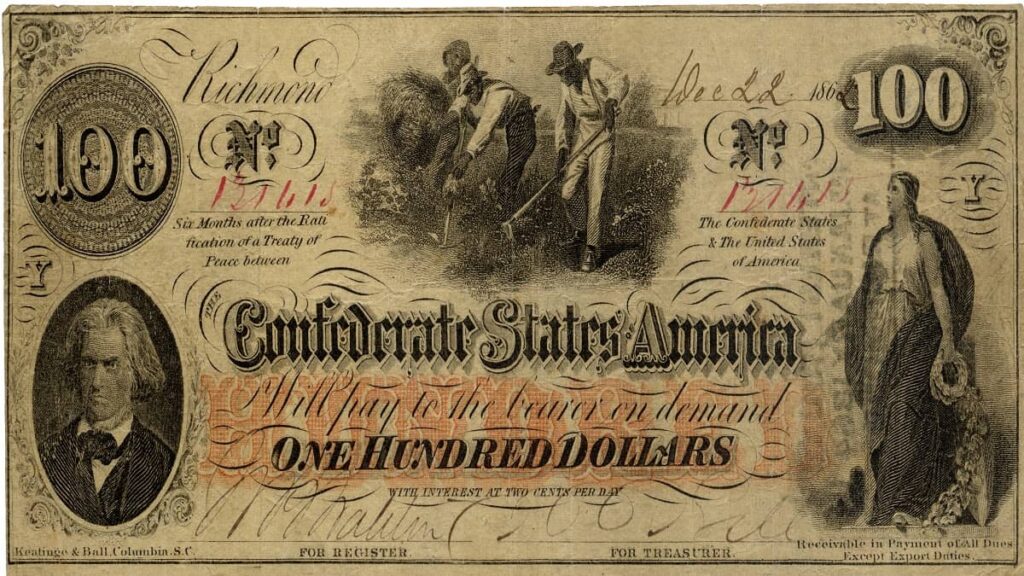
The first paper money came into use in 1189 AD during the reign of the Jin Dynasty in China. The papers were able to express larger values and were, therefore, more useful than coins. Over time, government-sponsored banks began to print paper money, which could theoretically be replaced by an equal amount of gold (the Gold Standard System). But when the economy crashed after the First World War, countries had to give up on the gold standard.

Subsequently, the real values of the banknotes and coins became rather nominal, rather than relying on a gold system. Since the 1950s, the increase in credit card usage, in which buyers give nothing but promise to pay at a later date, has taken the evolution of money further.
Timeline of the History of Money
The timeline of money and the hundreds of years of change and development of currency:
Prehistoric – Cattle as capital
In the prehistoric period, cattle animals were considered as a method of payment, and small animals such as sheep and chickens were considered small payments.
1200 BC – Shell money
The use of snail shells spread from the Maldives to the Pacific and Africa in the 19th century.
1000-500 BC – Instrument money
In China, everyday tools were made of metal with a hole (to connect them) and used as money.
640-630 BC – The first real coins
The Lydian state produced the first real coins made of electrum (gold and silver alloy) and printed them with a lion or deer symbol.
465-454 BC – Greek coins
Almost every Greek city-state often issues its own coin on which the name of the state is written. Silver replaces electrum as the main metal component used in coins.
27 BC-AD 14 – The aureus of Augustus
The emperor Augustus renews the Roman coin system. Aureus, a new version of the standard gold coin was worth 25 silver.
806-821 – Paper money
In China, the emperor Xianzong issued the first paper coins during the time of copper shortage. The Jin dynasty issued the first real paper money around 1189.
1158 – Monetary change
King of England II. Henry issues high-quality coins with a cross on them, based on the silver penny, which remained in circulation for 100 years.
1519 – Taler
This silver coin found in the Joachimstal mine in Bohemia became the standard unit of the Habsburg empires of Spain and Austria.
17th-century – Modern check
The checks, which are endorsed by major jewelers, found wide use in Europe in the 17th century.
1694 – First banknote
The Bank of England was established to finance England’s growing national debt. The Bank issued the first banknote money guaranteed by its own gold reserves.
1862 – First dollar bill
The US Treasury issued the first dollar bills for national circulation. These coins are known as “greenbacks” because of their vibrant green color.
1949 – Credit and debit cards
The first credit cards were issued in the USA in 1949. Debit cards came later in the 1980s as an electronic method of payment.
Bibliography:
- Glyn Davies. “A History of Money,” Chapter 2. University of Wales Press Cardiff, 2016.
- A. Mitchell Innes. “Credit and State Theories of Money,” Chapter 2. Edward Elgar Publishing Limited, 2004.
- Glyn Davies. “A History of Money,” Pages 9-11. University of Wales Press Cardiff, 2016.