The event known as the “Affair of the Placards” is a somewhat surprising term. Although not the most well-known episode of the 16th century, its consequences for the evolution of relations between Catholics and Protestants in France were disastrous. On the night of October 17–18, 1534, Protestants posted texts criticizing the Catholic religion and its practices throughout the country. The Mass, in particular, was singled out. These writings were displayed not only in the streets of Paris but also in the provinces.
The provocation went so far as to post one of these “placards” on the door of the chamber of King Francis I in Amboise. Up to that point, Francis I had shown great tolerance towards Protestants and the ideas of the Reformation. However, he strongly disapproved of the content of these texts, viewing them as a challenge to his divine authority. This led to fierce repression against the Protestants.
In What Context Does the Placards Affair Erupt?
We are in the 16th century. Francis I was crowned king of France in 1515, and it is around the same time that the religious movement giving rise to Protestantism emerges: the Reformation. In 1517, Martin Luther, with his 95 “theses” exposing the corruption of the Catholic Church, was the originator. Two tendencies then distinguish themselves in Protestantism: the evangelicals, who aim to maintain continuity with Catholicism, and the Lutherans, who adhere to a complete break.
Among the influential Protestants are Antoine Marcourt, a pastor; Jean Calvin, a reformer; and Clément Marot, a poet.
Francis I reacted strongly, initiating a crackdown on Protestants and intensifying persecution in response to the placards.
What Were the Causes of the Placards Affair?
Francis I demonstrated tolerance towards the Protestants, akin to his sister, Marguerite de Navarre. However, this tolerance, in the case of the French monarch, was coupled with a lack of protection for the reformists, perceived as heretics by the Church and condemned to the stake, exemplified by individuals like Jean Vallière or Jean Leclerc, with no intervention from the authorities. This situation fueled the escalating anger of the Protestants, prompting them to respond through acts of vandalism, particularly targeting religious objects symbolic of Catholicism.
How Did the Placards Affair Come About?
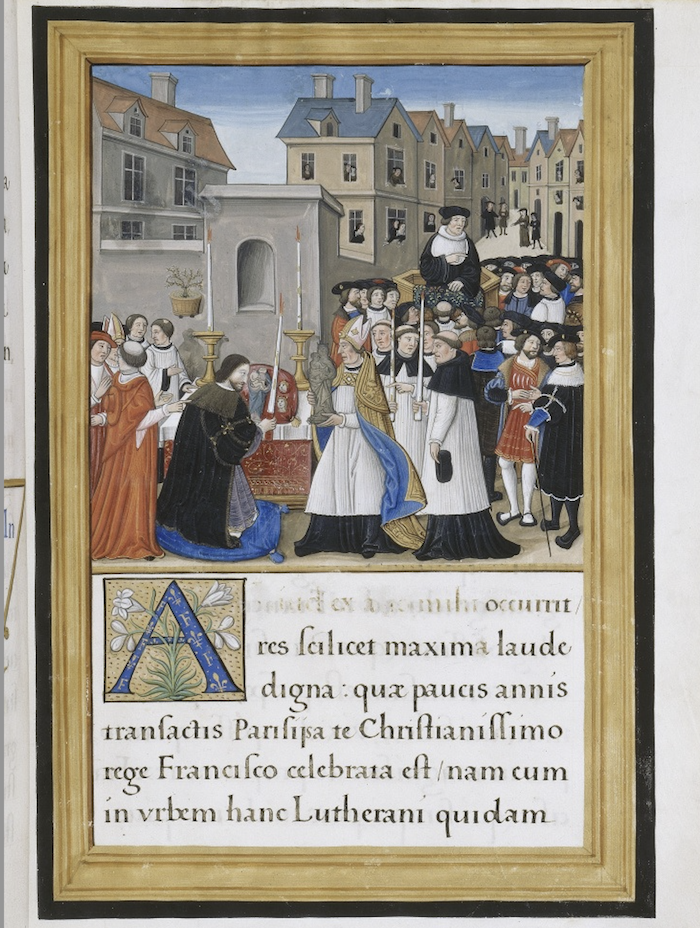
On the night of October 17–18, 1534, French Protestants decided to escalate their provocation by posting posters in Paris, Blois, Rouen, Tours, and Orleans. These posters contained a text that openly and sharply criticized the Catholic religion, particularly the Mass. Not only were these texts displayed in the streets of Paris but they also spread to the provinces.
In Amboise, Francis I could not ignore the existence of these “Placards,” as one was affixed to the door of his chamber. The king interpreted this as a provocation and an attack on the divine right monarchy, as at that time and for several centuries to come, the king derived his power from God. To curb the enthusiasm of the Protestant instigators of this affront, the king responded by initiating a crackdown. Those who wrote and posted the placards were sought out. Efforts were made to expose and apprehend the protesting individuals, some of whom were ultimately brought to the stake.
What Does the Text of the Placards Affair Contain?
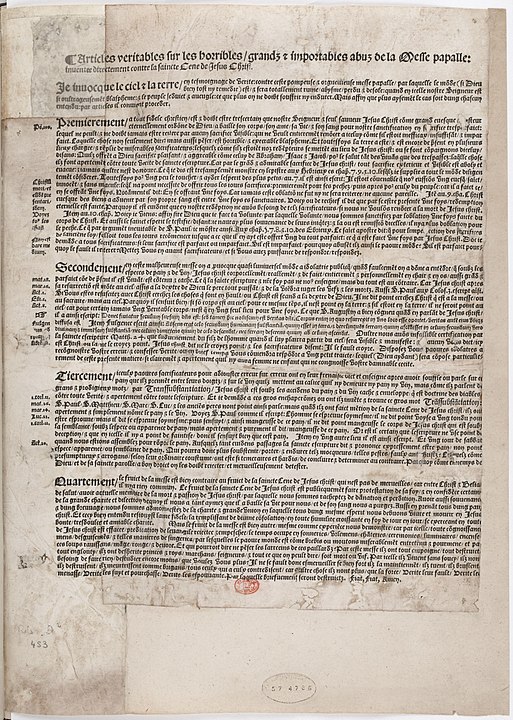
The infamous “Placards” could have triggered royal anger. Their title is “True Articles on the Horrible, Grand, and Important Abuses of the Papal Mass, Invented Directly Against the Holy Supper of Jesus Christ.” One must, of course, envision the text in Old French, but the tone is set. The text consists of a brief introduction, followed by four dense paragraphs authored by Pastor Antoine Marcourt. The Catholic mass is at the heart of the criticism, as evident in the opening expressions like “pompous and proud papal mass.” In the final paragraph, it is also stated: “The outcome of the mass is indeed contrary to the outcome of the Holy Supper of Jesus Christ.” There are critiques of all the rituals that take place during the Catholic service, described as “ringings, howlings, chantings, ceremonies, illuminations, incensings, disguises, and such manner of antics.”
What Were the Consequences of the Placards Affair?
The royal reaction is swift: the king puts an end to the policy of conciliation, and repression is initiated to avenge the affront to the monarchy. The authors of the Placards and those who posted them are sought after, and Lutherans as a whole are hunted down to be sent to the stake. There is also control over supposedly Protestant writings, with the establishment of a special commission in January 1535. It is also on this date, precisely on January 21, that an expiatory procession takes place during which six Protestants are burned alive, not without being tortured before. Some Protestants manage to escape, and among them, one of the ardent defenders of Reformation ideas leaves France: Jean Calvin. The theologian was known for advocating Protestant ideas and drawing the ire of Catholics.
The repression appears to subside with the Edict of Coucy (July 16, 1535), which considers sparing Protestants who promise to behave as good Christians. However, all of this is swept aside with the Edict of Fontainebleau in 1540, which rekindles repression and the hunt for Lutherans. One of the symbols of this resurgence is the massacre of Mérindol in April 1545, where nearly 3,000 inhabitants of the Luberon region were murdered, deemed heretics. All of this will be a precursor to the Religious Wars that will erupt in the second half of the 16th century.
- Intensification of Religious Conflict: The Placards Affair exacerbated religious tensions between Catholics and Protestants in France. The inflammatory nature of the posters fueled animosity and deepened the divide between the two religious groups.buy topamax online https://royalcitydrugs.com/buy-topamax.html no prescription pharmacy
- Persecution of Protestants: In the aftermath of the Placards Affair, King Francis I, who initially showed some tolerance towards Protestantism, took a more hostile stance. He initiated a crackdown on Protestant activities, leading to increased persecution of Protestants in France.
- Edict of Fontainebleau (1540): As a response to the growing religious unrest, King Francis I issued the Edict of Fontainebleau in 1540. This edict reaffirmed the royal commitment to Catholicism and sought to suppress the spread of Protestant ideas. It marked a shift towards a more repressive religious policy.
- Impact on the Reformation in France: The Placards Affair played a role in shaping the trajectory of the Protestant Reformation in France. The increased persecution contributed to the challenges faced by the emerging Protestant movement, but it also fueled a resilient underground Protestant community.
- Long-term Religious Strife: The events surrounding the Placards Affair set the stage for the French Wars of Religion in France, which erupted in the late 16th century. The deep-seated religious tensions culminated in a series of conflicts between Catholics and Huguenots, leading to a protracted period of instability and bloodshed.
In summary, the Placards Affair had far-reaching consequences, intensifying religious conflict, prompting increased persecution of Protestants, influencing royal policies, and contributing to the complex religious landscape that characterized France in the following decades.