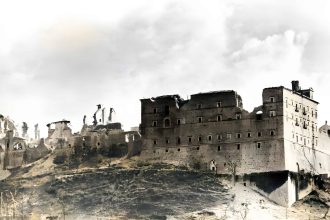
The Battle of Aspern-Essling, also known as the Battle of Aspern, took place from May 20 to 22, 1809. Following an initial assault against the French forces in Bavaria, which proved to be a defeat, Austria had to retreat towards Ratisbonne. Napoleon Bonaparte pursued his enemies and entered Vienna, which quickly fell under the French assault. The Austrian army, positioned to the north on the left bank of the Danube, resisted and launched a formidable attack, blocking access.
Napoleon had the option to pass through two islands. His first choice, Schwarzlackenau, turned out to be a mistake. He then deployed his troops on the island of Lobau, a perfect base to cross to the left bank. He initiated the attack on May 21. The Austrian outposts withdrew a stratagem by the archduke to allow a significant portion of the French army to pass. They found themselves in the village of Aspern, where a battle ensued before shifting to Essling. The Austrian forces formed a solid front, compelling Napoleon’s troops to retreat.
When and Where Did the Battle of Aspern-Essling Take Place?
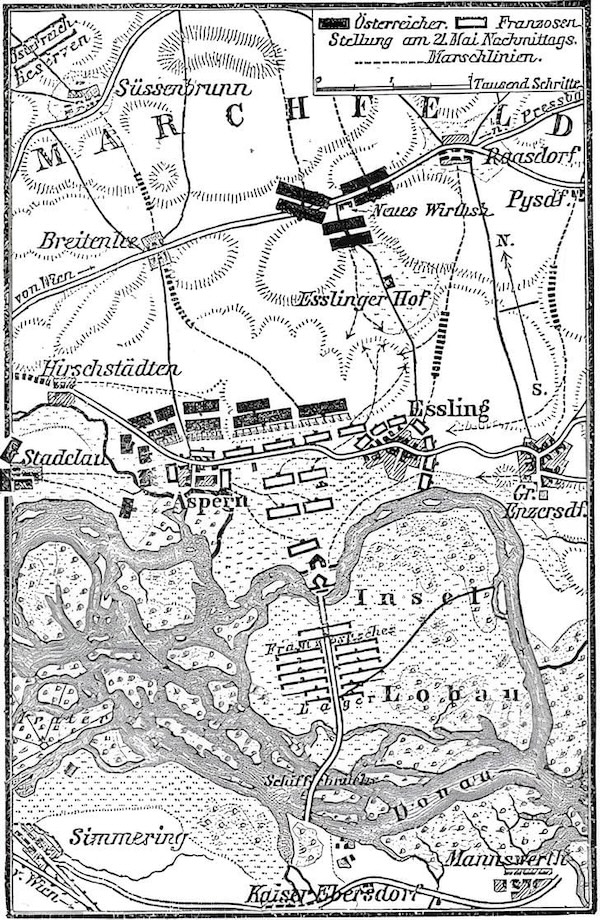
Essling is located to the east of the Austrian capital, about ten kilometers away. The place is situated on the left bank of the Danube, not far from Wagram. It is currently a district of Vienna. The village is built on a vast, flat, and marshy expanse. In May 1809, heavy rains and snowmelt created challenging conditions for movement. The Danube is then powerful and wide. The town was relatively unknown until May 1809, when it became the site of the eponymous battle, which took place from the 20th to the 22nd of May.
Why Did This Battle Take Place?
In 1809, Napoleon faced significant challenges. Engulfed in an endless war with Spain, he encountered severe setbacks, including guerrilla warfare by the Spanish population, inadequate troop equipment, and difficulties in overcoming the British. Meanwhile, England encouraged Austria to seek revenge for its defeat at Austerlitz in December 1805. The motivation extended beyond vengeance; Austria aimed to reclaim territories lost through the Treaty of Pressburg, including Venetia, Istria, and Swabia, among others.
France’s position was further weakened by discord with its ally, Russia, which refused to threaten Austria in cases of aggression. This was despite Napoleon’s offer to cede the Danubian principalities to Alexander I. The Austrians seized this opportune moment to undermine Napoleon’s dominance, leading to their decision to launch an attack.
Who Took Part in the Battle of Aspern-Essling?
The Battle of Essling witnessed the involvement of over 80,000 French troops and 95,000 Austrian forces. Napoleon I commanded the French, while Archduke Charles-Louis of Austria was in charge of the Austrians. The main components of the French forces included the 4th corps of Marshal Masséna, supplemented by the cavalry of Marshal Bessières’ guard, and the 2nd corps of Marshal Lannes. On the Austrian side, there were the corps of Bellegarde, Hohenzollern, Rosenberg, Hiller, and the cavalry of Liechtenstein.
How Did the Battle of Aspern-Essling Unfold?
The conflict began in April with several battles between the French and the Austrians (Tengen on April 19, Abensberg on April 20, and Eckmühl on April 22). The Austrians were forced to retreat. Napoleon pursued them and reached Vienna on May 12. The capital capitulated the following day, but Austria rejected peace and withdrew beyond the Danube.
The archduke orders the destruction of all bridges, blocking the enemy, who must hastily construct makeshift bridges to reach the other side. On May 20, Aspern and Essling were reached. The swollen river became a significant ally for the Austrian forces. They threw various objects into the water to weaken the French construction.

On May 21, the Austrian army, commanded by Johann von Hiller, Heinrich-Johann de Bellegarde, and Friedrich Franz Xaver von Hohenzollern-Hechingen, attacked Aspern, held by Masséna. The French positions were crushed. Napoleon then sent his cavalry. Similar clashes occurred in Essling. On May 22, the fighting continued. At Aspern, the Austrians gain the upper hand. At Essling, it was the opposite. Napoleon counterattacks and sends Lannes’ troops.
Marshal Lannes was wounded in the legs. The French victory seems assured. However, the bridges established by the Napoleonic troops gave way. The French army was then cornered, with no reinforcements possible. Under Austrian bombardments, the troops retreat. The belligerents are exhausted, and the losses are enormous.
Who Won the Battle of Aspern-Essling?
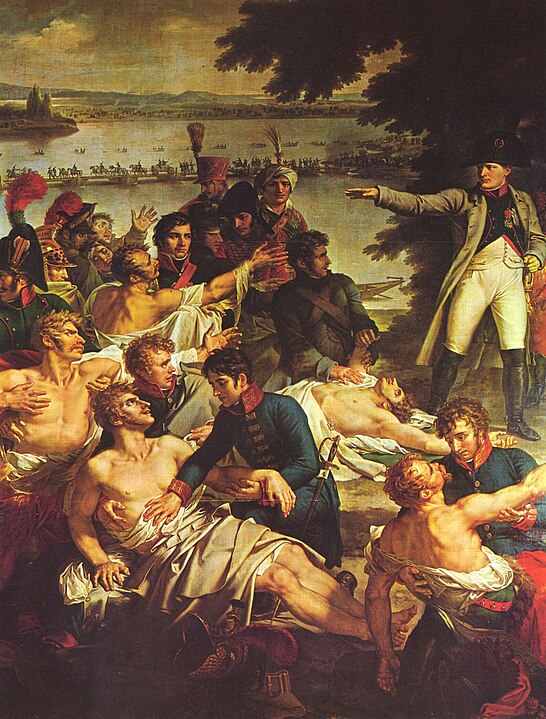
Austria regards it as a victory. France perceives this defeat as a temporary setback. What began as a straightforward crossing turned into a full-fledged battle. Despite the resilient resistance of the French, the failure is evident. The significant loss of life and the withdrawal of the Napoleonic forces have left a lasting impact. Essling was deemed to be Napoleon’s first personal failure. Concerning Austria, the triumph may not be absolute, but Charles-Louis of Austria asserts its claim.
What Were the Consequences of the Battle of Aspern-Essling?
The Battle of Aspern-Essling is primarily known for its significant human losses. The French lost over 20,000 men, including one of Napoleon’s ablest field commanders and closest friends, Marshal Jean Lannes, who died after losing a leg to a cannonball wound. On the Austrian side, there were 23,000 fatalities.
Source:
- Parker, Harold T. (1983). Three Napoleonic Battles (2nd Ed). Duke University Press.
- Bodart, Gaston (1908). Militär-historisches Kriegs-Lexikon (1618-1905)