In the pantheon of nineteenth-century nation-builders, if Count Camillo di Cavour served as the calculating diplomatic brain of Italian unification and Giuseppe Mazzini acted as its idealistic prophetic soul, then Giuseppe Garibaldi was indisputably its fearless, indispensable sword. Born a sailor in Nice, condemned to death in his twenties as a revolutionary rebel, hardened by twelve years of guerrilla warfare in South America, and adored across the globe in his signature red flannel shirt and poncho, Garibaldi accomplished military feats during the Risorgimento—the “Resurgence” or unification of Italy—that transformed a geographic collection of divided monarchies into a single unified Kingdom of Italy in 1861.
From Merchant Sailor to the Hero of Two Worlds
Giuseppe Garibaldi was born on July fourth, 1807, in the coastal city of Nice (Nizza), which had recently been annexed by Napoleonic France and was soon returned to the Italian Kingdom of Piedmont-Sardinia. Growing up on the Mediterranean docks, he became a merchant sea captain in his twenties. During a voyage to the Black Sea in 1833, Garibaldi met followers of the exiled nationalist thinker Giuseppe Mazzini and joined Young Italy (La Giovine Italia), a secret movement dedicated to driving Austrian Habsburg rule out of the Italian peninsula and establishing a unified democratic Italian republic.
After participating in a failed republican sailors’ mutiny in Genoa in February 1834, the twenty-six-year-old Garibaldi saw his name printed in a newspaper notice sentencing him to death by firing squad in absentia. Fleeing in disguise across the Atlantic Ocean to South America, Garibaldi spent the next twelve years fighting for independence and republican causes—first for the breakaway Rio Grande do Sul Republic in southern Brazil, where he met his fearless comrade and future wife, Anita Ribeiro da Silva, and then commanding the Italian Legion in the defense of Montevideo during the Uruguayan Civil War. It was in Uruguay in 1843 that Garibaldi acquired a shipment of cheap red woolen tunics originally manufactured for workers in Buenos Aires slaughterhouses; worn to mask bloodstains and identify his volunteers in gunsmoke, the Red Shirt (Camicia Rossa) and South American gaucho poncho became Garibaldi’s lifelong uniform and earned him international fame as the “Hero of Two Worlds.”
The Defense of the Roman Republic in 1849
When the Revolutions of 1848 swept across Europe and Milan and Venice rose up against Austrian rule, Garibaldi sailed back to Italy with sixty of his veteran Red Shirts to offer his sword to the cause of national liberation. In the spring of 1849, after Pope Pius IX fled a popular uprising in Rome, Mazzini and Roman democrats proclaimed the short-lived Roman Republic, entrusting the military defense of the Eternal City to Garibaldi.

When French President Louis-Napoleon Bonaparte dispatched a professional French expeditionary army under General Oudinot to crush the republic and restore the Pope, Garibaldi led a heroic, outnumbered defense atop the Janiculum Hill from April to July 1849, routing the initial French assault at the Porta San Pancrazio before weeks of heavy French siege artillery breached the ancient walls. Refusing to surrender personally, Garibaldi led four thousand volunteers—accompanied by his pregnant wife Anita mounted on horseback—in a legendary mid-summer retreat across the Apennine mountains while hunted by French, Austrian, Spanish, and Neapolitan armies. Although Anita died tragically of malaria in his arms inside a farmhouse near Ravenna while Garibaldi barely escaped back into exile—spending time working quietly as a candle maker on Staten Island, New York, and captaining ships in the Pacific—his defense of Rome made him a living legend to every patriot in Italy.
The Pragmatic Alliance With Cavour and King Victor Emmanuel II
Returning to Italy in 1854 to purchase a rugged granite farm on the Sardinian island of Caprera, the maturing Garibaldi made a momentous political decision that broke the hearts of strict republicans like Mazzini: recognizing that only the regular army and diplomatic alliances of the Kingdom of Piedmont-Sardinia had the realistic strength to expel the Austrian Empire from northern Italy, Garibaldi set aside his republican idealism and pledged his loyalty to King Victor Emmanuel II and his brilliant Prime Minister, Count Cavour.
During the Second Italian War of Independence in 1859, while Franco-Piedmontese forces fought the Austrians at Magenta and Solferino, Garibaldi commanded a volunteer mountain corps called the Hunters of the Alps (Cacciatori delle Alpi), winning dazzling victories over Austrian forces at Varese and San Fermo to liberate northern Lombardy. Yet his relationship with Cavour soured into bitter fury in early 1860 when, in exchange for French military help and annexation of central Italy, Cavour ceded Garibaldi’s beloved hometown of Nice to Emperor Napoleon III of France—turning Garibaldi into the eloquent Italian parliamentarian noted wryly that Cavour had made him a foreigner in his own homeland.
The Expedition of the Thousand (1860): Conquering a Kingdom
Just weeks after losing Nice, in May 1860, Garibaldi launched the most audacious military campaign of the nineteenth century: the Expedition of the Thousand (Spedizione dei Mille). Learning of an armed revolt in Sicily against the tyrannical rule of the Bourbon King Francis II of the Kingdom of the Two Sicilies—who commanded a well-equipped regular army of over one hundred thousand soldiers and a powerful navy—Garibaldi crowded exactly one thousand and eighty-nine volunteers, mostly students, professionals, and artisans wearing red shirts and armed with rusty antique smoothbore muskets lacking bayonets, aboard two hijacked paddle steamers, the Piemonte and the Lombardo, sailing out of Quarto near Genoa on the night of May fifth, 1860.
Landing at Marsala on the western tip of Sicily on May eleventh under the indirect presence of British Royal Navy warships, Garibaldi declared himself Dictator of Sicily in the name of Victor Emmanuel II, King of Italy. Only four days later, at the terraced hill of Calatafimi, when his outnumbered volunteers came under heavy rifle fire and his lieutenant Nino Bixio suggested retreating, Garibaldi uttered his immortal reply: “Here we make Italy, or we die!” Charging uphill with the bayonet, the Thousand routed the Bourbon troops.Joined by thousands of Sicilian peasant insurgents (picciotti), Garibaldi executed a brilliant feint through the mountains to storm the capital city of Palermo, won a fierce pitched battle at Milazzo, crossed the Strait of Messina onto the Italian mainland in August, entered Naples in an open carriage to the thunderous cheers of the populace without firing a shot on September seventh, and defeated thirty-five thousand Bourbon regulars at the Battle of the Volturno on October first. In under five months, a thousand poorly armed volunteers had toppled an eight-hundred-year-old kingdom of nine million people.
The Handshake at Teano and Legacy
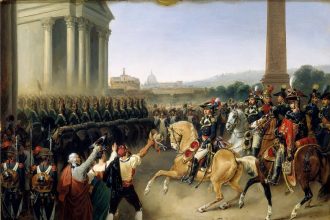
As Garibaldi stood victorious in Naples preparing to march north to liberate papal-held Rome—a move that would have triggered an immediate war with the French garrison protecting the Pope—Count Cavour hastily marched the royal Piedmontese army south through the eastern Papal States to intercept him. The climax of the Risorgimento occurred on the morning of October twenty-sixth, 1860, at a rustic crossroads bridge near Teano, north of Naples.
Riding forward in his poncho and cap to meet King Victor Emmanuel II at the head of the royal army, Garibaldi—who held absolute dictatorial command over all of southern Italy and could have easily carved out his own personal realm—reined in his horse, removed his hat, and shouted aloud: “I salute the first King of Italy!” Having handed half of the Italian peninsula over to the King, Garibaldi asked solely for the recognition of his volunteer officers and a year’s supply of seed grain for his farm; when offered royal titles, dukedoms, castles, and fortunes by the grateful monarch, he refused every single coin and sailed quietly back to his rocky island of Caprera carrying only a sack of dried beans, a bag of seed corn, and a barrel of salted cod. Although he spent his later years campaigning tirelessly to add Venice (achieved in 1866) and Rome (achieved in 1870) to the new nation before passing away on Caprera in June 1882, that selfless handshake at Teano secured Garibaldi’s place as the incorruptible father of modern Italy.