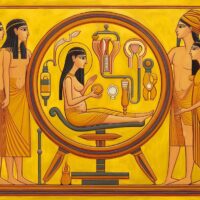
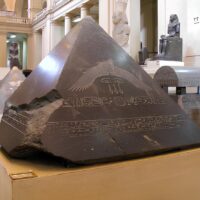
When ancient Egyptian embalmers spent seventy days preparing a pharaoh’s body for eternity, they took a sharp bronze hook, inserted it up through the left nostril, smashed the ethmoid bone, and liquefied and drained the human brain onto the floor to be thrown away as useless stuffing. Yet when those exact same priests opened the abdomen to remove the internal organs into canopic jars, they obeyed one absolute, inviolable command: the heart—known in ancient Egyptian as the ib or haty—had to remain untouched and sewn securely in its natural place inside the chest cavity. To the physicians, philosophers, and priests of the Nile, the heart was not merely a muscular pump; it was the physical throne of intelligence, emotion, memory, and the literal moral witness that decided whether a soul lived forever or ceased to exist.
The Ebers Papyrus and the Channels of the Metu
From a purely anatomical and clinical standpoint, ancient Egyptian doctors understood the mechanics of the cardiovascular system centuries before any other civilization on Earth. In the famous Ebers Papyrus (written around 1550 BC, copying much older Old Kingdom medical treatises) and the Edwin Smith Surgical Papyrus, an entire section known as the Treatise on the Heart lays out an empirical observation of the pulse that astonished later Greek visitors.
The Egyptian medical writer opens by stating that the secret of the physician is the knowledge of the heart’s movement. When a doctor places his fingers on the crown of the head, on the back of the neck, on the wrists, on the arms, or on the legs, he is measuring the heart directly, because “the heart speaks out of every vessel of every member.” Egyptian anatomists called this network of radiating tubes the metu—a term that grouped together arteries, veins, tendons, and hollow ducts extending from the heart to every organ in the body. Just as the Nile River branched into irrigation canals to carry life-giving water and silt to every field in Egypt, the heart pumped blood, air, water, and vital energy through the metu to nourish the limbs, while diseases were diagnosed as “floods,” blockages, or sluggishness within the vessels descending from the heart.
Ib vs. Haty: The Seat of Mind, Will, and Creative Thought
While modern Western culture separates the “logical brain” from the “emotional heart,” ancient Egyptian psychology located every single cognitive, intellectual, and emotional faculty inside the heart itself. Interestingly, the Egyptian language used two distinct words for the organ: haty (written with the hieroglyph of a physical animal heart with its attached aorta and pulmonary vessels) referred primarily to the physical muscular organ beating in the chest, whereas ib referred to the metaphysical heart as the seat of consciousness, memory, courage, wisdom, and moral character.
Everyday Egyptian idioms reflected this cardiocentric worldview: a brave man was called “broad of heart,” an impatient or angry man was “short of heart,” a joyful person was “long of heart,” and to forget something was literally to “eat one’s heart.” Even the creation of the universe itself was attributed to the heart in the Memphite Theology inscribed on the Shabaka Stone: the creator god Ptah first conceived the design of every god, human, and object inside his heart (mind) through rational thought, and then spoke their names aloud with his tongue to bring them into physical existence.
The Weighing of the Heart and the Heart Scarab
Because the heart recorded every single thought, word, and action a person committed from birth to death like an incorruptible black box flight recorder, keeping the physical heart inside the mummy was essential for surviving the ultimate trial of the afterlife: the Weighing of the Heart (Psychostasia), detailed in Chapter 125 of the Book of the Dead. Guided by the jackal headed god Anubis into the Hall of Two Truths before Osiris and forty two divine judges, the deceased watched as Anubis placed their heart (ib) on one side of a golden balance scale and placed the ostrich feather of Maat—representing cosmic truth, justice, and harmony—on the opposite pan.
If the deceased had lived a virtuous life, the heart balanced perfectly with the feather—being literally “light hearted”—and the soul was welcomed into the eternal Field of Reeds (Aaru). However, if the heart was heavy with greed, cruelty, and lies, the scale tipped downward, and the terrifying composite monster crouching beside the scale—Ammit, the “Devourer of the Dead,” possessing the jaws of a crocodile, the forequarters of a lion, and the hindquarters of a hippopotamus—leaped forward and swallowed the heart on the spot, causing the person’s soul to suffer the “second death” and vanish into nonexistence forever. Just in case a person’s own honest heart tried to blurt out embarrassing sins committed on earth during the trial, wealthy Egyptians had a heavy green jasper or basalt stone carved into the shape of a dung beetle—the Heart Scarab—placed directly over the mummy’s chest and inscribed with Spell 30B of the Book of the Dead, begging their own organ: “O my heart which I had from my mother! Do not stand up as a witness against me, do not oppose me in the tribunal, and do not tip the scales against me in the presence of the Keeper of the Balance!”