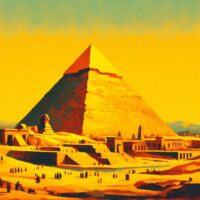
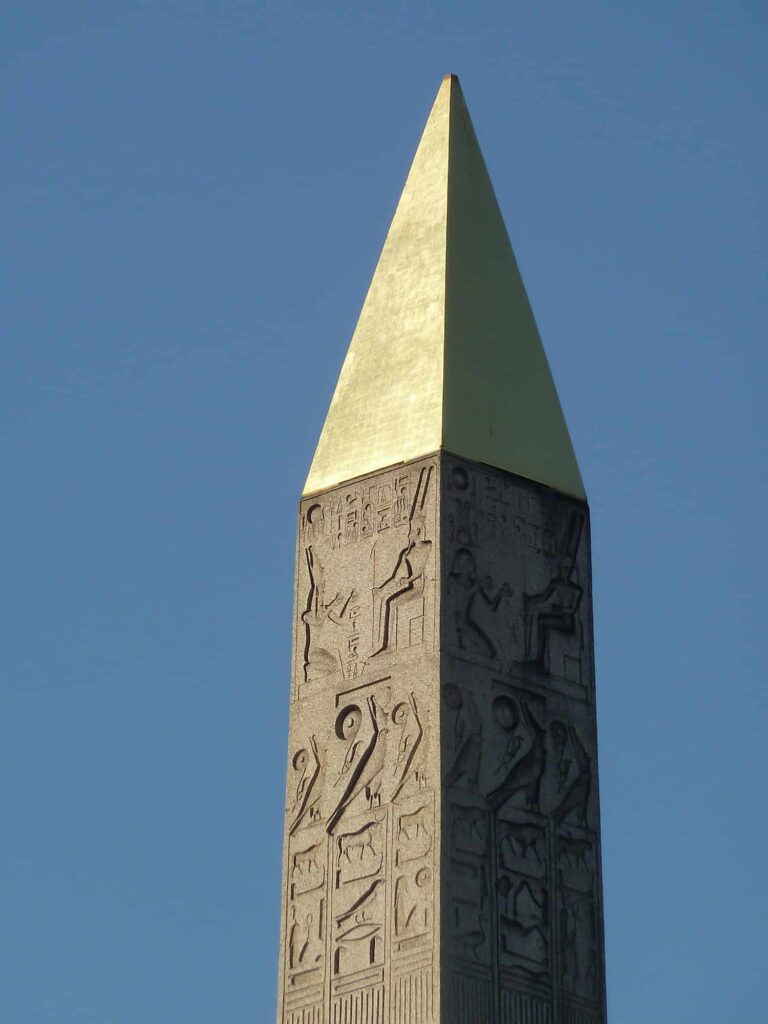
Pyramidion is the term used in archaeology to refer to the pyramid-shaped top, last, or final stone of a pyramid—called benbenet in Ancient Egyptian, associated with the so-called Benben—as well as the pyramid-shaped tip of an obelisk. Pyramidia from pyramid structures have nearly the same proportions as these structures and represent them in a reduced or condensed form. In the Old Kingdom, this form was carved out of a block of diorite, granite, or limestone. Often, the sides are inscribed and coated with electrum.
Discoveries
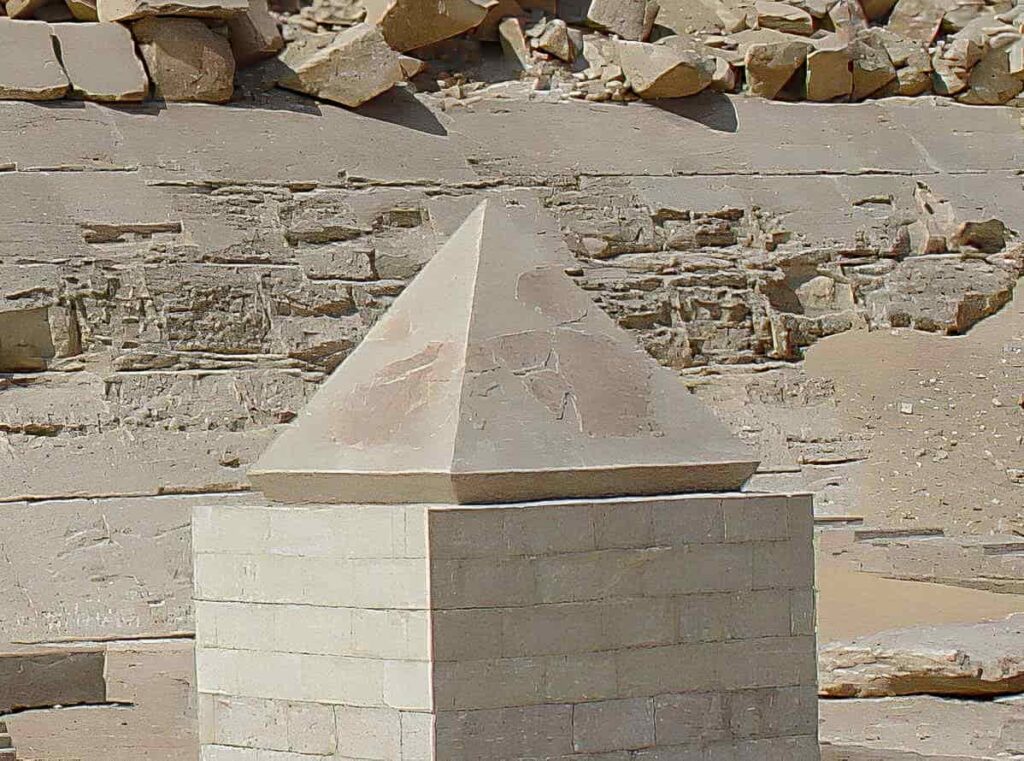
Not many pyramid tops from Egyptian pyramids have been found so far. For some of the findings, also due to the state of preservation, it is not certain whether they actually sat atop a pyramid and, if so, which one. Some may have also belonged to an obelisk.
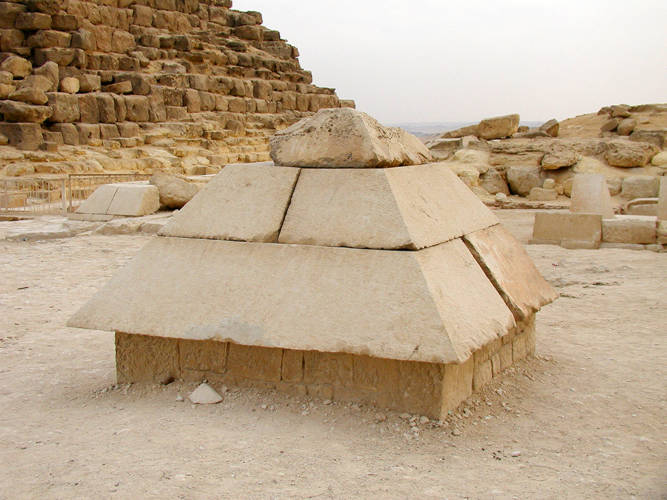
From the Old Kingdom come the earliest ones. The limestone fragments of the pyramidion, now restored and standing in front of the Red Pyramid of Sneferu in Dahshur, which are about 5 feet high (see top illustration), are dated as the oldest to the time before 2620 BCE. Also belonging to the 4th Dynasty is the pyramidion of the cult pyramid (G I-d) of Khufu at the southeast corner of the Great Pyramid of Giza, and also the square base of a pyramidion of a subsidiary pyramid (G III-a) of Menkaure south of the Pyramid of Mykerinos, both in Giza and made of limestone.
Dating to the 5th Dynasty is a pyramidion fragment from the pyramid of Khentkaus II made of dark granite, which had a metal coating, and one near the Lepsius XXIV pyramid, both in Abusir. For the 6th Dynasty, several pyramidia are known, four alone from the complex of the Teti Pyramid in Saqqara, two of them with a rectangular base and each about 1.65 feet high.
From the Middle Kingdom and attributed to the 12th Dynasty are fragments of pyramidia made of red granite near two queen’s tombs of the pyramid complex of Senusret I in el-Lisht, inscribed fragments of the pyramidion of the pyramid of Senusret II in el-Lahun, as well as the inscribed one made of black granite from the pyramid of Amenemhat III in Dahshur (see illustration below).

Two uninscribed pyramidia made of black granite from the Second Intermediate Period, both at the entrance of a begun tomb construction (the South Pyramid), also in South Saqqara, and several fragments of the inscribed pyramidion from the pyramid of Khendjer, as well as, according to its inscription, that of the (so far unlocated) tomb of Aya I, all from the 13th Dynasty, also from the 17th Dynasty, that of the mudbrick pyramid of Nubkheperre Intef in Dra’ Abu el-Naga.
(Wowo2008, cc by sa 4.0)
From the New Kingdom, numerous pyramidia are decorated according to a fixed image schema, from officials’ tombs, whose superstructure could be built as a brick pyramid at that time. This includes the 1.65 feet high pyramidion of Mose or Mes, a scribe of the 19th Dynasty during the time of Ramesses II, which was made of limestone in the 13th century BCE and is now housed in the Hildesheim Roemer and Pelizaeus Museum.
Geometric Proportions
The found pyramidia correspond in their shape to the idealized geometric body of a straight pyramid based on a square. Some have a rectangular base, most have a square base; differences exist in the dimensions of the base and the height, or in the size of the base and the slope of the sides. For a regular straight pyramid on a square base, the angle of inclination α of the four sides of the lateral surface results from the respective ratio of height h to base b (tan α = 2•h / b). For example, for a pyramidion on a square base with four exactly equilateral triangles as lateral surfaces, where all 8 edges are of equal length, an inclination angle of 54° 44′ (rounded height to base length ratio) results here.
Approximately that inclination angle was realized around 2650 BCE in the Old Kingdom during Pharaoh Sneferu’s first attempt to build a large unstepped pyramid in the 2nd construction phase of the Bent Pyramid on a square base of about 620 feet (190 m) in base length; however, due to the technical difficulty of stabilizing the enormous load of the structure, its upper part was then executed in the final 3rd construction phase with a shallower slope at an angle of about 44°. With this inclination angle, subsequently, 1.2 miles north on a larger base (base measurement about 720 feet), the first unstepped and un-bent large pyramid was erected, the roughly equally high Red Pyramid of Sneferu on the plateau of Dahshur.

Details of the Pyramidion of Amenemhet III.
The pyramidion of the structure also known as the Black Pyramid, which Pharaoh Amenemhet III of the 12th Dynasty in the Middle Kingdom had erected in Dahshur at the beginning of his reign, still before 1800 BCE, was found there in the rubble at the east base in the year 1900 CE. The pyramid-shaped capstone measures about 6 feet as the base length of the square base and about 4.6 feet in height; it is made of black granite and inscribed all around. Possibly, the stone, like the tips of some obelisks, was previously covered with electrum, a metallic alloy of gold and silver. The slightly worn smooth surface, however, also suggests that this pyramidion was never placed atop a pyramid.
During the construction of the Black Pyramid in Dahshur, subsidence and cracks in the structure, which was too heavy for its foundation, became apparent.
At an assumed slope angle of around 57°, it would have become or was the highest pyramid built in the Middle Kingdom, reaching over 262 feet. Soon after this first one, Amenemhet III began the construction of a second one, the Hawara Pyramid with the same base (side length about 345 feet), but with a lower inclination angle (around 49°) and in a different location, near the pyramid of Senusret II in the Fayyum Basin.