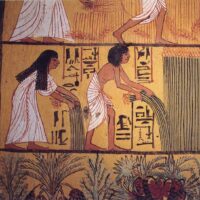
When the Greek poet Homer wrote in the Odyssey that in Egypt, “every man is a physician, wise above all human-kind,” and when the historian Herodotus visited the Nile in the fifth century BC, both marveled at a healthcare system unlike anything in the classical Mediterranean. Five hundred years before Hippocrates was born, ancient Egypt possessed state-salaried medical specialists—doctors who treated only the eyes, others who treated only the teeth, others who specialized in the stomach, and others who treated hidden internal diseases—operating within a dual healing framework that seamlessly blended clinical observation, anatomical diagnosis, and preventative hygiene with protective spiritual rituals.
The Swnw, the Priest of Sekhmet, and the Magician
As the Ebers Papyrus explicitly stated, a patient seeking medical care in ancient Egypt was served by three distinct, cooperating classes of healers who never viewed science and religion as enemies:
- The Swnw (Lay Physician): Educated inside the temple libraries known as the Per-Ankh (“House of Life”) at cities like Sais, Heliopolis, and Abydos, the swnw was a clinical practitioner who examined the body physically, took the pulse, palpated the abdomen, inspected urine, sputum, and sweat, and prescribed rational herbal, mineral, and surgical remedies. Remarkable tomb inscriptions from the Old Kingdom even prove that Egypt had female physicians: around 2700 BC at Saqqara, a woman named Merit-Ptah and certainly Peseshet held the official royal title “Lady Overseer of the Female Physicians”—the earliest named female doctor in world history.
- The Wab Priest of Sekhmet: Because the lioness goddess Sekhmet both unleashed and cured epidemic plagues, her specialized priests acted as public-health inspectors, veterinarians (inspecting sacrificial cattle for tainted meat), and crisis healers who checked pulses alongside the swnw.
- The Sau (Exorcist / Magician): When an illness had no visible external trauma—such as sudden fevers, scorpion stings, or epilepsy—Egyptians believed an invisible malignant wind or spirit had entered the body, requiring a chanted incantation (heka) spoken right over the herbal potion to activate its healing power.
Diseases of the Nile: Schistosomiasis, Sand Pneumoconiosis, and Teeth
Thanks to modern CT scans, X-rays, and DNA testing of thousands of preserved Egyptian mummies, paleopathologists know the exact everyday diseases that afflicted everyone from humble farmers to Pharaoh Ramesses II:
- Schistosomiasis (The “AAA” Disease): Because farmers and fishermen spent their days wading barefoot in the warm, slow-moving irrigation canals of the Nile, millions of Egyptians contracted schistosomiasis (bilharzia)—microscopic parasitic blood flukes carried by freshwater snails that burrowed through the skin of the legs and laid calcified eggs inside the bladder and liver, causing bloody urine (hematuria) documented extensively in the papyri.
- Sand-Worn Teeth and Abscesses: Why did almost every adult in ancient Egypt—including wealthy forty-year-old pharaohs—suffer from ground-down, flat molars and agonizing jaw abscesses even though they ate zero refined cane sugar? Because Egyptians ground their emmer wheat into flour for bread using rough sandstone hand-querns alongside blowing desert wind! Every loaf of daily bread was packed with microscopic grains of hard quartz sand that acted like sandpaper on tooth enamel, wearing teeth right down to the exposed nerve pulp by age thirty-five.
- Desert Lung (Sand Pneumoconiosis), Malaria, and Polio: Breathing fine Saharan silica dust caused chronic lung scarring, while marshes bred Plasmodium falciparum malaria (confirmed by DNA inside the mummy of eighteen-year-old Tutankhamun) and poliomyelitis (depicted vividly on an Eighteenth Dynasty limestone stele showing a Syrian priest named Roma walking with a withered, shortened right leg and a wooden crutch).
Remedies, Preventative Hygiene, and Moldy Bread Antibiotics
To combat these ailments in a hot climate, Egyptian medicine emphasized strict daily preventative hygiene: bathing twice a day in cold water, shaving head and body hair to prevent lice (which carried typhus) and wearing clean linen wigs instead, sleeping under woven mosquito nets (documented by Herodotus among Nile Delta marsh dwellers), and washing clothes with natron soda.
When illness struck, the remedies combined clever empirical science with sympathetic tradition: curing night blindness (caused by Vitamin A deficiency) by pressing the juice of roasted ox liver—one of the richest sources of Vitamin A on Earth!—directly into the patient’s eyes; treating asthma by inhaling the steam of heated henbane herbs through a reed; soothing dental pain with clove-like spices, onion, and willow bark; and pressing moldy wheat bread onto infected purulent wounds—unwittingly applying antibiotic fungal compounds more than three millennia before Alexander Fleming discovered penicillin.