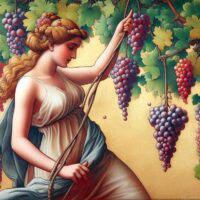
The Anthesteria (ancient Greek Ἀνθεστήρια, translated as “Flower Festival”) was a festival in the Attic festival calendar. It took place over three days, from the 11th to the 13th of the month Anthesterion, which overlapped with the modern months of February and March. Each of the three days had a different significance, with various rites and festival events. They were celebrated in honor of the god Dionysus, like four to five other festivals within and outside Athens. The festival was based on the second silent fermentation of wine. This means that the must from the previous year’s autumn had been transformed into finished wine in the meantime.
The name of the festival is derived from the Greek word ἄνθος (anthos), which served as an epithet Ἀνθεύς for Dionysus, the god of spring, and literally referred to simple flowers. This indicates the function of the celebrations as a spring festival to welcome the approaching spring. It is also known as the “older Dionysia.”
Attributes of the Anthesteria Festival
The Anthesteria is described as a joyful and exuberant celebration, carrying partly carnival-like features with its processions and costumes. The festival days were accompanied by a fair where various items from the surroundings were offered for sale, such as pottery, especially the pithoi, large painted clay vessels for the festival, young wine, and other export goods. This attracted many merchants and people from neighboring regions. The government gave small gifts to support the festival and officially recognized it. The main location for the festivities was a district on the western slope of the Acropolis, the Limnaion, which was said to be situated in a marshy area.
According to Thucydides:
[2.15.4] Proof that things were like this is that the temples of other gods are also located on the Acropolis, and those temples outside the city are rather built towards the southern part, such as the temple of Olympian Zeus, Apollo Pythios, Earth, and Dionysus in Limnae, where the oldest Dionysia are celebrated on the twelfth day of the Anthesterion month, as the Ionians, descendants of the Athenians, still believe. Other ancient temples are also built in the same area.
How the Anthesteria Festival Proceeded
Day 1: The Pithoigia—Opening of the Barrels
The Anthesteria began on the 11th of Anthesterion with the opening of the wine barrels, also known as Pithoigia. Here, the first reversal of normal circumstances became apparent, as all the temples of the gods in Athens were closed and draped with ropes. In contrast, the Dionysus temple, usually closed throughout the year, was only opened on this one day. This day was entirely dedicated to honoring Dionysus, thanking him for the completion of the new wine and, in general, for his role as its bearer. Mythically, special powers were attributed to this wine as it was the new wine.

In mythology, it was customary to initially consider the new and unknown as potentially dangerous, approaching them with caution and circumspection.
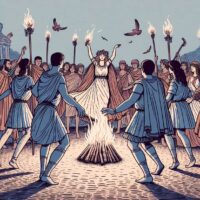
The celebrants handled the new wine in the same way. To eliminate the alleged dangers, specific rituals were performed. This included, for example, offering some of the wine to Dionysus at the beginning of the festival. This act sought to secure his favor and people hoped that he would purify the wine and banish its dangers. Participants took their pithoi and drinking vessels to the Limnaion, where they offered the wine. Additionally, they danced and sang in honor of the god. Slaves were also allowed to participate in this ritual. Apart from that, people enjoyed themselves on the accompanying markets, conducted business, and indulged in the new wine purified by Dionysus.
Day 2: The Choes—Opening of the Jugs
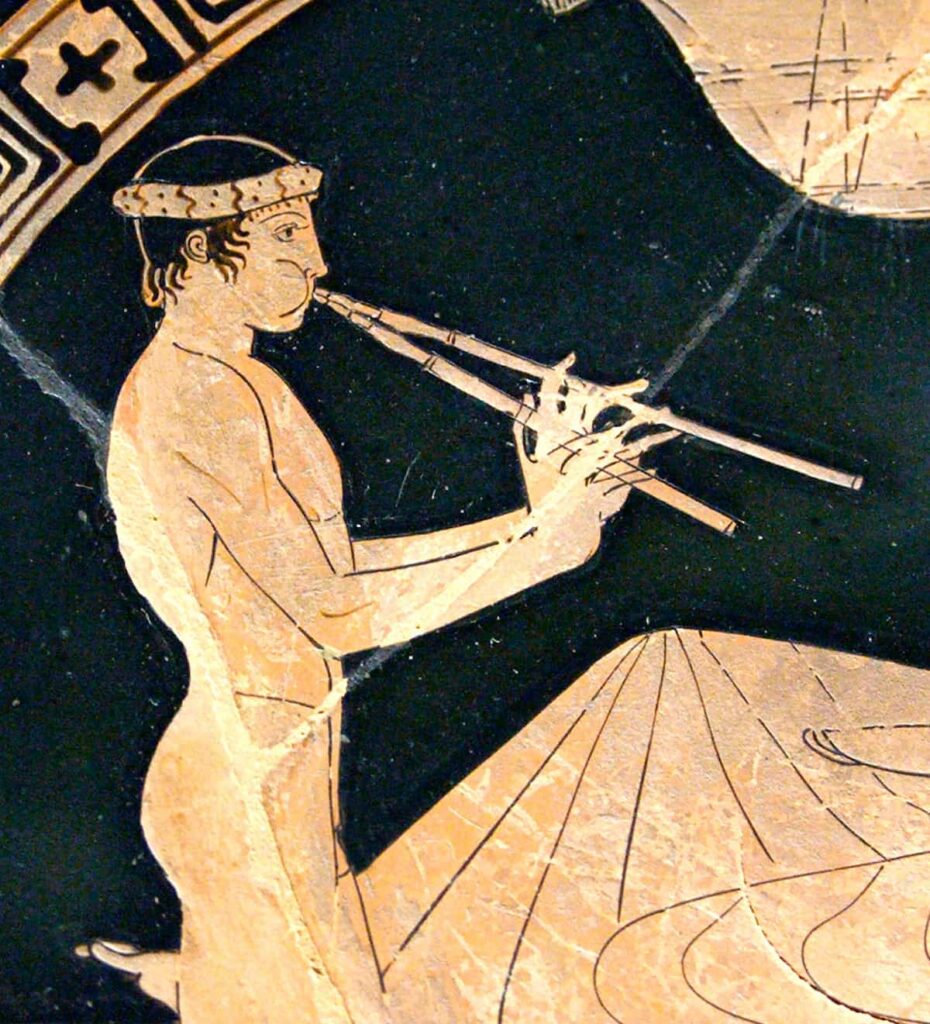
Another ritual displaying the unusual reversal of circumstances was the Choes. During the Anthesteria, each participant drank from their individual jug (Chous), instead of the usual practice of drawing from a communal mixing jug. Even children were sometimes given their own jugs (Choes cups), often adorned with images of playing and celebrating children. They were also adorned with flower wreaths on their heads, which, in connection with the first gift, could be seen as a kind of confirmation, an initiation rite. Due to high child mortality, it was believed that children were out of the greatest danger from the age of three onwards, and they were thus welcomed into the world of the elders.
Additionally, there was hope that the natural power of the flower wreaths would transfer to the children, strengthening them for the future. Adults also wore wreaths, which they placed around their jugs on the evening of the festivities and donated to the Dionysian priestess in the sanctuary. The Lenaion (a theater or a section of the Agora) was also entirely decorated with flowers. It is assumed that this function was performed by the Basilinna, who played another significant role in the cultic beliefs during the Anthesteria. The banquet was often accompanied by flute players. Another peculiarity was that everyone silently emptied their drinking bowls. The tradition of individual jugs and silence was based on an old legend about Orestes.
According to this legend, Orestes’ mother treacherously murdered his father, Agamemnon, leading Orestes, in deep despair, to commit matricide. After this terrible act, he wanted to present himself to the Areopagus in Athens on the day of the Anthesteria. The Areopagus decided to welcome Orestes warmly into the city and allow him to participate in the festivities. However, to avoid exposing the residents to the danger of being tainted by his sin, it was decided that everyone should drink from their own jug, contrary to their usual custom. This prevented transmission while still allowing Orestes to participate.
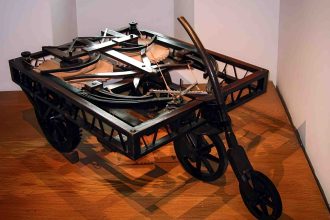
Apart from the crowning of young children, there were other blessing rites on the day of Choes. Perhaps the most important was the Hieros Gamos (a divine marriage), involving the Basilinna’s ritual marriage to the god Dionysus. In the early afternoon, the Ship Cart Procession took place. A ship on wheels, steered by a priest, traveled from the harbor into the city and then to the temple. Several rounds were made in the marketplace, with the population following behind and around the cart. Even the smallest children were allowed to participate in this event. Those on the cart mocked the population, and vice versa, creating a lively and wild atmosphere. Leading the procession was the Kanephoros (an honorific office for an unmarried young woman). The mythological significance suggests that Dionysus made his entrance on the cart for his wedding with the Basilinna, symbolizing his journey across the sea before arriving in Attica.
On the cart, actors portraying Dionysus and his entourage, dressed as gods, satyrs, or maenads, interacted with the crowd. Once the cart reached the temple, the Basilinna had to prepare for the wedding night. In the Dionysus temple, she lit a torch and took an oath affirming her personal purity, chastity, and the fulfillment of her religious duties. Accompanied by the 14 Gerarai (priestesses of Dionysus), under the expert guidance of the Basilinna, they performed various ritual functions at 14 altars in the temple. The title of the women meant “venerable,” expressing respect for their crucial role. They were not viewed as lustful followers of Dionysus but held a high standing in society.
Following these purification rituals, a wooden stele resembling the god was carried in a solemn procession, considered a wedding procession with the Basilinna, from the temple to the Bucolion. These premises were an old, renovated office of the Archon. The procession was accompanied by a large and exuberant audience, walking alongside the cart. Once the Basilinna arrived at the Bucolion, she was the only one allowed to enter, aside from the god, her bridegroom.
To be worthy of this task, she, as the wife of the Archon Basileus, had to meet certain requirements, such as not having had another man before him. On the premises, she then conducted the wedding night, which was said to involve secret rituals. The role of Dionysus might have been represented by individuals, with her own husband being the most likely candidate, essentially providing the outer vessel for the god. While intimacy was celebrated inside, the outside population continued to revel through the night. At the first light of day, the stele was brought back to the Dionysus temple, concluding the wedding night and completing the ritual marriage.
Despite all these festivities and commotion, one must not neglect another crucial aspect of Choes. Towards the evening of the 12th Anthesterion, the transition to Choes began. The entire day was critically viewed by contemporaries, who advised against concluding any business deals and generally regarded it as an unlucky day.
In the evening, according to the Athenians’ beliefs, the deceased began to emerge to haunt the surface.
Day 3: The Chytroi—the Day of the Dead
The final day of the festival stood in complete contrast in its sequence and significance to the first and second days. It was the day of the dead, competitions, and cooking pots.
This is derived from the fact that on that day, a panspemie, a pot dish made from grains without sacrificial meat, was prepared and offered. The panspemie was presented as a gift by beautiful women. The women simultaneously prayed for the dead and their ancestors. The sacrifice was not consumed but, along with the components of water, flour, and honey, was offered in a trench half a meter wide near the Temple of Olympian.
These proceedings were meant to remind people of the chthonic Hermes as a death offering to atone for those flooded during the time of Deucalion (“Deucalion Flood”). The third day of the Anthesteria was considered an eerie time due to its strong connection to the dead, with its negative effects extending even to the entire month. Various defensive measures were taken out of fear of allegedly appearing spirits. Two of them, for example, were to smear doors with pitch and chew hawthorn in the morning, attempting to protect the house and bodily openings from invading souls.
Simultaneously, in honor and appreciation of the dead, mimetic dances, musicals, and rhetorical performances were presented. However, no play considered a sign or characteristic of Dionysus was staged. Various athletic competitions were organized but were regarded as funeral games. Temples were also sealed to keep out uninvited guests, such as ghosts. Particularly interesting was that the time of Chytroi coincided with another festival, the Aiora Swing Festival, mainly celebrated by children and teenagers.
They were supposed to swing long and intensively to cleanse themselves and gain blessings. This was to happen by hurling away misfortune through vigorous movement. The festival served as an expiatory celebration for the deceased Erigone (daughter of Icarius), a rite to honor the dead, to appease them, and thus to gain happiness in the new year. After the end of the last day, various chants were uttered to drive the spirits out of the houses.
Interpretations of the Anthesteria Festival
Connected to Dionysus, the Anthesteria is also called the Short Dionysia, and Thucydides mentions them as the “older Dionysia.”
The interpretation of Anthesteria as the “festival of flowers” dates back to antiquity, although flowers played a very limited role in this festival, only on its first day. In the time of the Cambridge ritualists, A. W. Verrall interpreted the name of this festival as a “calling back” or “re-calling” (from ἀναθέσσασθαι, “to pray back” or “up”), where the spirits of the deceased were called back into the world of the living (which might be compared to the Roman ritual of opening mundus).
His contemporary, Jane Ellen Harrison, viewed Anthesteria primarily in the context of the festival of “all saints,” whose purpose was to appease ancestral spirits.
Harrison considered the “opening of the jars” (Pithoigia) as a ceremony of opening tombs (πίθος would in this case denote a large urn in which the ashes of the deceased were placed), the “festival of wine jugs” (Choës) as a day for liquid offerings – libations (χοαί), and the “festival of pots” (Chytroi) as the day of grave vats (χύτροι), which actually preceded the day for opening the jars.
Later researchers, such as Eleanor Rohde and Martin P. Nilsson, believed that χύτροι meant “water vessels” and connected this festival with the Hydrophoria (“water-carrying”) ceremony, a libation festival organized to appease the dead who disappeared in the Deucalion Flood. Henri Jeanmaire agrees that it is precisely the festival of the dead that sets the tone for the entire festival.
Jean Haudry introduces the concept of darkness into the notion of anthos and interprets the name Anthesteria as the “festival of those who have passed through the darkness (winter).” The arrival of Dionysus at the water symbolizes the “passing of winter darkness” and the end of winter.
Both in the festival of the dead and in the festival of wine, Anthesteria, held at the end of winter, corresponds to the Athenian Oschophoria festival rites, held in the fall, where cooked seeds were offered as a sacrifice, revealing a kind of rhythm in the observance of rural festivals tied to the seasons.