It’s a common saying or tale that’s told over and over again: “People died young in the Middle Ages!” Alternately: “You would be an old man in the Middle Ages at the age of 40!” The average life expectancy of a medieval man is often mentioned in both popular and academic works, as well as in schoolbooks and pedagogical materials on medieval life. Somewhere between 33 and 50 years for males and 25 and 40 years for women is often cited as the average lifespan for Middle Age people; however, this range may vary greatly, as seen by a cursory examination of the available data. And it is unclear not only how these numbers were compiled but also whether they apply to the early, high, or late Middle Ages, to a certain location, or to a specific socioeconomic group.
How Long Did People Live in the Middle Ages?
The “Middle Ages” are now to be interpreted as “the dark, backward, unhygienic, unenlightened period before modernity,” when people’s lives were short and difficult, full of sickness and filth, and dominated by a foreign church and ruler. But this cliche has been disproven many times. What can we say with certainty about the average lifespan in the Middle Ages?
No, you did not suddenly begin getting gray hairs at the age of 20. A person who made it to maturity could expect to live for a long time beyond the age of 35 during the Middle Ages.
In the 15th century, the median age of the French infantry was 32, and 51 percent were 31 or older. As usual, we know very little about the lives of the poor and working classes of the Middle Ages. Their birth and death dates, as well as the number of children they produced, are unknown. Only by chance do things about people’s lives in the Middle Ages come out in directories of landlords, chronicles, and other written sources.
But famous names are an exception to this norm. To give a rather arbitrary example, Charlemagne lived to be 66 or 67 years old, while his biographer Einhard lived to be about 70. The Flemish poet Jacob van Maerlant lived for approximately 60 years. It is estimated that the Holy Roman Empire bishop and scholar Albertus Magnus lived to be 80, the saint Hildegard von Bingen to be 81, the author Christine de Pizan to be at least 65, Eleanor of Aquitaine to have perhaps died at 82, and the Nuremberg master builder Endres Tucher to have died soon after his 84th birthday.
On the other hand, it is also easy to name instances of renowned people’s children who died at a young age themselves, whether in puberty or youth. So, what do these numbers suggest? Did people really die young or only live to an average age of 35 in the Middle Ages?
Life Expectancy From the 13th to 18th Centuries
The Australian mathematical statistician Henry Oliver Lancaster looked into the lifespan of English aristocrats from the year 1200 to the year 1745. He determined the life expectancy of individuals who died of old age or sickness by omitting those who died through violence, accidents, or poison. A 21-year-old in the 15th century had a minimum life expectancy of 69 years. Citizens between the ages of 16 and 60 were eligible to serve in the militia, meaning that all adults up to that age were deemed physically and mentally capable of participating in military service.
Henry Lancaster compares how long people have lived across different time periods:
1200–1300: 43 years, 1300–1400: 24.5 years, 1400–1500: 48 years, 1500–1550: 50 years, 1550–1600: 47 years, 1600–1650: 43 years, 1650–1700: 41.5 years, 1700–1745: 43 years.
The Factors That Affected Lifespan in the Middle Ages
During the Middle Ages, most deaths occurred in three age groups: Young children (0–5) from childhood diseases, young adults from war or childbirth, and the elderly (60+), who lived to an age that was considered old according to the Bible’s lifespan of 70 years, as a historical source. The medieval people who lived to the age of 25 were not old, but they were a group for the most unpredictable factors: war and childbirth deaths.
In common with other pre-modern nations, medieval people had little medical expertise and a high mortality rate overall. At adolescence, life expectancy started to differ between the sexes, despite continuing to rise with age. When boys reached the ages of 15 and 16, life expectancy was estimated at 60 to 80 years. However, mothers (especially the girl-mothers) were at increased risk for difficulties during delivery. Future King Edward I was born to Henry III (1207-1272) and his 16 years old bride Eleanor.
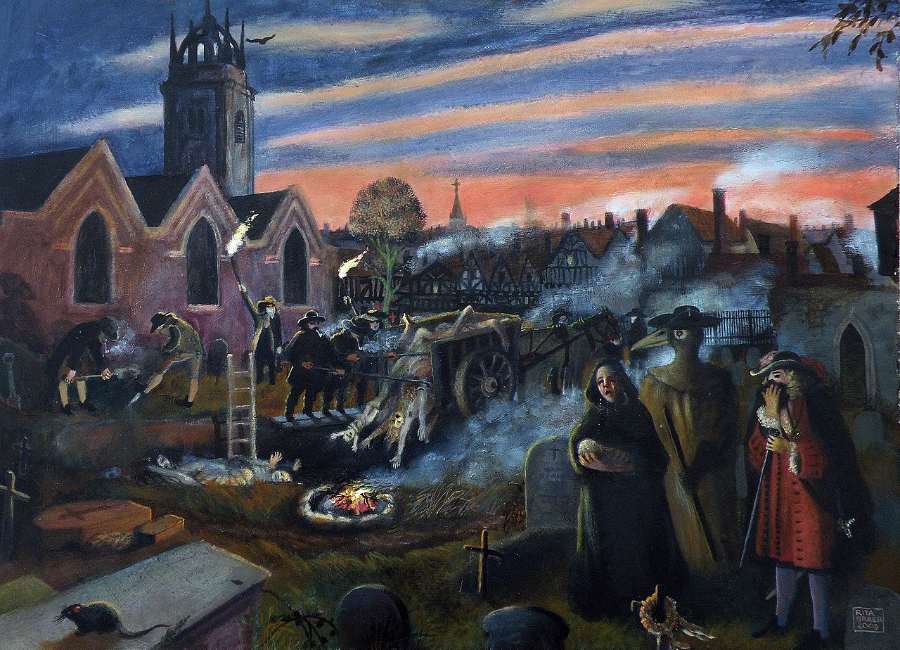
Natural calamities and illnesses like the Black Death significantly reduced the life expectancy of the medieval people, yet certain individuals, like the Doge of Venice, Enrico Dandolo (1107–1205), lived to be 90 years old and commanded the Venetian navy.
Just like today, a person’s lifespan in the Middle Ages was affected by a variety of factors, including their environment, genetics, diet, health, and access to medical treatment, as well as their socioeconomic level. According to the Nuremberg City Library archives, a Middle Ages citizen, a stonemason, lived in central Europe from the time he was 68 until his death in 1595. Monks and nuns of the Middle Ages, for example, had far higher life expectancy statistics than the general population since they did not rely on landlords for hard physical work. So, they were able to live pretty longer than other citizens.
The Reason for the Short Lifespan Estimations in the Middle Ages
The truth is that the average life expectancy in the Middle Ages actually says little about the actual age of death of a large portion of the population, the expected or achievable age, or the distribution of the average age.
Because child mortality rates in medieval times were quite high, they dragged down the overall life expectancy average.
This calls for statistics, but due to a lack of data, accurate statistics cannot be generated. In principle, most medieval individuals could indeed pass away by age 40, given that this is the median lifespan (give or take a few years). In reality, however, there is a much wider variation: While many medieval children died as infants due to illness, malnutrition, accidents, and other causes, another not insignificant number lived to a ripe old age at this time.
The high infant mortality rate, which was mostly attributable to illnesses or a lack of medical knowledge and treatment, an improper or insufficient diet, poor cleanliness, delivery problems, and sudden infant death syndrome, was a key factor in the fabrication of these short lifespan statistics for the Middle Ages. According to the estimations, up to 40 percent of children died before they reached puberty during the medieval period, and another 10 to 20 percent died within their first year.
However, if one made it through their youth unscathed in the Middle Ages, their chances of living to be 50, 60, or even older were not terrible. But threats to human safety from things like violence, war, disease, starvation, and accidents persisted. Medieval women had to deal with the added stress of having many children, while males had to contend with the risks of strenuous manual work, both of which might drastically reduce their lifespans relative to modern times. Today, smoking, cancer, cardiovascular disease, and diabetes are only a few examples of the many contemporary risk factors that either have little impact or none at all on our lifespan.
When Was Someone Considered Old in the Middle Ages?
People living all the way to retirement age or a greater old age were not uncommon in the Middle Ages. Depending on the time period and the historian, the phases of medieval life were defined in various ways. However, in general, a person was regarded as an adult (adultus) from the ages of 21 to 40, a “mature” (maturus) from the ages of 41 to 60, and an elderly man from 61 and beyond (senectus).
Thus, the perception of old age and young age was pretty similar in the Middle Ages to what it is today.
Many teenagers commonly took the lead in combat throughout the Middle Ages, and 25 was considered a mature adult, typically with a family and responsibilities. It was no surprise at the time that William the Conqueror invaded England in his late 30s. Since it does not take into account things like deaths from sickness, the average life expectancy might be deceptive. A longer life expectancy of 60 years includes more elderly individuals, but also more children who live beyond the age of 5.
Due to the lengthy apprenticeship and journeyman’s time required, few urban craftsmen would have been able to earn the master’s title and open their own workshop before the age of 30 or 40. Ages 40 and up had traditionally been seen as the cutoff for serious consideration for public office because of the inherent “maturity” that comes with it. However, the exception proves the rule, as typically only those who were considered “worthy” were granted any office role.
So, in the Middle Ages, people who were 40 were not considered “old,” even though a hardworking farmer, craftsman, or day laborer might have thought otherwise.