In anthropic geography, the ecumene (in ancient Greek: οἰκουμένη, oikoumene, the passive middle participle of the verb οἰκέω “to inhabit”) is part of the Earth where human beings find suitable conditions to settle. The term originates from ancient Greek, where it indicated the known part of the world, the opposite of which is the wilderness (in ancient Greek: ἔρημος, érēmos). Over time, the term has taken on two meanings: a geographical one describing the known world and a philosophical-religious one indicating belonging to a group particularly attentive to a faith or a philosophical theory.
Ecumene in Ancient Greece
Thanks to his astronomical observations and measurements, Eratosthenes succeeded in measuring the circumference of the Earth with astonishing precision and creating a map of its inhabited part known at the time. Like Aristotle before him, Eratosthenes viewed the ecumene as a gigantic island, surrounded by a single ocean, on the surface of a spherical Earth. Subsequently, Ptolemy attempted to map the ecumene in his work titled Geography.
The layout of the flat map of the world, a distant ancestor of our geography, was done along two orthogonal axes: the metric description (corresponding to our modern latitude) and the periegetic description (longitude). The metric description, relatively precise, involved tracing the meridian from Meroe to Thule over a length of 30,000 stadia. The periegetic description was much less precise, relying solely on disparate materials (accounts of voyages). Eratosthenes’ map was complemented by a topographical description and remarks on human activity and the economy.
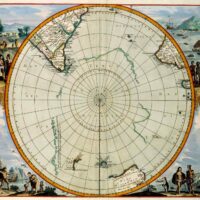
The ecumene occupied only a quarter of the Earth’s surface, stretching from the Pillars of Hercules in the west to the Columns of Alexander in the east, covering a distance of approximately 120 to 180°. Around 220 BCE, Eratosthenes described the Earth, well after Eudoxus and Aristotle, divided into five zones parallel to the equator or climates: the tropics, a band centered on the equator, two polar caps (one at each pole), and two temperate zones, situated between the tropics and the polar caps.
Geography
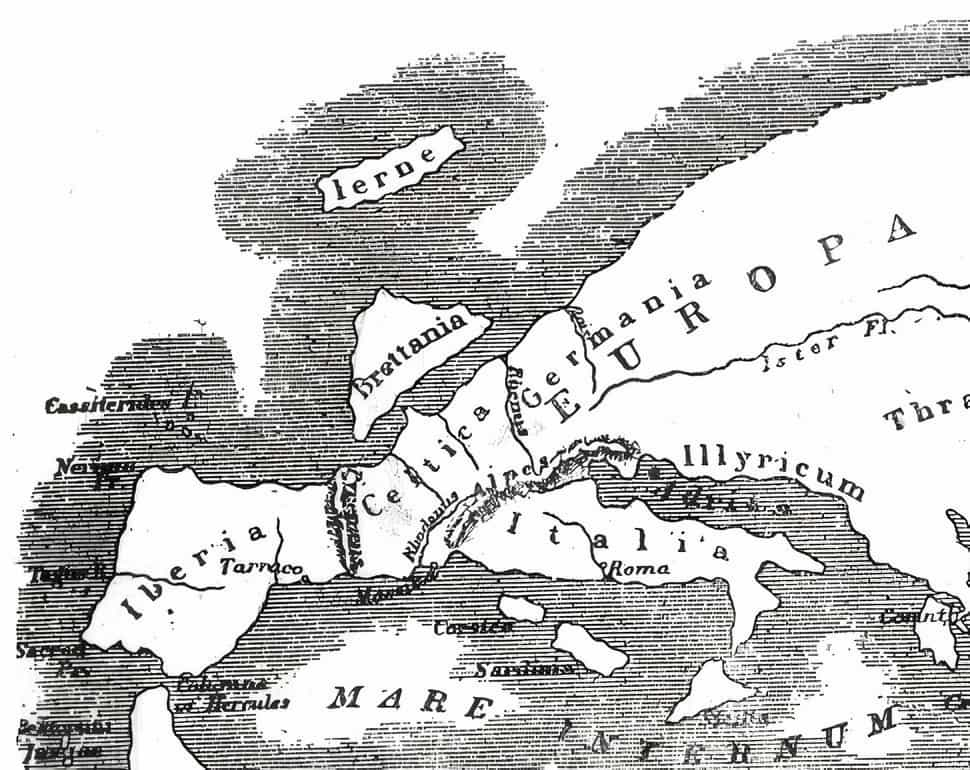
Since antiquity, the term has defined the territory known and explored by geographers, merchants, and adventurers who, with their “sea voyages” and exploration of lands, and thanks to periploi (coastal navigation), brought news and information about peoples and ethnicities.
The first to draw a map of the Ecumene was Anaximander of Miletus, a student of Thales, in the 5th–6th century BC. Later, a fellow citizen of his, Hecataeus of Miletus, depicted the Ecumene inside a circle, representing Europe, Asia, and Libya, surrounded by the River Ocean. To the north, he placed the mythical people of the Hyperboreans, opposed in the southern sector by the Hypernoti. In the 5th century BC, the Greek historian Herodotus proposed a new representation of the Ecumene, imagining it to be quadrangular instead of circular.
In the Hellenistic age, thanks to achievements in astronomy and geometry, the geographer Eratosthenes arrived at an approximate estimate of the Earth’s circumference by observing the sun on the day of the summer solstice, at the same hour, in Alexandria, Egypt, and Aswan, where it reached the zenith.
During the same period, the historian Polybius, sent to Rome as a hostage and entering the social and cultural environment of the Scipios, becoming a friend and collaborator of Scipio Aemilianus, wrote his Histories with the intention of explaining “how Rome had managed, in less than 53 years,” to become the master of the “ecumene.” Polybius understood the known world as “inhabited or traveled by the Greeks,” beyond which only the “barbarians” existed.

However, he did not limit himself to just history; to obtain firsthand information about historical sites, he embarked on long journeys through the lands bathed by the Mediterranean, thereby expanding the knowledge of the geographical ecumene to the Western lands, still little known in Greece.
Religion and Philosophy
In philosophy and religion, ecumene is the metaphysical state describing all past, present, and future life (and not a common state of religious or cultural unification or coexistence).
The ontology of the ecumene is distinct from multiculturalism or religious pluralism, even though it may contain elements of either or both. Typically, there is a single dominant center used as a reference point for everything else.
This center is spiritual and reserved for divinity.
In this sense, Ecumene, “the house where all live,” is a philosophical state of being that encompasses those who lived in the past, those living in the present, and those who may live in the future.
Examples of religious ecumene:
- The Orthodox Christianity of Constantinople (on a theological and metaphysical level).
- The Christian Kingdom of the medieval Catholic Church (politically and economically).
- The permitted pantheism in the Roman Empire (conditioned on the respect for the Emperor’s worship).
Examples of social ecumene:
- The koinè (Kingdom of Alexander the Great and Hellenism).
- The late Roman Empire (with a Catholic religious foundation).
- The United Nations.
Ecumene in Christianity
In the New Testament, the word “Oikumene” is often used as a synonym for the whole world or represents the Roman Empire (see Luke 2:1, Matthew 24:14). In Hebrews 2:5, the word denotes a “future world.”
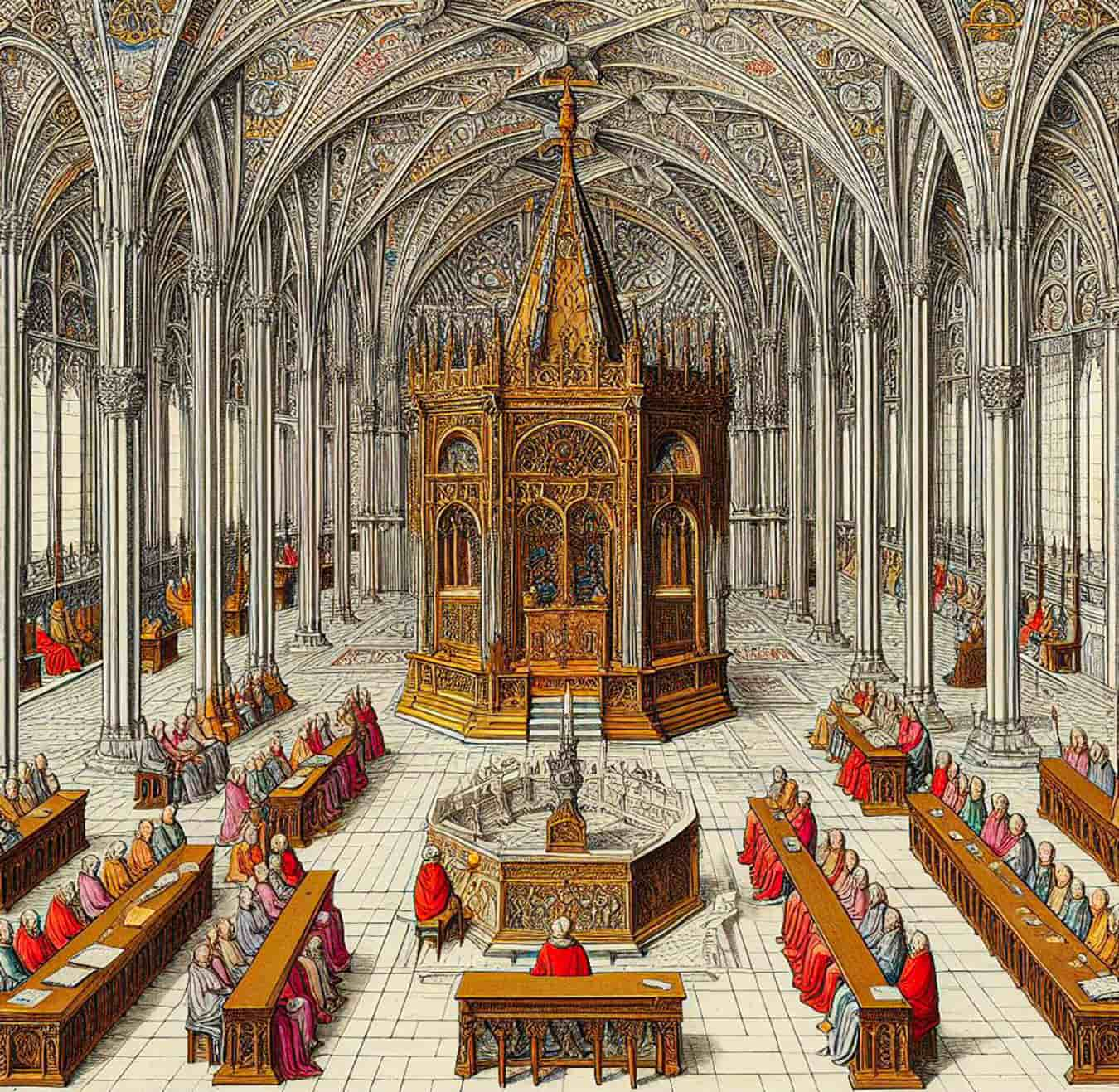
In the Early Church, alongside its political meaning in the Roman Empire, the word also had a religious significance, referring to the entirety of Christians. During the time of Constantine the Great, this distinction became less prominent. The so-called Ecumenical Councils played a significant role, with their decisions intended to apply to the entire Christian community and the entire empire.
After the end of the Roman Empire and the Byzantine Empire, the word retained only a religious meaning. In the 6th century, the Patriarch of Constantinople referred to himself as “ecumenical” to emphasize his primacy among various Eastern churches. This sparked vehement opposition from Pope Gregory the Great in Rome.
Since the 20th century, the term “ecumenism” has been used for the Christian ecumenical movement, aiming for dialogue and cooperation among denominations, churches, and monotheistic religions.
Literature
Ecumene is used in various works of fantasy by different authors. In a series of novels by the science fiction author Ursula K. Le Guin, the Ecumene (or Ekumene) represents the League of Worlds, an alliance between planets placed at immense distances and connected through the flight of hyper-light starships and communication via the ansible, a device that exploits the gravitational deformation of space-time. The novel series is known as the Hainish Cycle.
In the author’s fantasy, the original meaning of the term is thus preserved, combining both its geographical sense (though adapted to her fantastical vision of the future beyond the Earth) and the more philosophical aspect (referring to the peaceful and benign nature that unites the peoples inhabiting different worlds).