In the summer of 1270, twenty years after his disastrous capture in the Nile Delta during the Seventh Crusade, the fifty-six-year-old King of France—Louis IX, the only French monarch ever canonized as a saint by the Catholic Church—took up the pilgrim’s cross one final time. Known to history as the Eighth Crusade, this brief, tragic expedition never even came within a thousand miles of Jerusalem. Diverted by geopolitical calculations to the sun-baked coast of Tunisia in North Africa, the campaign was crippled within weeks not by enemy scimitars, but by contaminated water wells and camp dysentery, claiming the life of the Crusader King on a bed of ashes among the ruins of ancient Carthage.
The Threat of Sultan Baibars and the Second Vow of Louis IX
Throughout the 1260s, the fragile surviving Crusader strongholds along the coast of Syria and Palestine faced systematic destruction at the hands of one of the most brilliant military commanders of the Middle Ages: the Mamluk Sultan of Egypt and Syria, Baibars. Having already helped shatter the Mongol army at Ain Jalut in 1260, Baibars captured Caesarea and Arsuf in 1265, took Safed in 1266, and in May 1268 stormed and sacked the great Crusader principality of Antioch—leaving only a narrow strip of coastal towns around Acre and Tripoli in Christian hands.
Haunted for two decades by the failure of his earlier 1248–1254 Crusade in Egypt, King Louis IX summoned his barons to the Louvre in Paris on March twenty-fourth, 1267, and announced that despite his failing health—so frail that he could barely ride a horse or wear full iron armor for long—he was sailing back across the Mediterranean to rescue the Outremer. Even the King’s most loyal friend and biographer, Jean de Joinville, who had fought beside Louis in Egypt, refused to join this second expedition, arguing bluntly that the King was needed at home in France and that anyone who advised the frail monarch to go on another Crusade was committing a mortal sin.
Why Did the Fleet Sail to Tunis Instead of the Holy Land?
When Louis IX’s fleet of Genoese and French ships finally weighed anchor from Aigues-Mortes in July 1270 and regrouped at Cagliari in Sardinia, the ordinary knights aboard assumed they were sailing east to Cyprus, Acre, or Alexandria. Instead, the royal council announced a shocking destination: the fleet was sailing due south across the central Mediterranean to attack Tunis, the capital of the Hafsid Caliphate in modern Tunisia.
Historians point to two interlocking reasons for this bizarre geographical detour:
- The Ambitions of Charles of Anjou: Louis IX’s ruthless, ambitious younger brother, Charles of Anjou, had recently been crowned King of Sicily (which sat just a hundred miles across the water from Tunisia). The Hafsid ruler of Tunis, Caliph Muhammad I al-Mustansir, had stopped paying the traditional annual gold tribute to the Sicilian crown and was sheltering political refugees who opposed Charles.
- The Illusion of a Royal Conversion: Knowing his pious brother Louis would never divert a holy Crusade purely for Sicilian tribute gold, Charles of Anjou helped convince Louis IX that Caliph al-Mustansir was secretly sympathetic to Christianity and would gladly convert to the Catholic faith—and cut off North African supplies to Mamluk Egypt—if only a powerful Christian army appeared outside Tunis to give him political cover against his own subjects!
Landing at Carthage and the Siege by Disease
Landing unopposed on the sandy peninsula near the ancient Roman and Punic ruins of Carthage on July eighteenth, 1270, the French quickly realized that the rumor of the Caliph’s desire to baptize himself was a complete fantasy. Instead of welcoming the Crusaders, al-Mustansir fortified the walls of Tunis, called for Muslim volunteers from across the interior, and sent fast Berber light cavalry to harass the French camp day and night under the blistering forty-degree July and August African sun.
Refusing to launch a full-scale assault on the city walls until his brother Charles of Anjou arrived with the Sicilian fleet and army, Louis IX kept his ten thousand troops pinned inside a crowded, dusty fortified camp on the plain of Carthage. Within days, catastrophe struck from the ground beneath their feet:
- Contaminated Brackish Wells and Dysentery: With scant fresh water and poor sanitation in the summer heat, a virulent outbreak of bacillary dysentery (compounded by typhus or scurvy, which medieval chroniclers called “the camp plague”) tore through the tents.
- Death of Prince John Tristan: On August third, 1270, the King’s beloved twenty-year-old son, John Tristan, Count of Valois—who had ironically been born in Damietta during the dark days of the Seventh Crusade—died in agony in the camp, just as King Louis himself and his eldest son and heir, Philip, collapsed with raging fevers.
“Jerusalem! Jerusalem!” and the Treaty of Tunis
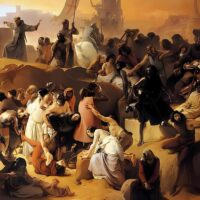
By late August, the French camp was a vast open-air hospital where bodies were thrown into trenches by the hundreds. Sensing that his final hour had arrived on August twenty-fifth, 1270, King Louis IX asked his attendants to lift him from his royal bed and lay him flat upon a bed of ashes spread in the shape of a cross on the tent floor in an act of ultimate Christian humility. Whispering softly on his back, “Jerusalem! Jerusalem! We will go to Jerusalem,” the King crossed his arms over his chest and breathed his last at three o’clock in the afternoon.
In one of the most dramatic coincidences in medieval history, the exact moment Louis IX died, trumpet blasts echoed from the harbor: the sails of Charles of Anjou’s Sicilian fleet had finally arrived, dropping anchor to find a silent, weeping camp. Taking immediate command alongside the recovering new king, Philip III (“the Bold”), Charles of Anjou defeated the Hafsid sorties enough to bring Caliph al-Mustansir to the negotiating table.
On October thirtieth, 1270, without a single Crusader setting foot inside Tunis, the two sides signed the Treaty of Tunis: in exchange for the Crusader army packing up and sailing home immediately, the Caliph agreed to pay a massive war indemnity of 210,000 ounces of gold, resume paying double tribute to Charles of Anjou’s Kingdom of Sicily, grant free trade to Christian merchants, and allow Christian monks and priests to live and preach inside Tunisia. Just days after the ink dried, England’s tall Crown Prince Edward (the future King Edward I, “Longshanks”) arrived off Tunis with an English Crusader fleet—too late for the fighting, prompting Edward to sail onward alone to Acre for the brief Ninth Crusade, while the French fleet carried the boiled white bones of Saint Louis back to the Abbey of Saint-Denis, closing the era of major royal French Crusades forever.