On March 17, Irish people celebrate St. Patrick’s Day, a religious celebration that has now become a national holiday. It is a holiday widely celebrated in Ireland, the United States, and Canada, but also across the globe. Since 1903, March 17 has been a national holiday in Ireland to commemorate the death of Saint Patrick (385-461), the apostle of the Emerald Isle, and to welcome spring with parades, singing, and dancing. On this holy holiday, the shamrock, a symbol of the Holy Trinity, was first used. While the government of Ireland does not officially recognize or celebrate St. Patrick’s Day as a holiday, the day is still widely celebrated throughout the country.
Saint Patrick, the evangelizer of Ireland
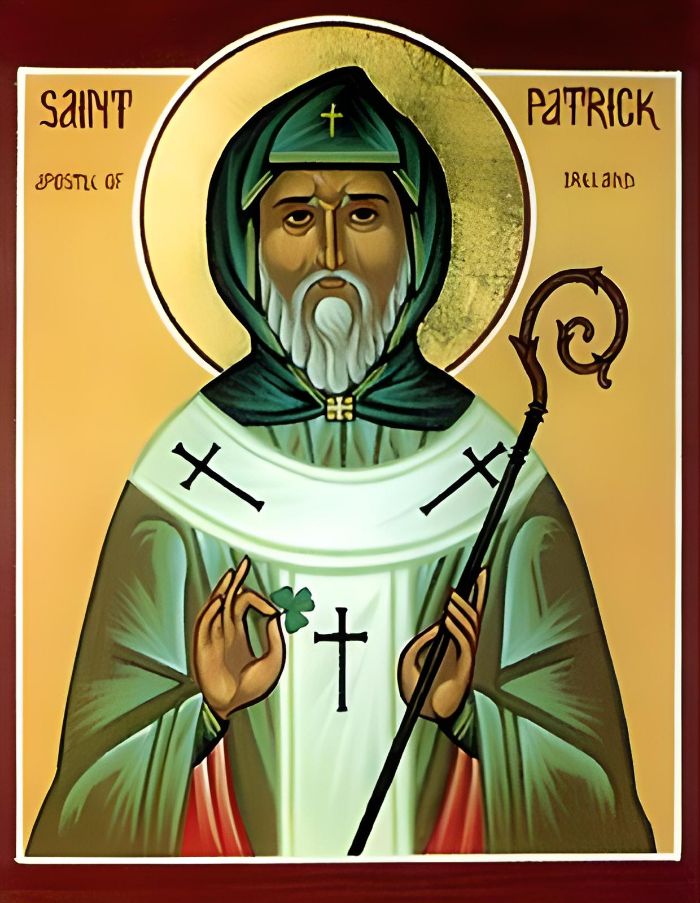
Saint Patrick, or Maewyn Succat, was born in Great Britain, most likely in Scotland, about the year 385. His death anniversary, March 17, is commemorated because he is revered as the spiritual father of all Irish Christians. His background is entangled with legendary events. At the age of sixteen, Saint Patrick was taken captive by pirates and sold to a druid in Ireland, who trained him to be a shepherd.
Legend has it that after having a dream encounter with the Almighty, he ran away to the Norman shore to become a priest and study theology. Saint Germain d’Auxerre was his spiritual leader, and he traveled with him and followed in his footsteps. When Pope Celestine I heard of Saint Patrick’s reputation, he sent an apostolic mission to Ireland on his recommendation. When he went back to Ireland in 432 to convert the monarchs, he used a shamrock to illustrate the Holy Trinity to King Aengus (the current national symbol). It’s important to remember that the island had already been seeded with Christian doctrine by the time he arrived, thanks to the entrance of missionaries from Britain and Spain around the tail end of the 4th century.
Legend has it that Saint Patrick drove all the snakes off the island of Ireland by drowning them. However, reptiles of any kind have never lived in Ireland. It’s most likely a metaphor linking snakes to druids, whose paganism made them enemies of the people. St. Patrick became a bishop and established several monasteries on his journey.
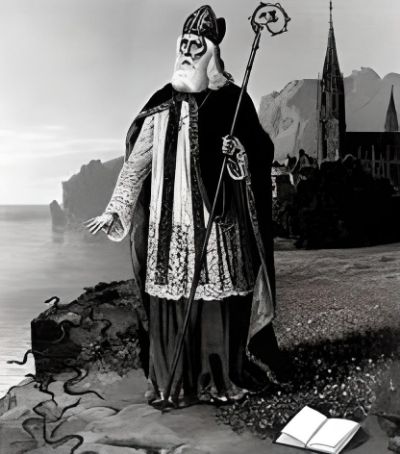
After seeing the Pope in 444, he went to Ireland to establish his own bishopric, the Diocese of Armagh, and its subsequent cathedral. He retired to Downpatrick, Northern Ireland, on March 17, 461 after a lengthy career of evangelizing.
March 17, from a religious holiday to a national holiday
St. Patrick’s Day is more than just a day for revelry and commerce; it’s a religious holiday marked by the traditional observance of mass attendance and the wearing of a shamrock in the lapel buttonhole. Irish Catholics celebrated Saint Patrick’s Day as a holy day beginning in the 17th century. It was Pope Urban VIII, in 1631, who officially added St. Patrick’s Day to the Christian calendar and designated March 17 as St. Patrick’s Day. Although the fast is normally broken on this day, it is retained during Lent (40 days of fasting). When the feast day falls on a Sunday, it is celebrated the following Monday.
A long time from now, people will celebrate this day as a national holiday. Bank Holiday Ireland Act, sponsored by British MP James O’Mara, made March 17 a legal holiday in Ireland in 1903. The latter also proposed a rule that, until the 1970s, made it illegal to operate bars on this day. After 700 years of British rule, Irish independence in 1921 made the event an essential part of Irish national identity.
How do people throughout the world celebrate Saint Patrick’s Day?
The first manifestation of St. Patrick’s Day was not held on Ireland but in the United States. It was in Boston, Massachusetts, in the United States in 1737 when the first modern-day St. Patrick’s Day parade were staged. Parades have been held in Ireland since 1931. From that point on, several major cities including Dublin, Cork, Limerick, Galway, Derry, Kilkenny, Belfast, and Waterford held parades.
In Canada, the biggest St. Patrick’s Day parade takes place in Montreal, a tradition that dates back to 1824. For over four decades, Chicago has had green river water. In 2006, a procession of 150,000 individuals assembled in New York City, and they were followed by 2 million spectators. This makes it the greatest celebration of its kind in the world. Many Irish people left their homeland in the 19th century due to hunger, which contributed to the holiday’s meteoric rise in popularity in the United States.
A five-day festival was added to the procession by the Irish government in 1995. Over 430,000 Irish people attended the inaugural event in 1996. Parades, fireworks, music, and Irish dances are all staples of the celebration. Wearing the traditional garb of the leprechaun, including the three-leafed clover, top hat, and green clothing, is a must.
The leprechaun measures about 12 inches (30 cm), with a bright red beard, and is decked out in green. The Irish term “lechorpan,” meaning “little man,” is the source of this name. Leprechauns, a kind of mythical creature from Irish mythology, are often shown as being extremely little, with a white beard and a pointed cap. They tend to be little, playful, and humorous types. It is said that if you manage to capture one, he would give up his loot at the end of a rainbow.