When Emperor Napoleon III of France stunned the royal houses of Europe in January 1853 by bypassing foreign princesses to marry a twenty-six-year-old Spanish countess of Scottish and Andalusian heritage for pure love, aristocratic snobs in Paris whispered that the upstart Bonaparte regime would never last. Instead, for the next seventeen years of the Second French Empire, Empress Eugénie (born María Eugenia Ignacia Agustina de Palafox y Kirkpatrick, Countess of Teba) reigned from the Tuileries Palace as the undisputed style arbiter of the Western world—single-handedly launching the modern Parisian haute couture fashion industry, championing the opening of the Suez Canal, serving three times as Regent of France, and living until the age of ninety-four to witness the aftermath of the First World War.
A Flame-Haired Spanish Noblewoman Educated by Stendhal
Born on May fifth, 1826, in Granada, Spain— reportedly inside a garden tent during an earthquake!—Eugénie was the younger daughter of Don Cipriano de Guzmán, Count of Montijo and Teba (a decorated Spanish artillery veteran who had lost an eye fighting loyally for Napoleon I), and María Manuela Kirkpatrick, the lively daughter of a Scottish wine merchant and American consul in Málaga. Sent to Paris in the 1830s to be educated at the prestigious Convent of the Sacré-Cœur, young Eugénie and her older sister Paca sat on the knee of two regular family houseguests who adored the girls and told them stories of Napoleon’s battles every evening: the great French novelists Prosper Mérimée (author of Carmen) and Stendhal (author of The Red and the Black).
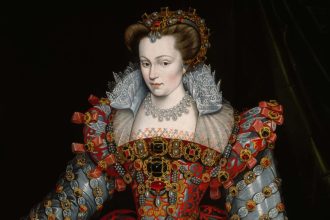
Growing into a striking beauty with luminous alabaster skin, violet-blue eyes, and a crown of copper-gold Venetian-red hair, Eugénie arrived in Paris in 1849 and caught the eye of the newly elected Prince-President, Louis-Napoleon Bonaparte. Used to easy palace conquests, Louis-Napoleon tried for two years to seduce the proud Spanish countess into becoming his mistress. Eugénie gave him a legendary, unyielding reply: “Sire, the road to my bedroom passes through the chapel.”
Shortly after proclaiming himself Emperor Napoleon III in December 1852 and being snubbed by cautious German and British royal houses, the forty-four-year-old Emperor married Eugénie in a glittering ceremony at Notre-Dame Cathedral on January thirtieth, 1853—driving to the cathedral in the exact golden coronation coach used by Napoleon I and Josephine.
Charles Frederick Worth, Louis Vuitton, and the Birth of Haute Couture
Recognizing that the prestige of the Second Empire—and the jobs of hundreds of thousands of French silk weavers in Lyon, lace-makers in Alençon, and jewelers in Paris—depended on dazzling luxury spectacle, Empress Eugénie turned her wardrobe into an instrument of economic statecraft:
- Discovering Charles Frederick Worth: In 1858, Eugénie appointed an ambitious young English dressmaker in Paris named Charles Frederick Worth as her official Imperial Court Couturier. By allowing Worth to design colossal, steel-hooped crinoline ballgowns draped in yards of Lyon silk and tulle—and later supporting him when he abolished the bulky crinoline in the late 1860s in favor of sleeker silhouettes—Eugénie and Worth invented the modern system of seasonal Parisian Haute Couture.
- Making Louis Vuitton Her Personal Packer: Because transporting one of Eugénie’s fragile silk crinoline gowns to the seaside resort of Biarritz (where the Emperor built the Villa Eugénie for her) required specialized luggage, she hired a young box-maker named Louis Vuitton in 1853 as her personal trunk-maker and wardrobe packer, launching the world’s most famous luxury luggage empire.
- Guerlain’s “Eau de Cologne Impériale”: To soothe her frequent migraines, perfumer Pierre-François-Pascal Guerlain created a bespoke citrus-and-neroli fragrance presented in a glass bottle embossed with sixty-nine golden Napoleonic bees, earning the title of Official Perfumer to Her Majesty.
Political Power, the Suez Canal (1869), and the Disaster of 1870
Far from being a mere fashion plate, Eugénie was fiercely intelligent, devoutly Catholic, and politically assertive. Three separate times—during the Italian Campaign of 1859, the Emperor’s visit to Algeria in 1865, and the opening of the Franco-Prussian War in 1870—Napoleon III officially appointed Eugénie as Empress Regent of France with full head-of-state powers. She advocated for women’s education (personally presenting the Legion of Honour to Rosa Bonheur, the first woman artist ever to receive the medal, and insisting that Julie-Victoire Daubié be granted France’s first university bachelor’s degree awarded to a woman), rebuilt hospitals and orphanages across Paris using her own wedding jewelry allowance, and enthusiastically backed her distant cousin Ferdinand de Lesseps in digging the Suez Canal—sailing personally aboard the imperial yacht Aigle in November 1869 to lead the first international convoy of ships from the Mediterranean to the Red Sea.
However, Eugénie’s conservative political instincts also contributed to two fatal imperial disasters: in the 1860s, she championed the doomed French military intervention in Mexico that placed Archduke Maximilian of Austria on the Mexican throne (ending with Maximilian’s execution by firing squad in 1867); and in July 1870, hoping a swift military victory over Prussia would secure the throne for her beloved fourteen-year-old only son, Louis-Napoleon, the Prince Imperial, she backed the hardliners who pushed the sickly Emperor into declaring the Franco-Prussian War.
Flight by Dentist’s Carriage and 50 Years in Mourning Black
When news reached Paris on September third, 1870, that Napoleon III had been captured at the Battle of Sedan and angry republican mobs marched on the Tuileries Palace on September fourth to overthrow the Empire, Eugénie refused to let palace guards fire a single shot on the Parisian crowd. Slipping out a side door of the Louvre Museum in a plain dark dress and veil, she hid inside the apartment of her American court dentist, Dr. Thomas Wiltberger Evans, who courageously drove the fugitive Empress in his carriage to the Normandy coast and smuggled her across the stormy English Channel aboard a forty-foot English yacht to exile at Chislehurst and later Farnborough Hill in England.
In exile, tragedy struck twice: first, her husband Napoleon III died in 1873 following bladder-stone surgery; then, on June first, 1879, her twenty-three-year-old son and sole hope of the Bonapartist dynasty—the Prince Imperial, who had volunteered to serve with the British Army—was ambushed and killed by nineteen assegai spear wounds during the Anglo-Zulu War in South Africa. Wearing mourning black for the remaining forty-one years of her life—even traveling to the remote South African kraal to pray on the exact spot where her son fell and befriending Queen Victoria—Eugénie lived long enough to turn her English mansion into a military hospital for wounded Allied soldiers in World War I and rejoice in 1918 when Alsace-Lorraine was finally returned to France, passing away during a visit to Madrid in July 1920 at the age of ninety-four.