After the shameful diversion of the Fourth Crusade in 1204—in which Western Crusaders never reached the Holy Land at all, instead sacking Christian Constantinople—Pope Innocent III spent the final years of his life organizing a massive, disciplined expedition designed to redeem the Crusader movement: the Fifth Crusade (1217–1221). Targeting the wealthy Nile Delta port of Damietta to strike at the economic heart of the Ayyubid Empire in Egypt, the Crusaders actually won their primary objective and were offered the peaceful return of Jerusalem itself on a silver platter by the Sultan of Egypt—only for the obstinate arrogance of a Papal Legate and a catastrophic miscalculation of the annual Nile flood to turn total victory into unconditional surrender.
Strategy: Why Attack Egypt to Liberate Jerusalem?
Planned at the Fourth Lateran Council in 1215 and launched in 1217 under Pope Innocent III’s successor, Pope Honorius III, the Fifth Crusade began with preliminary campaigns in Palestine by King Andrew II of Hungary and Duke Leopold VI of Austria before adopting the grand strategic doctrine first proposed by King Richard the Lionheart: the road to Jerusalem runs through Cairo.
Why sail to Egypt to recover a city in Judea? Because the Ayyubid dynasty founded by Saladin relied entirely on the agricultural tax wealth, grain, and maritime trade of the Nile Valley to fund its armies in Syria and Palestine. If a Crusader fleet captured the fortified gateway port of Damietta on the eastern branch of the Nile Delta and marched up the river to Cairo, Egypt could either be conquered outright or traded back to the Sultan in exchange for the entire Kingdom of Jerusalem.
The Chain Tower of Damietta and Sultan al-Kamil’s Peace Offer (1218–1219)
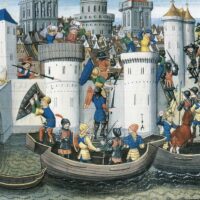
In May 1218, a fleet of Frisian, German, and Italian ships carrying King John of Brienne (nominal King of Jerusalem) and Duke Leopold VI of Austria landed before Damietta. Guarding the harbor stood a formidable engineering obstacle: a massive stone fortress built on an island right in the middle of the Nile—the Chain Tower—from which giant iron chains were stretched across the water to the city walls to block any ship from sailing upstream.
Using the ingenuity of a German priest and chronicler named Oliver of Paderborn, Frisian carpenters lashed two wooden cog ships together side-by-side across four masts and built a floating, revolving wooden siege tower and drawbridge on top, storming and capturing the Chain Tower on August twenty-fourth, 1218—a shock so severe that the elderly Ayyubid Sultan al-Adil (Saladin’s brother) reportedly died of a heart attack upon hearing the news, handing the Egyptian throne to his pragmatic son, Sultan al-Kamil.
As the grueling eighteen-month siege of Damietta dragged on and internal plots threatened Sultan al-Kamil’s rule, two extraordinary historical events unfolded outside the walls in the autumn of 1219:
- 1. Saint Francis of Assisi Walks Into the Sultan’s Tent: Appalled by the bloodshed in both camps, the barefoot Italian friar Francis of Assisi (founder of the Franciscan Order) and Brother Illuminatus walked unarmed across no-man’s-land directly into the Muslim camp! Instead of executing him, the cultured Sultan al-Kamil welcomed Francis warmly into his royal tent for several days of deep theological conversation, offering Francis lavish gifts (which the saint politely declined because of his vow of poverty) and escorting him safely back to the Christian lines with deep mutual respect.
- 2. The Sultan Offers to Give Back Jerusalem for Free! Desperate to save Damietta before its starving garrison collapsed, Sultan al-Kamil sent envoys to the Crusader camp with a stunning peace offer: if the Crusaders simply packed up and left Egypt, al-Kamil would immediately hand back the city of Jerusalem, Bethlehem, Nazareth, the True Cross, all of central Palestine, and thirty years of tribute money to pay for rebuilding Jerusalem’s walls!
Cardinal Pelagius’s Refusal and the Nile Flood Trap at Mansurah (1221)
King John of Brienne and the French, English, and German secular knights were thrilled: they begged to accept the Sultan’s offer immediately, pointing out that liberating Jerusalem was the entire reason they had left Europe! However, leadership of the Crusade had been usurped by the imperious Spanish Papal Legate, Cardinal Pelagius of Albano, backed by the Knights Templar and Hospitaller and the Italian merchant fleets who wanted to keep Damietta’s lucrative trade docks.
After the Crusaders stormed the disease-ravaged city of Damietta on November fifth, 1219, Cardinal Pelagius **flatly rejected Sultan al-Kamil’s peace offer twice**—convinced that the German Emperor Frederick II (who had promised to come on the Crusade, but stayed home in Sicily) was about to arrive with a giant army, and equally convinced by an Arabic prophecy scroll that a mysterious Christian king from the East (“King David,” actually distorted rumors of the pagan Mongol conqueror **Genghis Khan**, who was currently obliterating Persia!) was marching to help them conquer all of Egypt.
In July 1221, ignoring the urgent warnings of King John of Brienne, Cardinal Pelagius ordered the Crusader army to march south from Damietta up the Nile toward Cairo—at the exact worst possible week of the calendar year, right as the annual summer inundation (flood) of the Nile River was rising to its crest:
- Advancing into the wedge of low-lying land at the fork of the Nile opposite Sultan al-Kamil’s new fortress camp of al-Mansurah (“The Victorious”), Pelagius forgot to guard the canal behind him.
- Egyptian ships sailed through a side canal into the Nile behind the Crusaders, cutting off their supply boats from Damietta, and then Sultan al-Kamil gave a simple order: his engineers **broke open the dikes and sluice gates of the Nile canals**!
- Overnight, the entire plain turned into a waist-deep sea of sticky black mud and rushing water. Trapped on a shrinking strip of mud with their mules, tents, and gunpowder/food supplies washed away, the starving Crusader army was completely surrounded without a single battle needing to be fought.
On August thirtieth, 1221, to save his drowning army from annihilation, Cardinal Pelagius signed an eight-year truce handing Damietta right back to Sultan al-Kamil in exchange for nothing more than safe passage home and a bowl of bread and soup for the starving Christian soldiers—ending the Crusade that had held Jerusalem in its palm and thrown it into the waters of the Nile.