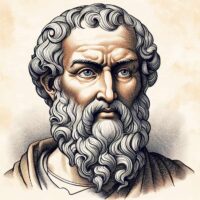
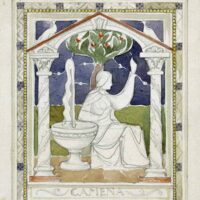
In the night sky of the Northern Hemisphere, forming the distinct V-shaped face of the constellation Taurus the Bull right beside the fiery red star Aldebaran, shines the open star cluster known as the Hyades. To the poets, farmers, and sailors of ancient Greece and Rome, these stars were not mere points of light; they were the celestial transformation of a devoted sisterhood of nymphs whose unceasing grief over their fallen brother brought the life-giving—and sometimes perilous—rains of spring and late autumn to the Mediterranean world.
Parentage of Atlas and the Tragedy of Their Brother Hyas
In classical Greek genealogy recorded by Hesiod, Ovid, and Hyginus, the Hyades were the daughters of the Titan Atlas, who bore the vault of the heavens upon his shoulders, and the Oceanid nymph Aethra (or Pleione in alternate accounts). This lineage made them the sisters or half-sisters of two other famous groups of mythological maidens: the Pleiades, who form the nearby seven-sister star cluster on the shoulder of Taurus, and the Hesperides, guardians of the golden apples in the far west.
The defining myth of the Hyades revolves around their deep devotion to their only brother, a handsome youth named Hyas. A passionate hunter, Hyas ventured into the wilds of Libya to track big game, where he encountered a ferocious lioness protecting her cubs—or in other versions, a wild boar or a venomous serpent—and was killed on the spot. When the sisters found Hyas’s lifeless body, their grief was so overwhelming that they refused to eat or sleep, weeping day and night until they died of broken hearts. Moved by such extraordinary sibling devotion, Zeus took pity on the maidens and placed them in the heavens as the star cluster that bears their name.
Guardians of Dionysus and Mount Nysa
Alongside the tragic tale of Hyas, a second major mythological tradition, preserved by Pherecydes of Athens and Apollodorus, celebrated the Hyades as the heroic foster mothers and nurses of the infant god Dionysus. Following the fiery death of Dionysus’s mortal mother Semele and his second birth from the thigh of Zeus, the king of the gods needed to hide the infant from the vengeful wrath of Hera. Hermes carried the baby to the misty caves of Mount Nysa and entrusted him to the care of the Hyades, often called the Nysiads in this role.
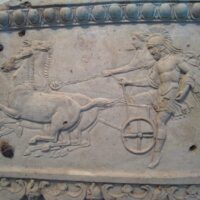
The nymphs raised the young god in secret, feeding him honey and hiding him in ivy-covered grottos until Hera discovered their involvement, prompting the sisters to flee for their lives into the sea where the goddess Thetis sheltered them. Later, using the rejuvenating cauldron of the sorceress Medea, Dionysus had his beloved nurses restored to eternal youth before asking Zeus to elevate them to the stars so they would remain forever beyond Hera’s reach.
Complete List and Names of the Hyades Sisters
Ancient mythographers differed on the exact number of sisters in the group, with counts ranging from two in early Athenian art to five, six, or seven in Hellenistic astronomical poetry, corresponding to the number of stars easily visible to the naked eye within the cluster. Hesiod, in a surviving fragment of his Astronomy, preserved the classic list of five sisters along with their evocative Greek names:
Phaesyle, whose name translates to Shining or Bright Light, represented the clear radiance of the stars before a storm. Coronis, meaning Crow-like or Curved, evoked the dark, swirling clouds that gather on the horizon. Cleeia, translating to the Renowned or Famous One, honored their celebrity among navigators. Phaeo, meaning the Dusky or Dim One, reflected how the stars appear to mist over and blur when atmospheric moisture rises. Finally, Eudora, meaning Generous or Giver of Good Gifts, celebrated the fertile rain that nourishes the grain crops. Other classical writers such as Hyginus and Servius added further names to expand the sisterhood to seven, including Ambrosia (Immortal), Polyxo, Dione, and Thyone.
Etymology of the Rainmakers and the Roman Suculae
Throughout antiquity, both the name and the astronomical behavior of the Hyades were linked directly to rainfall. Ancient Greeks derived their name from the verb hyein, meaning “to rain,” calling them the Rainy Ones because their heliacal rising with the sun in May and their cosmic setting in November coincided precisely with the two heaviest rainy seasons of the Mediterranean agricultural calendar. To a Greek sailor or Hesiodic farmer, seeing the Hyades rise or set meant it was time to haul wooden ships onto the beach for winter and plow the softened earth for sowing.
Interestingly, an alternative etymology linked their name to the Greek word hys, meaning pig or boar—either referencing the wild boar that killed their brother Hyas or describing the cluster’s resemblance to a mother sow surrounded by piglets. When Roman farmers and writers translated Greek star lore into Latin, they leaned into this second meaning, calling the star cluster the Suculae, or Little Pigs. As Pliny the Elder later noted with amusement, the Roman poet Cicero considered this translation an uneducated blunder by early Latin speakers who confused rain with pigs, yet both meanings endured in classical literature, uniting the weeping sisters of Atlas with the seasonal rains that sustained the ancient world.