In 2024, air temperatures and ocean temperatures once again reached record highs. According to climate researchers, ocean temperatures down to depths of 2,000 meters were higher than ever recorded.
The world’s oceans absorbed an additional 16 zettajoules of heat energy compared to 2023—equivalent to 140 times the global electricity production.
This heat absorption alone raised sea levels by one millimeter and contributed to extreme weather events worldwide.
Oceans: The Planet’s Key Climate Buffer
Oceans serve as the most crucial climate buffer for our planet, absorbing more than 90% of the heat generated by human-induced greenhouse effects. In recent years, ocean temperatures and heat uptake have repeatedly set new records, with significant consequences: marine heatwaves are becoming more frequent, the oxygen content of seawater is decreasing, and its stratification is becoming more resistant to mixing.
Ocean Heat Content Since 1958: 16 Trillion Joules More in One Year
2024 was the warmest year on record and the first in which the average annual temperature surpassed 1.5 degrees of warming compared to pre-industrial levels, confirmed by data as early as December 2024. New figures also reveal the state of the oceans, breaking another record. An international team led by Lijing Cheng from the Institute of Atmospheric Physics at the Chinese Academy of Sciences analyzed three datasets reflecting the temperatures and heat uptake of oceans down to 2,000 meters in 2024.
The results: “In 2024, the surface temperature and heat content of the upper 2,000 meters reached unprecedented levels,” Cheng and his colleagues reported. Ocean heat content exceeded 2023’s record by an additional 16 zettajoules—16 trillion joules or roughly 140 times the annual global electricity production. According to the team, this additional warming is only partially explained by the 2023/2024 El Niño event.

Record-Breaking Trend Continues Uninterrupted
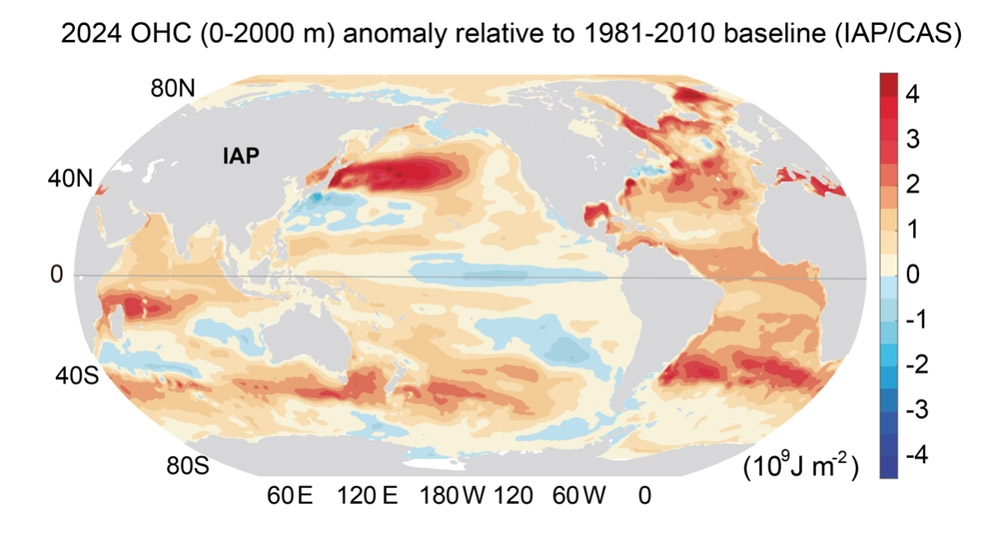
2024 continues the unrelenting trend of ocean overheating. “The sequence of annual records now resembles a broken record,” says Cheng. The data indicates that annual ocean heat uptake has increased every year over the last five years, regardless of fluctuations caused by the El Niño/La Niña phenomenon.
“This aligns with findings that Earth’s energy balance is no longer in equilibrium,” the researchers explain.
This imbalance is also reflected in sea surface temperatures, which reached new highs in 2024. “The annual mean sea surface temperature for 2024 is an astonishing 0.61 degrees above the long-term average from 1981 to 2010,” Cheng and his team noted.
Mediterranean Particularly Affected
The increasing ocean warming is evident in nearly all major oceans: “Six out of eight marine regions reached record-high heat content in 2024,” the scientists report. This includes the Indian Ocean, the tropical and northern Atlantic, the North Pacific, and the Southern Ocean around Antarctica.
However, the most pronounced warming occurred in the Mediterranean: “It shows the highest warming rate, with a heat content increase of 1.1 zettajoules compared to 2023—more than any of the other seven regions,” the team noted. “This signal is also very robust.” The Mediterranean’s heat uptake in 2024 was five times higher than the average over the last 20 years.

Rising Sea Levels, Extreme Weather, and Global Heat
The recent figures highlight alarming developments in Earth’s climate, according to the research team. “The ocean is our guardian of planetary warming, as it serves as the main sink for excess heat in the Earth’s climate system,” says co-author Karina von Schuckmann from Mercator Ocean International. Because oceans show far less monthly and annual variability than land or air, ocean data is considered particularly robust and reliable.
However, ocean warming also has direct consequences for people and the environment. Thermal expansion of seawater drives sea level rise.
The 16 zettajoules of additional heat absorbed in 2024 alone raised sea levels by one millimeter, the researchers report. Warmer oceans also heat land areas, contributing to new global temperature records. In 2024, the global average temperature surpassed the 1.5-degree threshold for the first time since pre-industrial levels.
Another consequence is an increase in extreme weather events, particularly storms and heavy rainfall. Warmer oceans evaporate more water, increasing atmospheric water vapor. This vapor not only acts as a potent greenhouse gas but also fuels storms. “It powers storms of all kinds, raising the risk of floods, hurricanes, and typhoons,” explains co-author Kevin Trenberth from the US National Center for Atmospheric Research.