Monument to the Conquerors of Space at a Glance
What is the Monument to the Conquerors of Space?
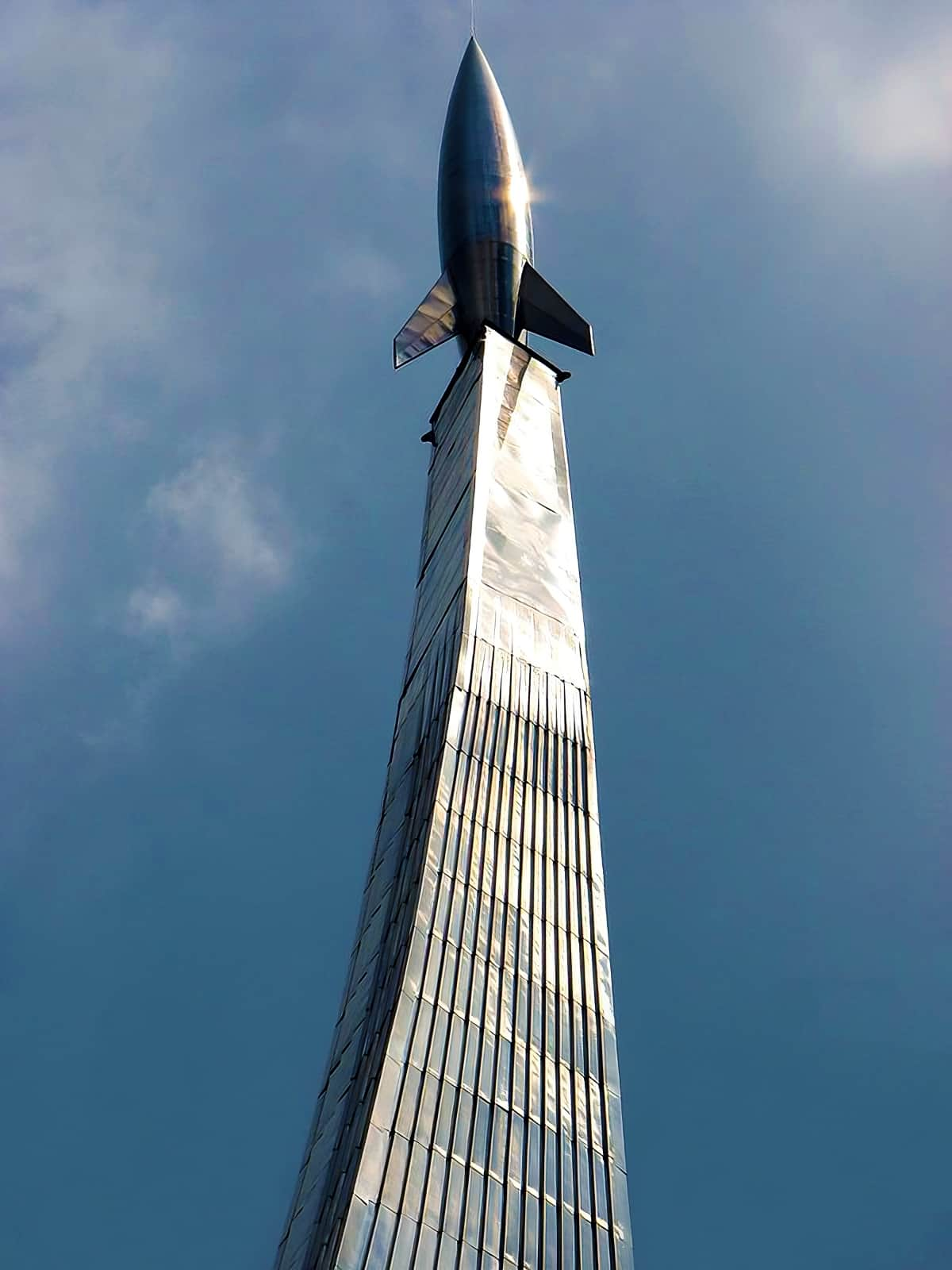
The Monument to the Conquerors of Space is a memorial unveiled on November 4, 1964, in Moscow to honor the Soviet people’s efforts in space exploration. The monument stands at a height of 351 feet (107 m) with an incline of 77 degrees and is made of titanium. It was designed by the sculptor Andrey Faydysh-Krandievskiy and architects Mikhail Barshch and Alexander Kolchin. The lower level of the monument houses the Memorial Museum of Cosmonautics.
What is the significance of the Monument to the Conquerors of Space?
The monument reflects the new image of the USSR as a modern and progressive country that opened up space to the world. It’s one of the most notable landmarks in Moscow’s northeastern area and the second-tallest structure in Russia after the Victory Monument. The monument is also notable for its extreme incline, which depicts a faulty launch or crash launch, earning it the nickname u0022the monument to suicide astronautsu0022 from the space community. The memorial has several replicas, including one in Borovsk, Kaluga, where the rocket scientist Konstantin Tsiolkovsky resided.
What is the architecture of the Monument to the Conquerors of Space?
The monument looks like an obelisk with a curled parabola on top, and it depicts the smoke trail of a rocket that is 36 feet (11 m) tall. Lines by Nikolaĭ Gribachev are arranged in metal characters on the monument’s façade which stands on a subordinate stylobate. On the side walls of the stylobate, there are large reliefs of scientists, engineers, and workers who made important contributions to space travel. At the end of the Museum of Cosmonautics and in front of the Conquerors of Space is a statue of one of the earliest Soviet rocket scientists, Konstantin Tsiolkovsky.
What cultural significance does the Monument to the Conquerors of Space have?
The Monument to the Conquerors of Space was featured on the back of a 10 kopeck (a Soviet monetary unit) piece and on the flip side of a ruble-denominated Olympic token. It has also been featured in music videos, including the Pet Shop Boys’ u0022Go Westu0022 and the Deep Forest’s u0022Sweet Lullaby.u0022 Additionally, there’s a 1960 Soviet animation called u0022Murzilka on a Sputniku0022 that pays tribute to the monument.
On November 4, 1964, in the Ostankinsky neighborhood of Moscow, a memorial called “Monument to the Conquerors of Space” was unveiled to honor the efforts of the Soviet people in the discovery of space. The memorial is made of titanium and stands at a height of 351 feet (107 m) with an incline of 77 degrees. It was designed by the sculptor Andrey Faydysh-Krandievskiy and architects Mikhail Barshch and Alexander Kolchin and installed in 1964. After the Victory Monument (465 ft; 181 m), it is Russia’s second-tallest structure. The monument’s lower level houses the Memorial Museum of Cosmonautics.
- Monument to the Conquerors of Space at a Glance
- What is the Monument to the Conquerors of Space?
- What is the significance of the Monument to the Conquerors of Space?
- What is the architecture of the Monument to the Conquerors of Space?
- What cultural significance does the Monument to the Conquerors of Space have?
- The Architecture of the Monument to the Conquerors of Space
- “The Monument to Suicide Astronauts”
- Replicas of the Conquerors of Space Monument
- The Monument to the Conquerors of Space in Culture
- History of the Monument to the Conquerors of Space
The Architecture of the Monument to the Conquerors of Space
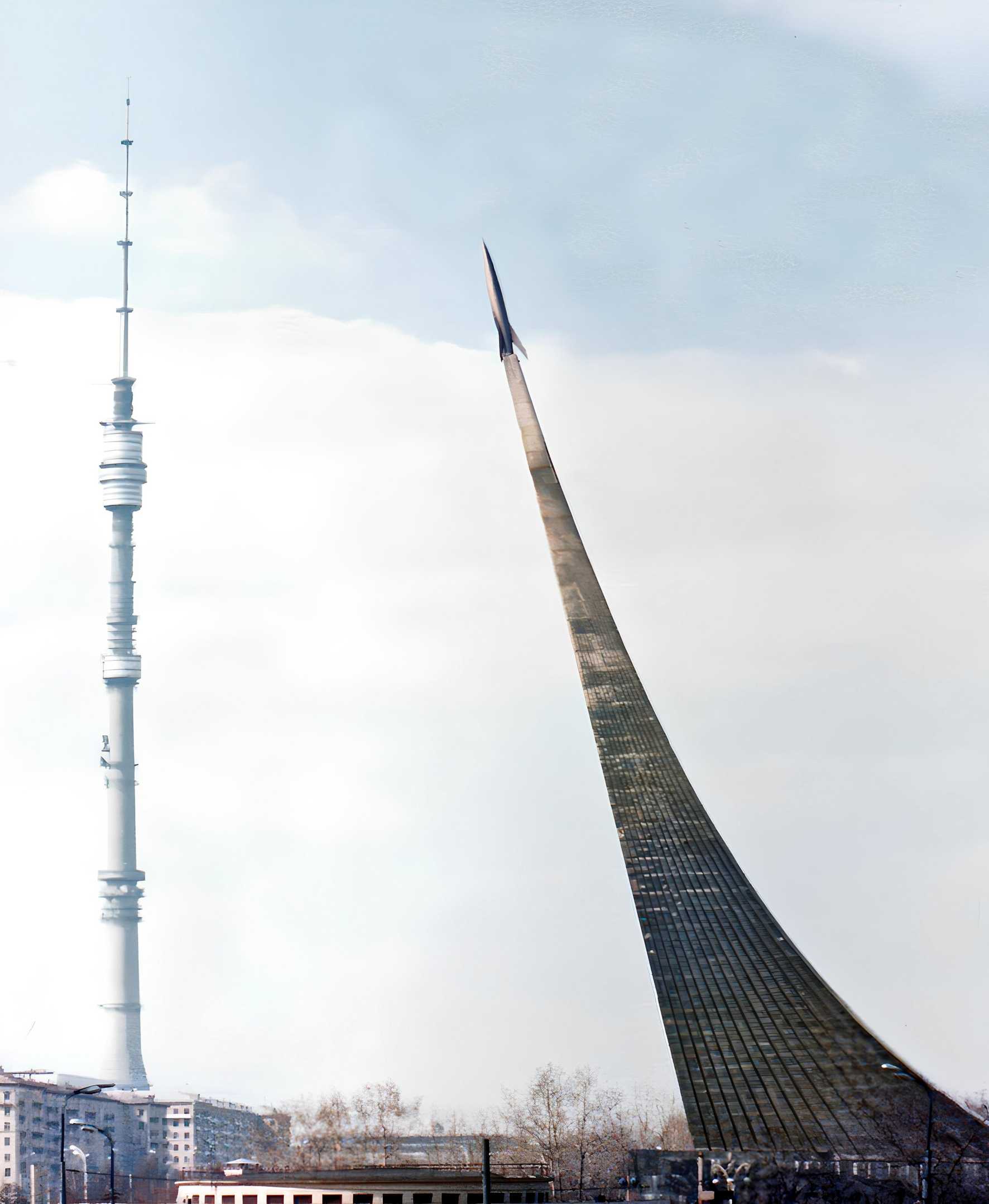
According to the authors of the guidebook “Moscow: A Guide to Soviet Modernist Architecture 1955–1991,” the Space Conquerors monument was given an unusually abstract solution for Soviet monumental art because it reflected the new image of the USSR as a modern and progressive country that opened up space to the world.
The monument looks like an obelisk with a curled parabola on top, and it depicts the smoke trail of a rocket that is 36 feet (11 m) tall. Lines by Nikolaĭ Gribachev are arranged in metal characters on the monument’s façade which stands on a subordinate stylobate:
And our efforts are so rewarded,
For, having overcome lawlessness and darkness,
We have forged fiery wings
For our country and our age!
Below the lines read the description of the Monument to the Conquerors of Space: “In commemoration of the outstanding achievements of the Soviet people in the exploration of outer space, this monument was erected.“
On the side walls of the stylobate, there are large reliefs of scientists, engineers, and workers who made important contributions to space travel. At first, Faydysh-Krandievsky included Sergei Korolev among them, which infuriated the physicists because they thought there were better champions to feature.
The Museum of Cosmonautics’ entry can be found at the stylobate’s rear. At the end of the Museum of Cosmonautics and in front of the Conquerors of Space is a statue of one of the earliest Soviet rocket scientists, Konstantin Tsiolkovsky. This placement serves as a kind of intermediary between Earth and the cosmos to honor the man.
“The Monument to Suicide Astronauts”
The Monument to the Conquerors of Space is one of the most notable landmarks in Moscow’s northeastern area.
The monument is also notable due to its extreme incline, which could serve an artistic purpose. But according to others, the depicted rocket launch can be considered a faulty launch or crash launch.
The memorial has earned the nickname “the monument to suicide astronauts” from the space community due to its skewed orientation. When the rocket reaches this angle of orientation, it’s an emergency.
Because a rocket only has enough fuel to travel into orbit by the shortest path, which is perpendicular to Earth. The highly inclined smoke trail of the Monument to the Conquerors of Space tells a different story.
Replicas of the Conquerors of Space Monument
There are several replicas of the Conquerors of Space Monument. There is one in Borovsk, Kaluga, where the rocket scientist Konstantin Tsiolkovsky resided, worked as a teacher, and did his initial study on astronautics for 15 years before being promoted and moving to the larger city of Kaluga.
The memorial was originally a smaller version of the Monument to the Conquerors of Space with a bust of the scientist. However, the figurine was vandalized and removed in the 1980s, and a bronze statue of the scientist was not installed until 2007.
The Soviet Union gave the United Nations another replica of the monument, which is now on display outside the Palace of Nations (Palais des Nations) in Geneva.
The Monument to the Conquerors of Space in Culture
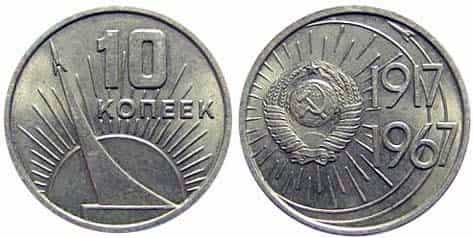
In 1967, as part of the “50 Years of Soviet Power” collection, the Monument to the Conquerors of Space was featured on the back of a 10 kopeck (a Soviet monetary unit) piece.
On the obverse of this denomination, the memorial can be seen to the top right, against the depiction of a sunlit backdrop. Images and text are carved into a raised surface. The picture of the sun on the currency represents sunrise.
The memorial was also featured on the flip side of a ruble-denominated Olympic token. The “Salyut” orbital space station is in the backdrop; directly below the memorial is the 1980 Summer Olympics logo; and the curled phrase “Games of the XXII Olympiad — Moscow — 1980” runs along the coin’s top border.
Both the Pet Shop Boys (1993 footage for “Go West”) and the Deep Forest’s (1992 clip for “Sweet Lullaby”) music videos feature the Monument to the Conquerors of Space, along with the monument to Yuri Gagarin on Leninsky Prospekt. There’s also a 1960 Soviet animation called “Murzilka on a Sputnik” that pays tribute to the monument.
History of the Monument to the Conquerors of Space
The launch of Sputnik-1, the world’s first man-made spacecraft, occurred on October 4, 1957. Near the future site of a memorial to Vladimir Lenin and the Moscow State University’s main building, the decision was made to erect a monument commemorating the commencement of the space era of humanity.
After announcing the competition in March 1958, the competition committee received over a thousand designs from around 114 cities in the USSR and other countries by the May 10 deadline, of which 356 were displayed in a special exhibition in the Manege. Three pieces that focused on the launch of a rocket were the favorites of the judges.
The winner was “The People-Creator,” a monument project by Mikhail Barshch and Alexander Kolchin, engineer Lev Shchipakin, and sculptor Andrey Faydysh-Krandievsky. The rest of the top spots included “The Three,” a collaboration between architects I. Volkov and Karo Halabyan, and sculptor A. Zelensky; and finally, “The Red Star of CEC,” by A. Antonov and N. Bystryakov.
However, the winner’s design didn’t fit in with the overall aesthetic of the Lenin Hills (“Sparrow Hills” today), so it was agreed to relocate the monument to a spot by VDNkH’s (All-Russia Exhibition Centre) main entryway.
Initial Limitations
The winner monument certainly wasn’t perfect. The rocket’s tail was supposed to be made of smoky transparent glass with night lighting from within, but no feasible technological answer existed for this tall building.
Under Vladimir Laptev’s direction, the Melnikov Central Research Institute of Space Device Engineering developed non-standard engineering designs. One of the designers of the Sputnik-1, the Soviet rocket engineer Sergei Korolev, suggested using polished titanium plates to cover the soon-to-be-named Monument to the Conquerors of Space memorial. This was because of their resistance to corrosion and their ability to reflect the night sky.
During the redesign process, the Monument to the Conquerors of Space’s height was raised from 164 to 351 feet (50 to 107 m), making it the tallest building in Moscow. Korolev proposed including a Memorial Museum of Cosmonautics in the monument’s future stylobate.
The project was authorized by Decree No. 316 of the Council of Ministers of the USSR on March 10, 1960. According to Nina Mikhailovna, Korolev’s wife, he and the building site were regular stops on their evening strolls after he relocated to the Ostankino neighborhood and became deeply invested in the monument’s creation.
Construction of the Monument
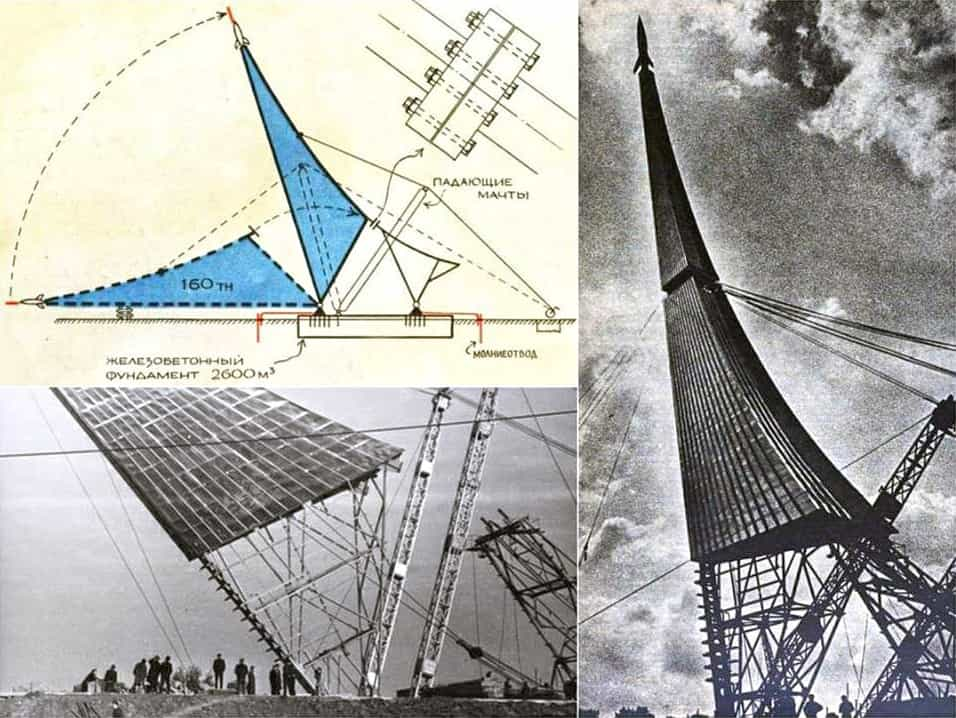
While the architects and engineers were hard at work on the project, the first human space mission took off with Yuri Gagarin in 1961. Therefore, the monument’s inscription was changed to honor the “Conquerors of Space.”
During the construction of the Monument to the Conquerors of Space, the 250-ton steel grid framework armored with slabs of titanium was built by hand on the ground before being hoisted into place using specialized winches.
The monument was dedicated on November 4, 1964, the morning of the 47th anniversary of the October Revolution and the seventh anniversary of the launch of the first man-made satellite, Sputnik-1.
The Cosmonauts Alley
Three years later, at the intersection of Mira Avenue and Akademika Koroleva Street, a park named Cosmonauts Alley was created to honor the heroes of space travel.
The Cosmonauts Alley memorial was completed in 1967.
Cosmonaut and rocket pioneer statues, including those of Yuri Gagarin, Valentina Tereshkova, Vladimir Komarov, Sergei Korolev, Mstislav Keldysh, and Valentin Glushko, have been placed in the park over the years.
The Museum of Cosmonautics, an idea of Korolev, was opened to the public by the firm Energia on April 10, 1981, the 20th anniversary of Yuri Gagarin’s journey to space. The famous engineer Mikhail Tikhonravov oversaw its construction.
Between 2006 and 2009, the alley was remade. A statue by Salavat Scherbakov was placed in the alley, and the bust of Korolev was taken to be displayed in the museum built in his honor.
A scale model of the solar system was also on display on the avenue in 2008. On top of the other eight planets, it included Pluto, which had been demoted from planet status by the International Astronomical Union and reclassified as a dwarf planet in the Kuiper Belt just two years prior in 2006.
The Monument to the Conquerors of Space’s restoration project kicked off in the summer of 2022.
References
- Moscow: A Guide to Soviet Modernist Architecture 1955-1991 – Anna Bronovitskaya, N. Malinin – Google Books
- “Conquerors of Space” – 55 years! – Museum of Cosmonautics